


Few boats under 35ft (10.5m) are built to this sort of quality. This is why the Faurby 335E stands out, as David Harding found out
Faurby 335E: Elegant craftsmanship meets effortless sailing

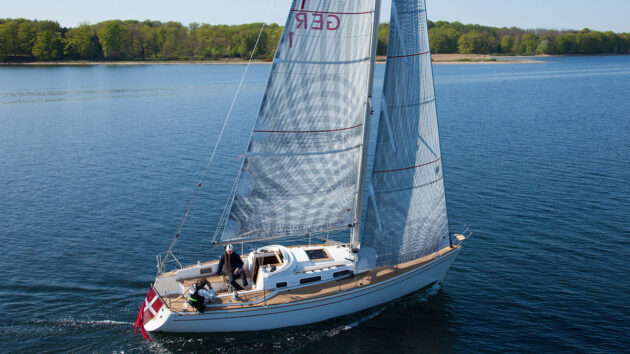
Builders generally make bigger boats, so smaller models tend to be built in a more modular, cost-effective way. This is barely noticeable with the Faurby 335E.
She started life as the 325, launched in 2011, though the 325 in turn was an evolution of the 330 from 1992. In her latest incarnation she’s essentially a 325 with an extra 10cm (4in) in the topsides to give her full standing headroom.
The Faurby 335E is still slim, with a beam of just 2.80m (9ft 2in), and lighter than many cruising yachts of similar size: the sail area/displacement ratio is 20.7 and the displacement/length ratio just over 200. Numbers, however, will only ever tell part of the story. Wetted area and hull shape play a major role.
There’s not a lot of the 335E in the water and, as I found, she will slip along in a zephyr. Going to Denmark in April one might expect to find some breeze. It’s often a windy part of the world – hence all those wind turbines – but while I was there we had sunshine, temperatures into the high teens and winds that rarely exceeded 10 knots. In these conditions our boat speed seldom dropped below 5.5 knots on any point of sailing, even downwind under plain sail.
Our test boat had the Sport rig, the middle of the three sizes offered. It was kept pointing skywards by a T-bulb keel that’s one of several choices in either T-bulb or L-fin form.
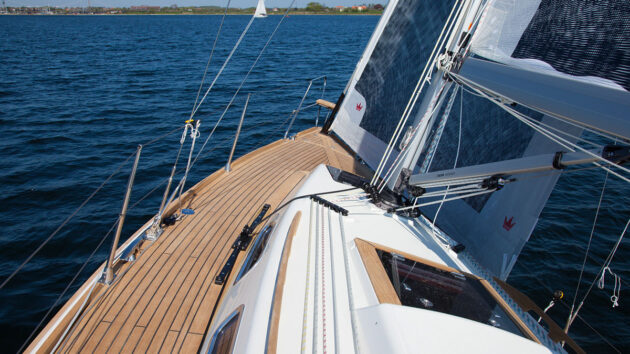
Teak decks, laminate sails and good hardware make for a pleasing view forward from the cockpit. Credit: David Harding
As is often the case with slim-hulled boats, she felt beautifully smooth and slid along effortlessly. During one brief spell when the wind picked up I was taking photos from another boat. She powered along at around 6 knots looking totally at ease.
Her crew have every reason to be at ease as well. The teak-capped coamings provide a comfortable perch for the helmsman with the tiller extension in his hand. This is a tiller-steered boat and the cockpit is designed accordingly. If you want a wheel, a Faurby of this size is probably not for you.
In light conditions you hardly need to steer upwind: she’s so well balanced that you can leave the helm and sail her on the traveller, tweaking the tiller only when necessary in any fresher spells because she carries just enough helm to give a positive feel. If you want to sit inboard, you can: the cockpit is the right width for bracing your legs against the leeward seat.
Although we had no chance to sail her in a breeze, I see no reason why the Faurby 335E shouldn’t be a powerful performer both upwind and down. As the GZ curve shows, that low-down ballast gives her a healthy righting moment (at an unusually high angle of over 60°, combined with impressively low inverted stability).
Downwind she should benefit from her flat run aft and a good deep rudder.
Pleasant surroundings
Apart from sailing very nicely, tacking through within 75° or so and looking after her crew, the Faurby 335E is simply a nice boat to be aboard. Detailing and quality of finish are hard to fault. Hardware – from Antal, Seldén and Andersen – is well positioned and up to spec, though we didn’t have occasion to try reefing in 30 knots.
Details include a barber-hauling arrangement with snatch-blocks for the minimal-overlap headsail to keep it working off the wind. Instead of an aluminium slotted toerail, Faurbys have toerails in solid teak – and protective teak rubbing strakes too – so D-rings are bolted to the deck for the barber-hauler, spinnaker guy block and so on.
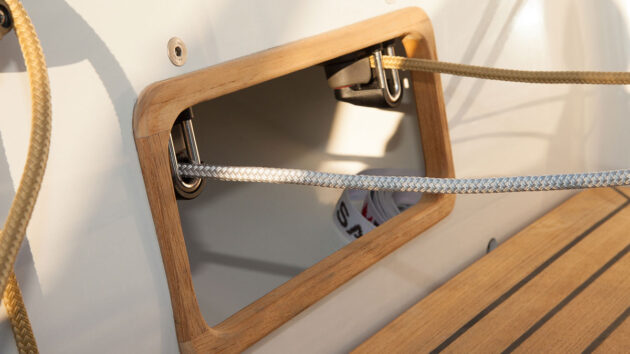
When towing genoa cars are chosen, the control lines run through conduits to cleats in the forward coaming lockers. It’s an expensive option but one that helps keep the decks clear, as does the under-deck routing for the headsail’s furling line (optional on the 335; standard on the rest of the Faurby range). Credit: David Harding
Spars are from Seldén and our sails were laminates from Elvstrøm. They might be seen as a bit racy by some cruising owners in the UK, but again most Faurbys have them whatever sort of sailing they’re going to be used for. According to Faurby, woven fabrics would be a compromise – and Faurby owners are rarely of a mind to compromise on something as important as sails.
Back at deck level, the hatches are edged by teak surrounds with drain channels. There appears to be little on deck that hasn’t been given careful thought, even if sailing in heavier conditions would inevitably have shown up different aspects of the design and layout.
Accommodation in the Faurby 335E
The fundamental design of the Faurby 335E would allow her to sail anywhere and to be a highly competent passage-maker. Nonetheless, boats of this size tend to sail by day and stop for the night, and this is reflected in the accommodation. Owners of the 335 take the view that plenty of speed allows a good cruising range, while modest dimensions usually make it easy to wriggle into a slot in a marina.
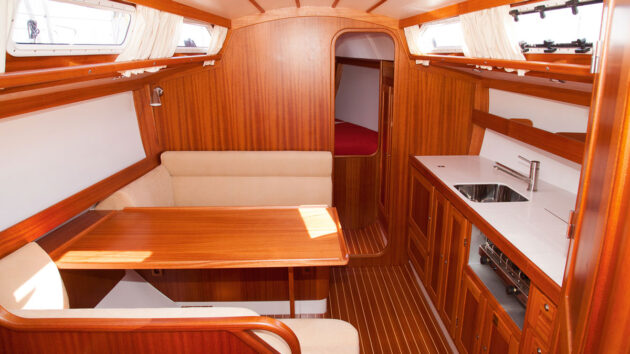
Beautifully finished mahogany combines with white laminates and painted ash down below, where a linear galley opposite a dinette makes good use of space. Credit: David Harding
In the saloon you find a linear galley to starboard opposite – wait for it – a dinette. The dinette was popular in the 1970s and 1980s before falling out of fashion. Faurby took the decision to reintroduce it, first building a full-size mock-up to make sure it worked. Owners seem to approve.
For the galley, given the boat’s modest beam, a linear arrangement is the best way to make it big enough.
A relatively narrow beam means the quarter berth is a cosy double at best. Most owners use it for stowage. At the other end of the boat, however, the forecabin is massive. Consultation with owners showed that it’s what they wanted: somewhere that allowed them to go in, close the door and stow their kit. There’s loads of under- bunk stowage because all the systems and tanks are amidships.
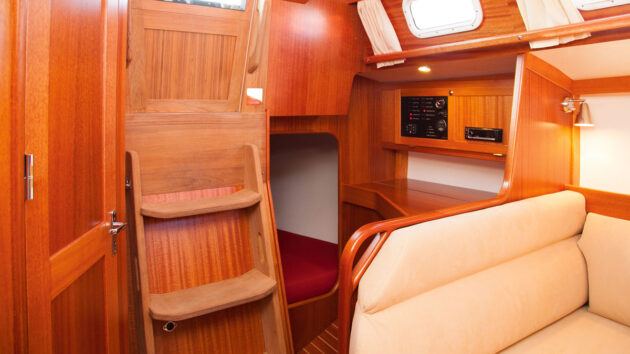
An aft heads, but the narrow beam means a quarter berth rather than a full-size
aft cabin. Credit: David Harding
The finish is in mahogany and the only inner moulding – apart from the headliner in the forecabin and over the quarter berth – is in the middle of the boat. Whereas the larger models use steel frames to distribute the loads from the keel, this didn’t work with the 335, so the load-bearing structure is laminated in composites instead and incorporated into an unobtrusive central tray moulding.

Switch panels hinge down to reveal a neat installation, with breakers and terminals kept away from the sides of the hull to reduce the chances of condensation leading to corrosion. Credit: David Harding
Differences in structure include the core material in the topsides. Divinycell is used in the larger models, but in the 335 it’s balsa. The core is cut away around the skin fittings and replaced with solid laminate. Resins are vinylester.
Verdict
Not everyone is drawn to boats with slim hulls and interiors finished in traditional hardwoods. But if you are, and you’re prepared to pay good money for a boat built to exacting standards, go to Denmark, see how the boats are built, discuss exactly what you want in terms of rig, keel and interior layout, and prepare to indulge yourself.
This is classic Scandinavian boatbuilding with a modern twist, and the results are stunning.
Details
Price when first launched:£165,500
LOA:9.95m (32ft 8in)
LWL:8.26m (27ft 1in)
Beam:2.80m (9ft 2in)
Draught (standard fin):1.65m (5ft 5in)
Displacement:4,100kg (9,038lb)
Ballast:1,600kg (3,527lb)
Sail area:52sq m (560sq ft)
Sail area/displacement ratio:20.65
Displacement/length ratio:204
Engine:Volvo D1-13 Volvo saildrive
Headroom:1.88m (6ft 2in)
RCD Category:A
Designer:Niels Peter Faurby/Steen Olsen
Builder:Faurby, Denmark