



Thirty willing volunteers lined up outside a mobile blood bank to donate to help one of the Atlantic Rally for Cruisers participants.
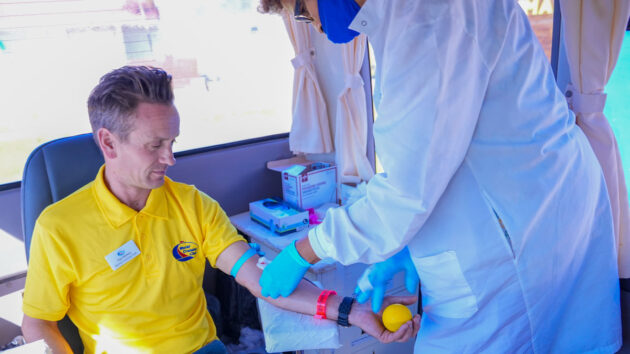
Camaraderie between the crews has long been a draw for joining the Atlantic Rally for Cruisers (ARC) fleet, however this year, some participants and World Cruising Club staff even gave blood for a fellow sailor.
The 40th edition of the ARC attracted more than 800 participants from 39 nationalities to sail to the eastern Caribbean with the reassurance of safety in numbers.
They departed Las Palmas de Gran Canaria on 23 November in 145 monohulls and multihulls ranging from 10.34m to 30.6m in length.
One yachtsman sailing on an ARC boat suffered cracked ribs during an accident a few days out from St Lucia, which resulted in internal bleeding.
He required hospital treatment and a blood transfusion and following an appeal on the event’s new ARC radio, sailors and WCC crew stepped up to top up the island’s limited supplies.
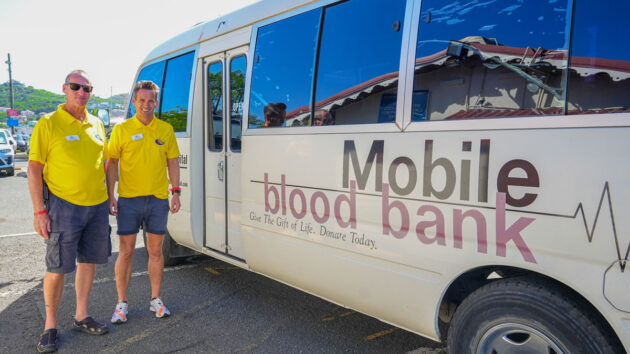
ARC ‘yellow shirts’ Bones Black and Paul Bishop were among those to volunteer to give blood. Credit: WCC
Peta Cozier, ARC programme manager, the only St Lucian on the ‘yellow shirts’ team, said: “The ARC is great, it’s exactly what people want, it’s on their bucket list of dreams to have done but people tend to forget, it’s not an easy crossing, dangers can happen.
“We try to make sure our participants’ boats are as safe as possible but unfortunately one gentleman on board one of the ARC boats had an accident, broke some ribs, quite a few days out.
“He thought he could make it but he started developing complications and so by the time he got here we had to have an ambulance ready for him. We rushed him over to the hospital to see what was wrong and he was actually bleeding internally.
“He had an operation, they took care of him but Tampion, being a small hospital we have quite a demand for blood.
“He needed O-positive so we did an appeal for that but emphasised that the hospital would be grateful for any donations to make sure the bags were full.”
She added: “The reaction we got was wonderful.
“The mobile blood bank rushed over around 10.00 in the morning, and we had a stream of at least 30 ARC participants coming out to volunteer.
“Some couldn’t – for various reasons, if they had low iron for example – but we had 10 or 11 who could give blood.
“It was so inspiring, we’re thinking about organising it again next year, give back to the community, give blood!”
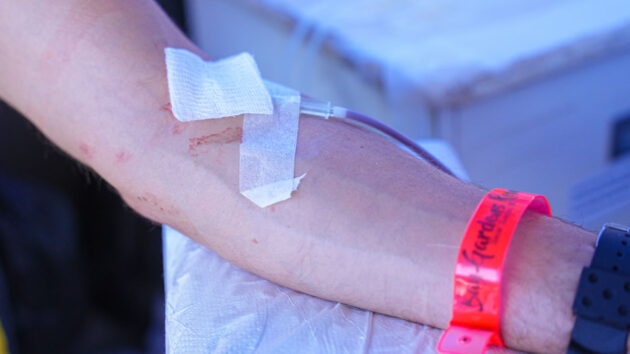
ARC ‘yellow shirt’ Paul Bishåop was among those to volunteer to give blood. Credit: WCC
WCC team member Paul Bishop, an experienced sailor who works as a yellow shirt, assisting ARC participants, was among those who volunteered.
He told PBO: “One of the skippers, a few days out of here, had suspected broken ribs and difficulty breathing.
“We learned when he arrived and went in the ambulance that he was O positive blood type but they didn’t have enough.
“His nephew had donated as he’s the same blood type, but they needed more and asked for other people.
“Any blood was welcome as they’re always short of blood here.
“Me and Bones were among those who went along.
“I give blood whenever I can. It’s easy to do and can make all the difference.”
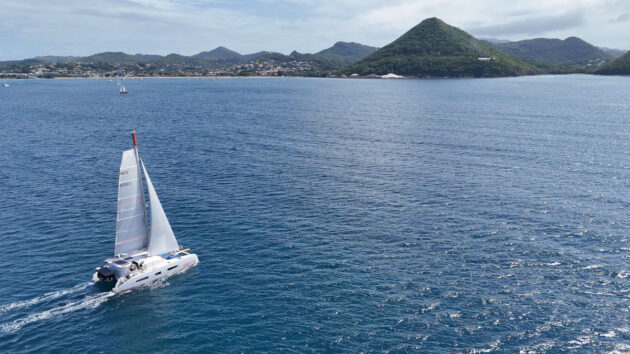
The 15.73m multihull Idefix arriving in St Lucia. Credit: Peter Gilmore/WCC
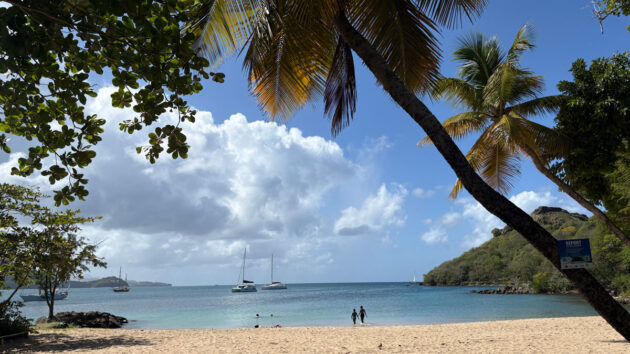
One of the beaches at Pigeon Island some 3.2km from IGY Rodney Bay Marina. Credit: Laura Hodgetts
Line honours
The first boat of the ARC fleet to reach Saint Lucia was Nextgen by Jajo, a Volvo 65, which completed the 2700nm passage on 3 December in 10 days, 48 minutes and 51 seconds.
The crew were greeted ashore by the WCC team and representatives from the Saint Lucia Ministry of Tourism, the Saint Lucia Tourism Authority and IGY Rodney Bay Marina.
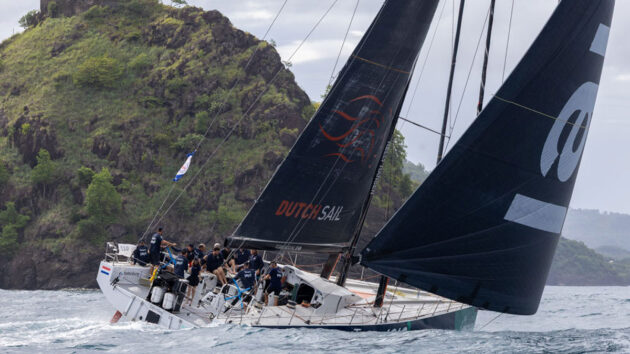
Nextgen by Jajo reached St Lucia 10 days after leaving Gran Canaria. Credit: Tim Wright/Photoaction.com
Nextgen by Jajo owner and skipper Jelmer Van Beek, said: “It’s been such a nice warm welcome by the ARC team after finishing our Atlantic crossing. After 10 days at sea, we’ve had a nice rum punch and the crew are going to have a shower.
“We’re really happy to be here.”
When the rally was founded 40 years ago by Jimmy Cornell, it was not intended to be a race, he told PBO’s sister title Yachting World, “I still believe that the main attraction of the ARC was the sense of camaraderie and the safety in numbers it provided.
“I find it very irritating to read that some boat had ‘won’ the ARC. My attitude all along was that everyone who took part in the ARC was a winner.”
However, as the saying goes ‘when two sailing boats are going in the same direction, it’s a race’ and the racing division has been a popular section of the ARC rally since it was introduced in 1989 – engines cannot be used.
This year, it attracted the smallest boat in the ARC fleet Heartbeat2, a JPK 10.30, which completed the transatlantic crossing in 16 days.
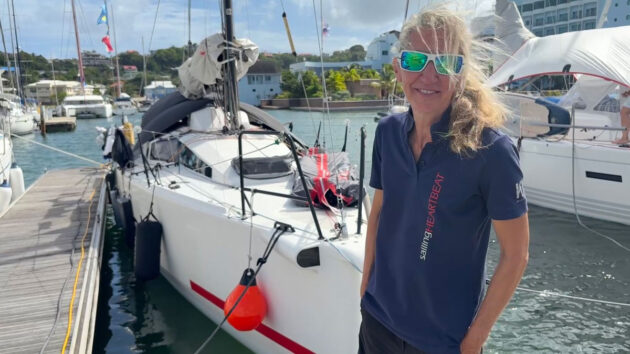
One of the biggest problems for a small boat like Marlene’s, was the sargasso weed. Credit: Laura Hodgetts
German skipper Marlene Brudek, who sailed with two male crew, said: “It was absolutely amazing to surf the big waves with the boat, but I think the JPK 10.30 is a bit small for the big Atlantic.
“We had really big seas, 4m-5m, ‘if you look back you think ‘I can’t believe I would do this.’
“I tried to always be looking forwards, not back!
‘The squalls were challenging, in the night we had squalls of 40 or more knots of wind and they come very fast, and then 10 to 30 minutes and it was over and you can hoist the sails, the spinnaker again but always you have to look to the clouds, day and night.”
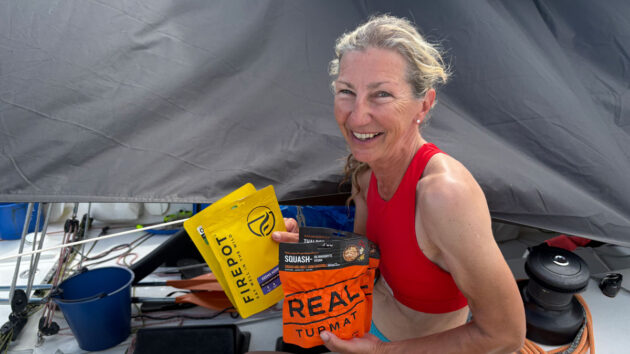
Heartbeat2 was provisioned with only dried food, these were skipper Marlene’s favourites. Credit: Laura Hodgetts
She added: “I was very happy that I prepared the boat so well, and thought about food, medical supplies and spare parts.
“Preparing for the boat took over half a year, the crossing was a small part of the challenge.”
Cold canned food
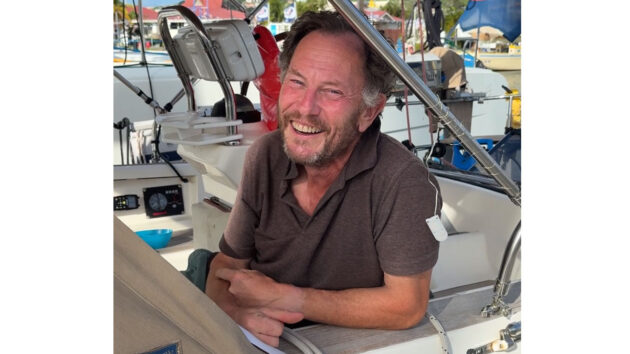
Falken skipper Mike Neave’s spirits couldn’t be dampened by a blocked heads pipe and cold tinned food during his first Atlantic crossing. Credit: Laura Hodgetts
Skipper Mike Neave, of Najad 38ft Falken, and two crew ate cold tinned food for 13 days of their passage, after their gas regulator and then their oven failed.
He told PBO: “We had an interesting time, we had a few breakages.
“The two most fundamental though were one day out from Las Palmas, our heads outlet pipe blocked completely.
“So changing that in rough sea was quite an interesting experience and then two days from Las Palmas, our gas regulator failed on our gas cooker.
“We were able to nurse it for about 4 or 5 days and then the oven basically gave out so we were surviving on cold tinned food. It’s amazing how creative you can get.
“We were running the engine to get hot water and trying to heat tinned ratatouille up by sinking it in the hot water.
“But other than that, and breaking our Code Zero halyard through chafe, it was fine, these things are sent to challenge you and there’s no where to pull over and fix it.”
He added: “The reality of fixing the toilet is that it is a horrible job doing it on the dockside but doing it in a rolling sea where you have to remove the blocked pipe by being inside the cockpit locker, and then to be on the back of the boat basically breaking up the scale, I wouldn’t recommend it to anybody.”
Yet the experience hasn’t put Mike off doing another ARC, he said: “We enjoyed ARC Portugal in 2024 and now we’ve done ARC here, I think it’s a great organisation, and certainly the social side of it and the camaraderie it builds is excellent.”
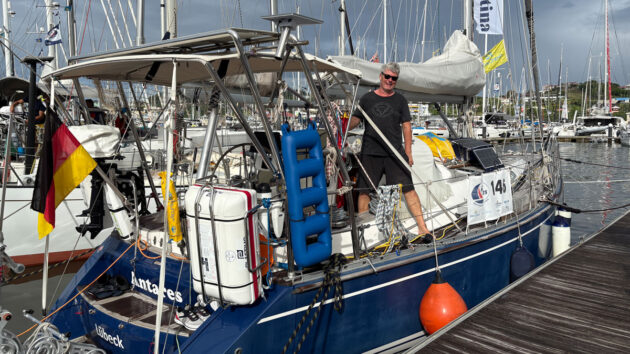
Antares, Comfortina 42, skipper Kai Palm, who completed his first crossing with three crew, said: “I’m super glad I signed up for the ARC and didn’t do it on my own, the full package was great.
“You meet a lot of people you can socialise with, people not just from your nation, that’s really very cool.
“The ARC Weather forecast was helpful. We have PredictWind subscription but it was helpful to have the extra weather reports. The fleet Whatsapp was good and the tracker.
“Starlink was also fantastic, I would recommend it.”
Emotional welcome
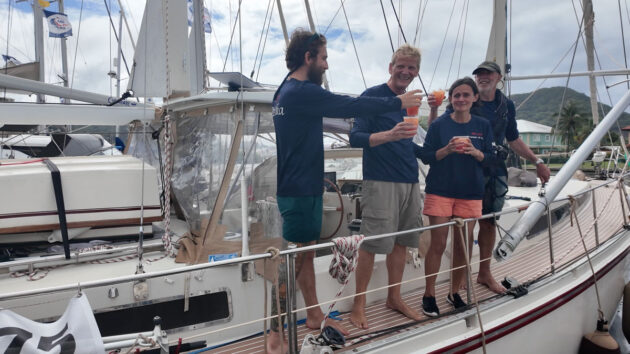
The crew of Perdika arriving in St Lucia. Credit: Peter Gilmore/WCC
Rafa Courtenay completed her first Atlantic crossing with crewmates aboard, Amel Super Maramu yacht Perdika, following an impromptu diversion to Mindelo for a safety check of the forestay.
She was overwhelmed by the reception from the ARC sailors with klaxons and cheering wellwishers.
The former dinghy sailor, who used to sail at Weirwood, before embarking on a bluewater cruising adventure with her husband Robin, told PBO: “It was a beautiful welcome, I didn’t expect that, I can’t stop crying.
“It’s incredibly special.”
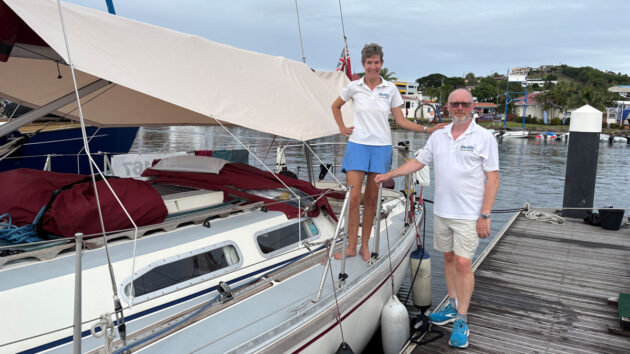
Sonja and David Dullaway attempted an Atlantic crossing on their own in 2005 but had to divert to Cape Verde due to a tropical storm, 20 years later they have achieved their dream of sailing transatlantic in Rustler 36 Gannet. Credit: Laura Hodgetts
David and Sonja Dullaway, who had completed a previous ARC as crew, and attempted it in their own boat alone in 2005, joked that the welcome party “gave us a strong rum punch and then sent us to deal with immigration.”
The couple was delighted to achieve their dream of sailing the Atlantic in their own boat – 20 years after their last endeavour, where they ended up in Cape Verde for repairs after being hit by a tropical storm.
This time, in a fleet that had multiple breakages of sails, spinnakers and Parasailors, their 1990-built Rustler 36 Gannet, which was specially fitted with a new working jib instead of a genoa that ‘just filled the fore triangle without flapping when poled out’, suffered only minor chafe and a batten pocket stitching coming undone.
David said: “We knew we were going to be poling the sail out a lot, and we knew that with the genoa, even with the pole fully out, the sail just flaps around. With a slightly smaller jib, you can triangulate it very nicely, it’s very solidly in place and basically we ran under that for 99% of the time we were crossing the Atlantic.”
He added: “Our most embarrassing incident is that we accidentally lost our main halyard up the mast, or rather, around the radar reflector.
“We’d taken the sail down to have a look and make sure it was ok and when we looked up, the line had twisted itself all the way round the radar reflector at the top and just wouldn’t come down.
“That could actually have been a disaster as it could have meant we couldn’t put the mainsail back up but fortunately our topping lift was spec’d to exactly the same strength as the halyard so we just stuck the topping lift on the main and used that for the next three weeks. It worked!”
Near-MOB scenario
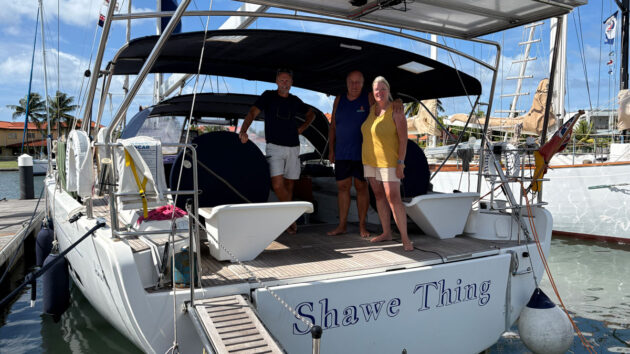
Shawe Thing skipper Clive and wife Linda Yarwood with crew Wayne. Credit: Laura Hodgetts
PBO subscriber Clive Yarwood, the skipper of Hanse 575, Shawe Thing, nearly had a man overboard situation mid-Atlantic.
He told PBO: “In our attempt to snuff the Parasailor as a squall was approaching. My son Daniel and I went on to the foredeck to use the snuffer.
“Evidently, it was very difficult to pull down and we ended up with a third crewmember on the foredeck – Wayne – and we were desperately trying to pull the snuffer down over the Parasailor when, holding on to the snuffing line, my son gripped it tightly.
“The Parasailor was caught in the first tranche of the squall and it literally lifted Daniel off the deck and unfortunately he swung outside the guardrails, with me shouting at him to ‘Hang on and do nothing but hang on’ because the boat kind of rolled, swinging out and then rolled back, and as it rolled back, he swung back in.
“And that was the bit where I grabbed him and said ‘Let go.’
“And he dropped to the deck but he’d got rope burns on both hands.
“We discovered that the collar on the snuffer had actually been damaged and had snapped too, so ultimately the only way we could recover the Parasailor was by dropping it in the sea immediately next to the boat on the starboard side and recovered it back over the guardrail and into the crew cabin.”
Clive added: “We’re still not sure what went on. We’re a little underwhelmed by what happened but everybody else in the fleet seems to swear by Parasailors.
“We had ours flying for 36 hours without any problems at all.
“And I was probably being cautious in bringing it down, because we just don’t know how big the squalls are, so it’s difficult to assess whether we could have sailed through it.
“With hindsight, had we left the Parasailor up, it probably would have been ok.”
Christmas food parcels

Leftover provisioning donated to The Boys Training Centre in St Lucia. Credit: WCC
At the final prize-giving ceremony, WCC managing director Paul Tetlow said in honour of the rally’s ruby year, WCC had set up the ‘Positive Impact Fund’ and donated £10,000 for grants and awards to charitable initiatives in countries visited by WCC events.
In St Lucia, this includes The Boys’ Training Centre and an initiative that does therapy music for young girls in school.
Leftover provisioning, a $3,000 folding bike and a skateboard has also been donated to the Boys’ Training Centre (the bike and skateboard will be sold to buy more food).
ARC programme manager Peta said: “One of the nicest things that our ARC participants do for us is they donate any of the leftover food, whether it’s cold cuts or frozen, or tinned food and the charity that we deal with mainly is one for children and The Boys’ Training Centre, which is a little bit up the hill past the marina, which is really good.
‘It’s a government entity that is for boys in need, who have been really naughty and are one step from going to jail, and wards of the court, where they have been abused or their family cannot take care of them.
“So they have been living at The Boys’ Training Centre, where they make sure they go to school, if accepted, and at the centre they learn how to play steel band, they learn welding, they have a football team, they learn camaraderie and how to work together.
“And they’re always in need.”
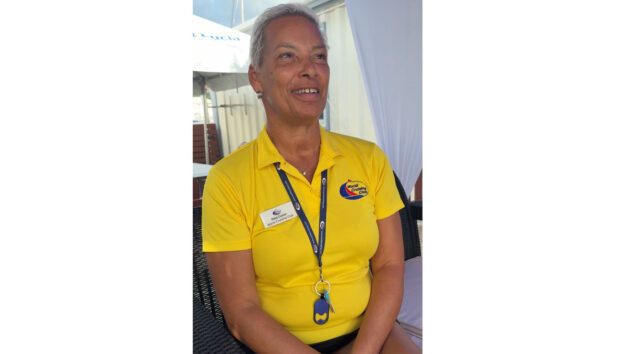
Peta Cozier, ARC programme manager, the only St Lucian on the ‘yellow shirts’ team. Credit: Laura Hodgetts
Peta added: “One of the things that hurt my heart last year is the ones who stay at the centre all year, got to go home for Christmas, they went Christmas Eve and came back on Boxing Day and they were lamenting that they were starving because their families didn’t have any food.
“So that’s not really a good thing, so this year we’ve set up so that they will take home a box of goodies.
“All of the things that the ARC participants donate is exactly what they need: flour, sugar, butter, oil, pasta, tins of corned meat, sausages, vegetables, cereal, oatmeal, water – as many homes do not have running water – seasoning, fruit, I cannot tell you how grateful we are.
“We had a ceremony of us passing it over.
“We’ve created 19 huge giveaway baskets for 19 families in need.
“It’s Christmas for them.”
Mineva Ross, of Events Saint Lucia, said: “40 years of the ARC, 37 years here in St Lucia, it does not get stale.”
She told the ARC sailors, “Your achievements are mind-blowing” and received big cheers when she gave a “special mention to the dockhands who work tirelessly, although their work is sometimes unseen, it’s indispensable.”
A standing ovation was also given to the WCC team of yellow shirts for their expertise and friendliness.
Bones Black, a stalwart yellow shirt who competed in the 30th ARC in their former classic Bowman 57 yacht Emily Morgan, said: “I feel quite emotional that it’s over.
“The ARC is fantastic. We performed in the 30th ARC, so 10 years ago.
“It’s lovely the camaraderie everyone has here, the fact that we now have live music every day on the new ARC radio, is great, it gives that real regatta feel.”
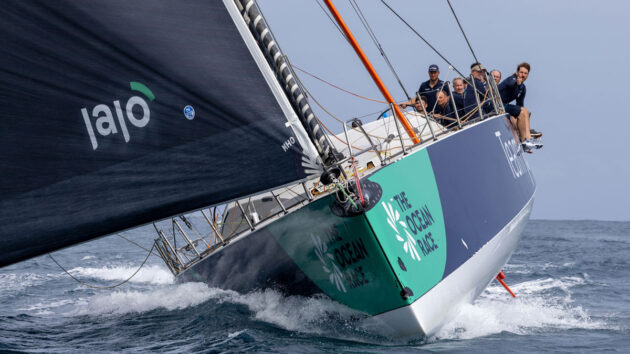
Nextgen by Jajo’s arrival in St Lucia. Credit: Tim Wright/Photoaction.com
Photographer Tim Wright was also praised ‘for waking up at all hours’ to capture the special moments of yacht arrivals.
Paul Tetlow said: “Tim sailed his yacht, an 8.8m Elizabethan 29 called Andani single-handed in the first ARC in 1986.
“He’s been photographing the ARC for years, and since ARC 2000 he’s photographed 5,179 finishers, storing 113,639 photos.”
Meanwhile, the all-female crew from Finland won the Spirit of the ARC award for ‘truly embodying what the rally is really about, seamanship and camaraderie and enjoyment at sea and ashore.
Sailing aboard Swan 441, Carissa, the Ocean Ladies club members were made up of eight women, ranging in age from 43 to 80.
The eldest being skipper Raija Alapeteri, who said: “The passage went very well, we had a very, very good crew.
“We were prepared for the rolly conditions. We had nice meals – the hamburgers were pretty good – and treats included salmiakki [a salty liquorice, Finnish treat] and chocolate.
“We had problems in Las Palmas with the propeller and gearbox but the passage went smoothly, we could just enjoy it.”
When asked about breakages, the Carissa crew joked: “We did have one problem on board, our Christmas calendar kept falling off the wall. Women power!”
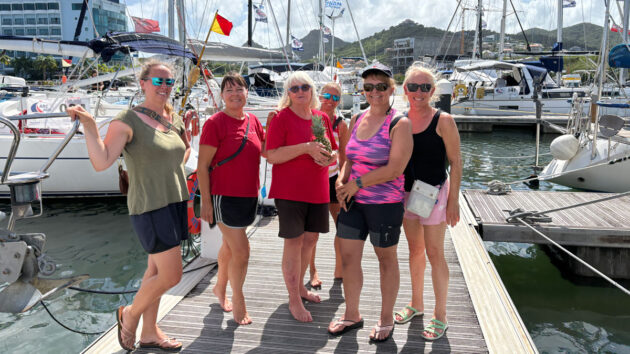
Skipper Raija Alapeteri (centre) with some of the Swan 441 Carissa Ocean Ladies all female crew. Credit: Laura Hodgetts
WCC operations director Suzana Tetlow said they had received ‘multiple nominations’ for Carissa’s crew across the awards, ‘including for made-up categories’.
Of this year’s fleet, five boats retired and Suzana said ‘we had more boats diverted to Cape Verde than previous years’ where after repairs or medical aid, they carried on to St Lucia.
She added: “There were challenges, of course there were, but the sailors were able to overcome those challenges which is so good for them.
“It’s their achievement.”
Paul told the crews: “We provide that trusted structure for the events we’ve developed but it’s you, the participants, who make the event what it is.
“Thank you for choosing to cross the Atlantic with ARC this year.”

Freeing mast lines: untangling a halyard
David Mead puts a spanner in the works to create a weighty solution for freeing a tangled halyard
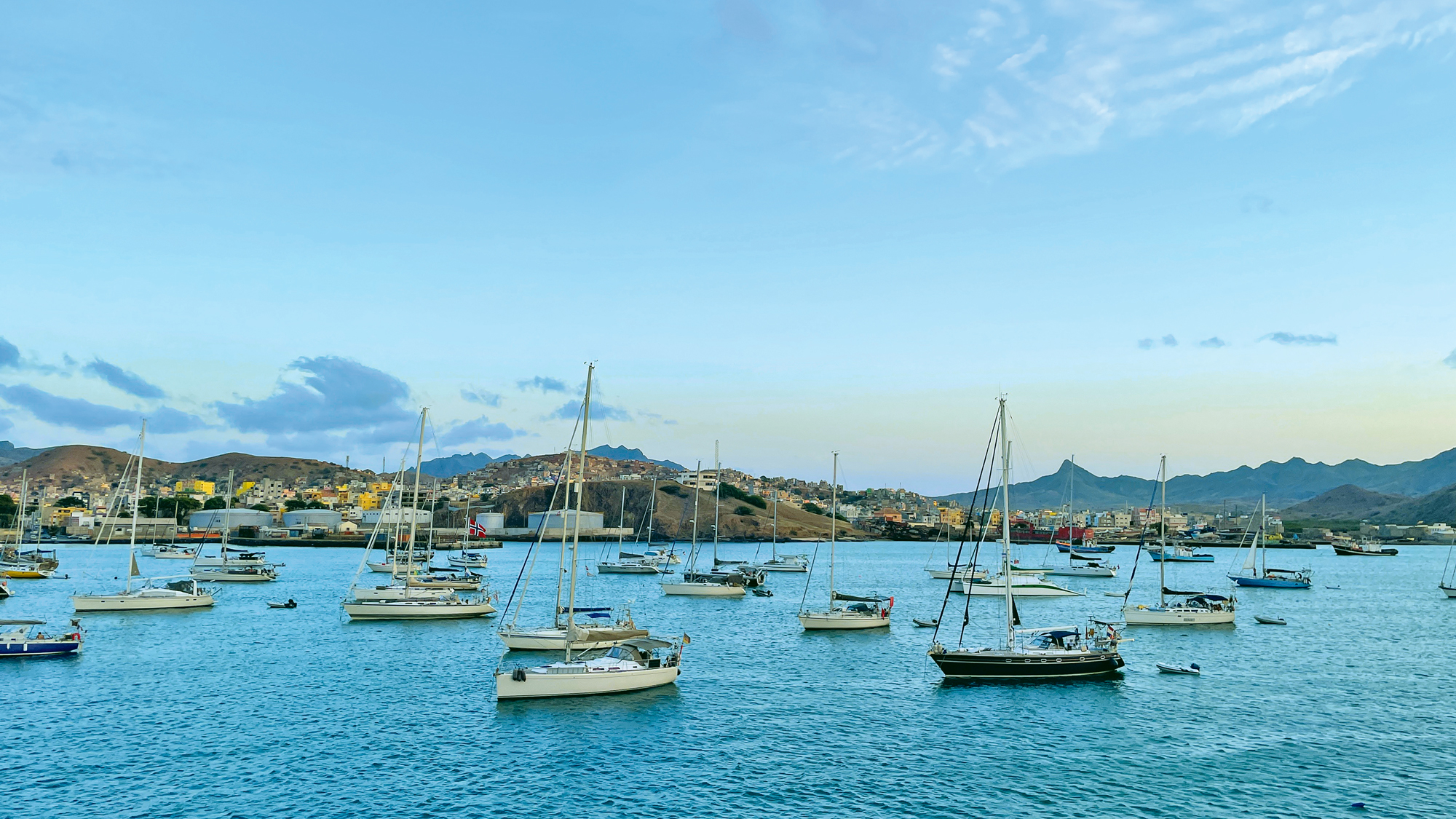
ARC Rally Stopover Survival Guide: The boatyard at the crossroads of the world
How do you fix a boat in the middle of the Atlantic? BoatCV, beloved by generations of ARC Rally cruisers,…

Popular classics – 1980s yacht designs that are still making waves today
The 1980s ushered in more change in the marine industry. A key trend was that boats were rapidly becoming larger…
Want to read more articles like this?
A subscription to Practical Boat Owner magazine costs around 40% less than the cover price.
Print and digital editions are available through Magazines Direct – where you can also find the latest deals.
PBO is packed with information to help you get the most from boat ownership – whether sail or power.
-
-
-
- Take your DIY skills to the next level with trusted advice on boat maintenance and repairs
- Impartial, in-depth gear reviews
- Practical cruising tips for making the most of your time afloat
-
-
Follow us on Facebook, Instagram, TikTok and Twitter