


Learning how to prepare your cruising boats for mechanical or electrical breakdowns at sea with essential system redundancy strategies. Richard Thomson reflects on contingency plans to get you home
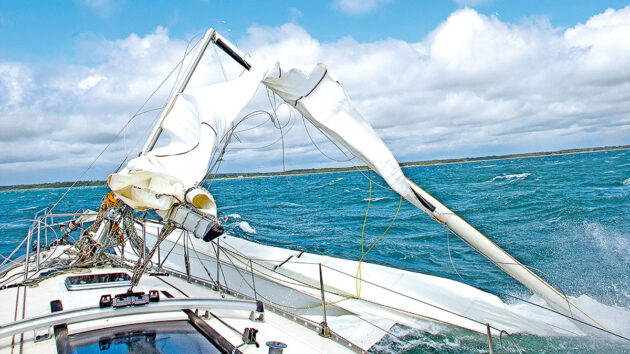
With the buzz of the successful and extraordinarily high-tech Artemis II lunar flyby mission this April, I can’t help reflecting on how monumentally low-tech those early crewed missions of the 1960s and 70s were. Famously, the Apollo 11 landed on the moon in 1969 with less computing power than a pocket calculator – and much less than a modern smartphone.
Just a few months before, Robin Knox-Johnstone on board Suhaili completed his circumnavigation in the Sunday Times Golden Globe Race with even more spartan systems. He spent significant time wrestling with his obstinate radio to reassure loved ones at home. He even set sail with a stubborn leak, but managed to plug it underway.
Another competitor Bernard Moitessier forwent the radio entirely, famously shooting messages and film onto passing vessels with a slingshot. On one occasion, he damaged the bowsprit of Joshua but managed to straighten it back out with winches.
The point I make is that in the course of these and many other incredible voyages, systems were challenged and things broke, but they were often fixed, worked around, or replaced with spares underway. Just as the tech-heavy Artemis II mission was worlds apart from those pioneers of the 1960s and 70s, so too are modern racing yachts (and most cruising boats) vastly more complex than the likes of Suhaili or Joshua.
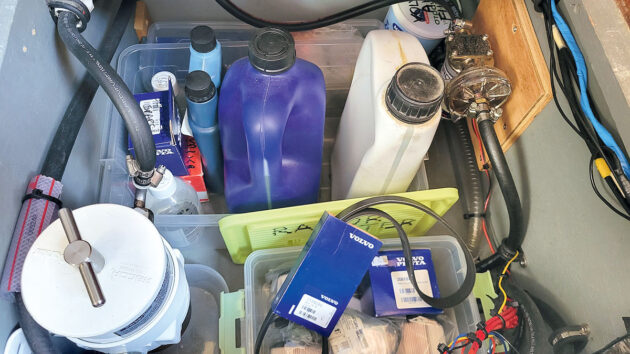
Contingency plans: Make sure you carry spares, like an alternator belt, to make repairs. Credit: Richard Thomson
Times have certainly changed, but the need for awareness of critical systems on board and the ability to repair or work around breakages, malfunctions and failures remains. While systems today often make sailing safer and more comfortable, they bring added complexity and sometimes challenging interdependency if things should go wrong.
Consequently, I think it’s worth spending time reflecting on critical systems for the vessels in which we put to sea. But first, a caveat. This is by no means intended as an exhaustive checklist, and priorities will vary across skippers, yachts and cruising plans. Rather, it is intended to indicate a way of thinking about challenges to hopefully be better prepared if and when we encounter them and arrive at suitable contingency plans.
Contingency plans: Electric redundancy
One of the most widespread system changes between yachts of the 1960s and today is surely the explosion in electrification and instrumentation. Chartplotters, pumps, autopilots, lighting, depth sounders, windlasses, radar and AIS, fridges and watermakers; the vast majority of boats will have some or even all of these electronic systems on board.
Electric cooking and electric motors for secondary propulsion are also growing in prominence. For the more critical of these systems the crew may feel capable of making some repairs or fitting new parts in place of old. Doing so will require a rudimentary understanding of DC electrics (and possibly AC), as well as potential parts or replacements for the system in question.
The cautious, well-prepared skipper may therefore prepare to counteract Murphy’s Law (what can go wrong will go wrong) with their own mantra (‘two is one and one is none’) and carry spares and/or the equipment needed to replace or repair the part in question. They may sail with two or more electric bilge pumps plumbed or bring a spare autopilot. It’s a good practice to make a list of onboard systems (some will be more critical than others) and identify whether you could repair or replace them at sea with the boat’s tools and spares.
Cost and space will likely limit what you can or want to bring so being honest about what you cannot fix is almost as important as being prepared to fix or replace what you can. You do need to consider a way of working around any problems with critical systems that you can’t fix at sea.
Electricity, in general, is a potential weak link given how central it is to so many systems and there are a few specific choke points to consider. AC systems have a common weak point in the inverter. Depending on the sort of sailing you do and what you run from the inverter, is it worth carrying a spare?
Possibly. On our Trident Marine Voyager 38, Namika, the inverter is used for power tools. Failure of the inverter would mean no power tools; probably not the end of the world, but this train of thought is worth exploring.
Weak points
For DC systems the battery bank or charging sources are obvious weak points. All cruising boats should have at least two battery banks: one to start the engine, one to run the domestics. Any further bank can offer added redundancy depending on how it is set up, though this is not hugely common. Nevertheless, the two banks already give you something to work with for emergencies. Having jump leads or even a hard-wired connection with a switch that remains off is probably a sensible precaution.
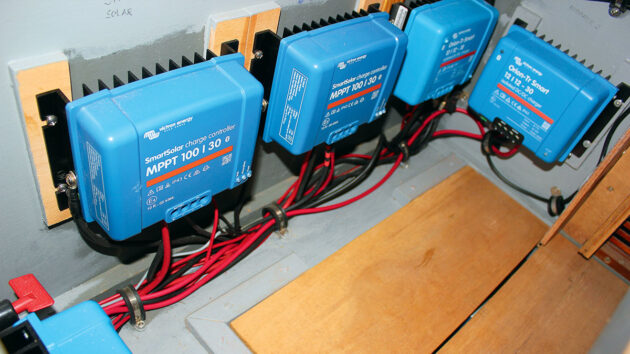
Contingency plans: Separate chargers will help ensure you still have some power should the worst happen. Credit: Richard Thomson
Charging is another weak point. If you rely on the alternator alone for this, carrying a spare alternator belt becomes essential. The alternator itself could even be considered a weak point, and adding an alternative charging source, even a low level one, may be wise. On Namika we have two solar panels wired and charging independently, as well as the alternator charging via a DC-DC charger. A further DC-DC charger allows us to charge the starter battery from the domestic bank. This means we have three ways of charging the domestic bank, two ways of charging the starter bank, and jump leads if all else fails.
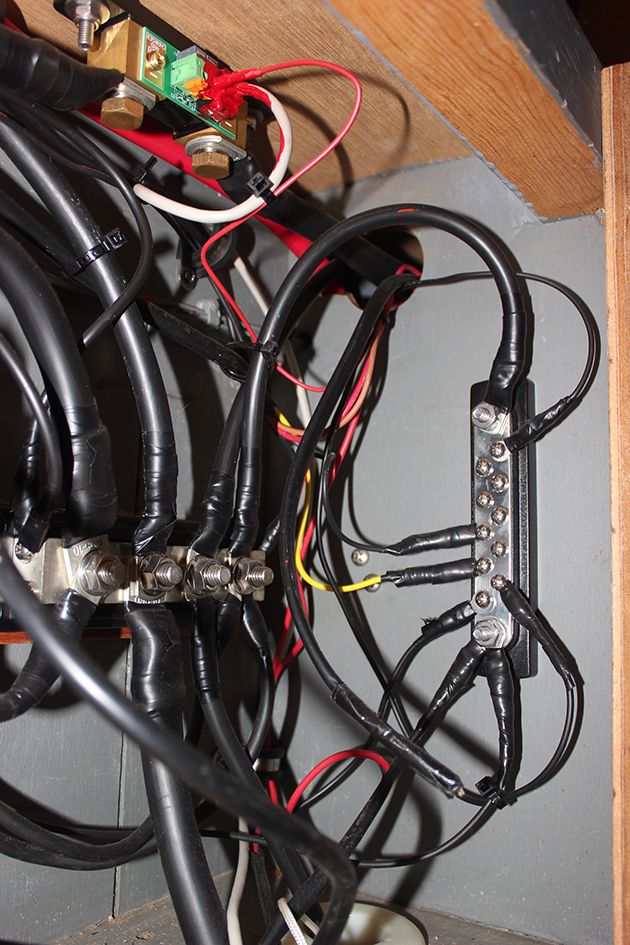
Run all cables to bus bars as they connect separately to the batteries, enabling isolation of the domestic bank to keep systems running. Credit: Richard Thomson
A further degree of redundancy can be achieved via a charging/discharging circuit. Running all cables to bus bars, which connect separately to the batteries, means you can isolate the domestic bank entirely and still keep critical systems running via the charging source. With the engine running on Namika, the alternator can power the main bus bar independently of the battery bank, as can the solar panels during the day.
In the event of battery failure, this would keep gear like the bilge pump, autopilot or depth finder operating. It’s also worth examining systems that could be run without electricity.
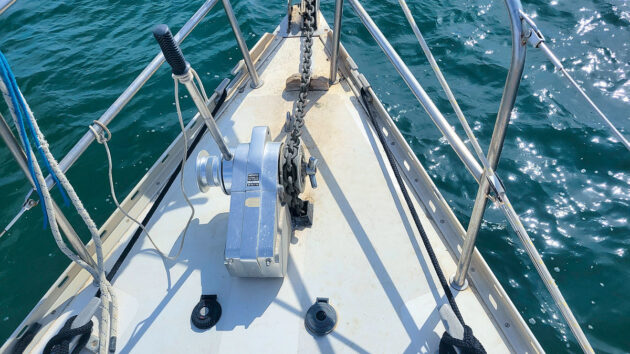
Having a manual backup for your electric windlass is a good idea, as is tying critical parts to the boat. Credit: Richard Thomson
Some electric windlasses have a handle and clutch for manual operation. While I wouldn’t go out and replace a perfectly functional windlass for the sake of it, choosing one with a manual backup when it needs replacing is a great idea. Lofrans is perhaps the most prominent brand to incorporate the feature, though there are others.
Manual bilge pumps are a must, and a manual water pump to access water in the tanks is also a good idea. Water canisters also provide a backup in case of a leak or freshwater contamination.
Contingency plans for mechanical failure
Contingency planning is also valuable for serious mechanical failures. Rigging failure is a commonly cited example; previous PBO testing has shown that bolt or wire cutters capable of handling stainless steel rigging wire are heavy and need a fair bit of strength to bite through all of the strands of wire.
The conclusion was that a cordless angle grinder would be worth having on board in case of a dismasting, though it’s worth considering that the conditions in which a rig comes down may not be electrics-friendly. A hacksaw should not be the primary cutter, but might prove useful in the event.
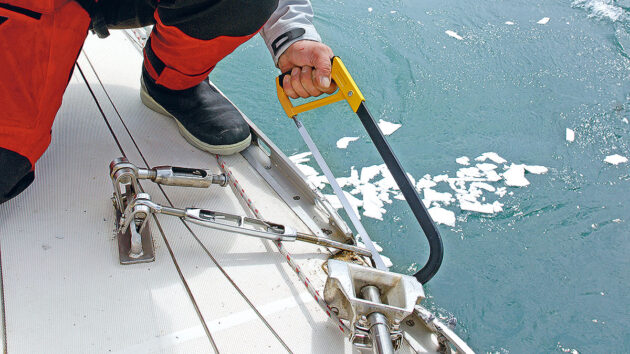
A hacksaw can be useful in the event of a dismasting, but a cordless angle grinder might be better. Credit: Graham Snook/Future PLC
Getting the rig away quickly may be key to preventing a serious situation from getting worse, so having a variety of tools to utilise and knowing where they are is important. Consider tying those tools to the boat, too. That fancy rig cutter or cordless angle grinder is no good if it goes over the side.
What about steering cable (or equivalent linkage) failure? Could you still use the rudder? An emergency tiller would be helpful and should be on board. On Namika, the autopilot independently connects to the rudder stock, so with the wheel out of action, the autopilot can still control the rudder. Failure of the rudder or stock itself is more serious. Unless you have a windvane or other auxiliary rudder system, you’d need to improvise.
Drogues or buckets trailed astern and off-centre might offer limited steerage; if so, what do you need to do this? Alternatively, a door or similar panel might serve as an emergency rudder. How would you attach it to the backstay, or pushpit, or to specially added fittings on the transom? You could consider predrilling holes for lashings.
Contingency plans: keep water out
Water ingress is another scenario most would rather not contemplate, but it’s better thought about before you are up to your knees in the wet stuff. Seacocks should be kept operational and replaced if seized or extremely stiff. Hoses to seacocks should be inspected more regularly than others and replaced if showing any signs of wear. The shaft seal or saildrive membrane should be replaced if there are any signs of leaking or unusual wear.
Precautions aside, if a reasonably serious leak occurs you need a plan. Early warning and getting as much water over the side are the first considerations. On Namika we have two electric bilge pumps and a manual pump. Remember, the manual pump requires a person to operate it, and you cannot be in two places at once. A bilge alarm is worth its weight in gold, as time is not on your side if the leak is serious.
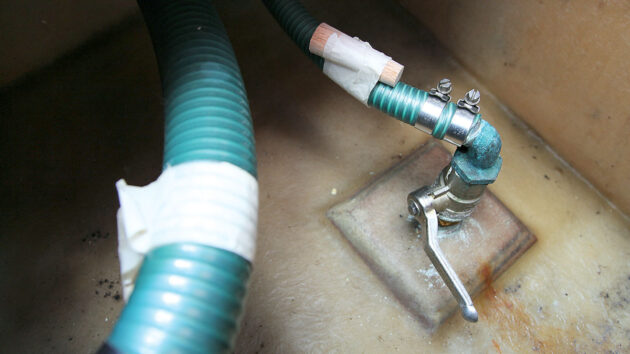
Know where your seacocks are and ensure there are bungs to stem water. Credit: Future PLC
Remember, if the batteries flood, the electric bilge pumps will shut down, so keeping the batteries reasonably high up is a sensible precaution; on board Namika, they are above the waterline. Occasionally I’ve seen batteries located deep in the bilges which is far from ideal. Starting the engine is prudent, too; while it will run without electricity and may continue to do so for a time with seawater sloshing around it, the engine won’t start without power, so get it going while you can.
If the engine is running and the leak is really bad (or if you lose power), you can disconnect the cooling water inlet hose, close the seacock, and use the engine as a bilge pump. A friend of ours tells a horror story from a sailing course where the yacht he was on was saved using just this method.
Ideally, some sort of filter is needed to prevent debris from clogging the system as items will be floating around. Nylon tights have been used as an adaptable, cost-effective emergency strainer.
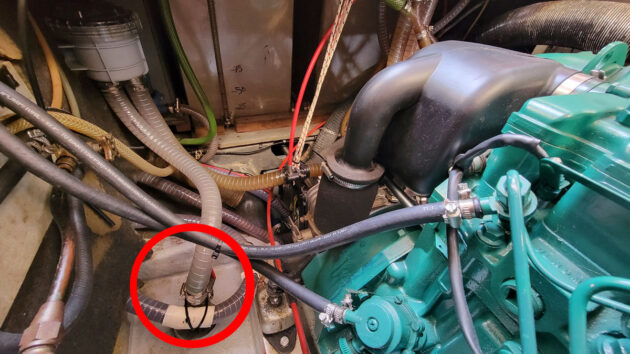
Know where your seacocks are and ensure there are bungs to stem water. Credit: Richard Thomson
As soon as possible you need to find the leak. Unless you’ve obviously hit something, through-hulls are the first place to check so know where they are. Bungs in various sizes and a mallet should be standard on board (ideally labelled in an accessible location and/or tied to the seacocks themselves). If the leak is elsewhere and cannot be reached, destroying cabinetry to reach the leak is justified, in which case a hatchet or crowbar might be useful.
Underwater sealant, thin plywood and self-amalgamating rubber tape should perhaps be added to your boat’s inventory. For irregular openings caused by hitting something, the old technique of fothering with a spare sail, tarpaulin or similar might work.
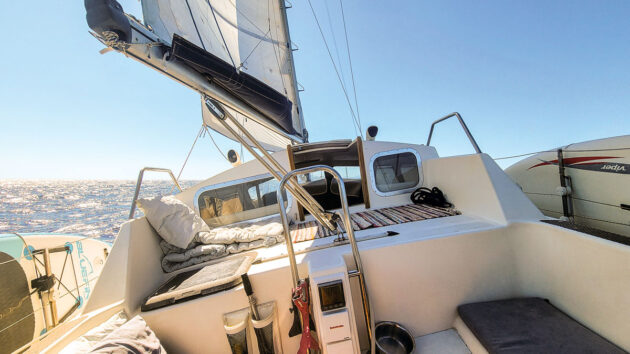
Tacking might help control the flow of water if there’s a hole near the waterline. Credit: Richard Thomson
The principle is that an underwater hole exposes the pressure differential between the outside and inside of the boat hull, forcing seawater through. By covering the opening from the outside with a water-resistant fabric and either securing it with ropes or wedging excess material into the hole, the inrush of water can be significantly reduced or even stopped.
In certain conditions a sail or tarpaulin can be guided into place using ropes and manoeuvring back from the bow without anyone leaving the yacht. Alternatively, a sailing jacket or salopettes, even a cushion, might help, though these would require getting in the water and would likely only be considered in reasonably benign, daytime conditions. If the hole is close to the waterline, tacking the boat so the hole is above the water can reduce the flow and may give you more time to figure out next steps.
Leaving the boat
All that said, major water ingress is right up there with the most serious of situations, behind fire and perhaps certain medical emergencies. If the moment comes to abandon ship it should be a last resort.
Consequently, a pre-prepared grab bag is vital if sailing more than a few miles from shore. This grab bag should be a floating dry bag (or other sealable container), with a strap or attachment point, and should contain emergency supplies required to survive and increase the chance of rescue. While there will be variation between boats, skippers and cruising plans, key supplies may include a waterproof radio, PLB and/or AIS-SART, flares and a fog horn or whistle, signalling mirror, waterproof torch, spare batteries, knife and/or multitool, basic first aid, emergency water and high-energy food, spare glasses (if you need them), survival blanket(s), perhaps sunscreen and sunglasses – the list can go on.
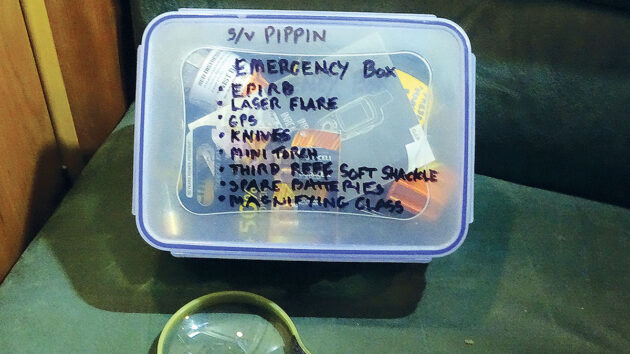
Make sure you have an emergency box in your grab bag. Credit: John Willis
As so often with boats, there will be a compromise between what you can easily lift and what might aid survival in your sailing environment. Passports, boat documents and credit cards will likely be vital after rescue.
Most of us who choose to go to sea do so to feel the wind in our face, the sun on our skin, and to enjoy the freedom that time spent on the water offers. We do not want to encounter and may even not want to think about unpleasant scenarios, but unlikely though the worst of them may be, things can and inevitably do go wrong. Most are minor, but they can be or turn serious.
Spending a bit of time reflecting on what you’d try and the gear you’d need if something goes wrong will leave you better prepared. Perhaps there is some law of the universe that says being equipped for an eventuality makes the event less likely to happen. Part of me certainly believes so. In any case, the best time to plan for contingencies is before you put to sea.
Sailing by numbers: Are instruments dulling our seamanship?
Richard Thomson ponders whether we should be focusing less on the tech and more on sailing by the feel of…
The essential tools to keep on your boat
What tools do you really need for a boat? Say you now own a new or new-to-you boat, and you’re…
Fend off rigging failure: the most common problems and how to prevent them
Most sailors will probably have seen or experienced a stranded wire, or a failed swage, or the catastrophic resulting from…
Understanding metal fatigue: What causes rigging and engine failures?
Do you know the difference between a sudden fracture and a fatigue fracture? Understanding the characteristic 'beach marks' is the…
Want to read more practical articles like Contingency plans for cruising boats?
A subscription to Practical Boat Owner magazine costs around 40% less than the cover price.
Print and digital editions are available through Magazines Direct – where you can also find the latest deals.
PBO is packed with information to help you get the most from boat ownership – whether sail or power.
-
-
-
- Take your DIY skills to the next level with trusted advice on boat maintenance and repairs
- Impartial, in-depth gear reviews
- Practical cruising tips for making the most of your time afloat
-
-
Follow us on Facebook, Instagram, TikTok and Twitter
PBO web categories