



Cruising Association members Paul and Val Lingard explain how they threaded an errant reefing line back into their boom
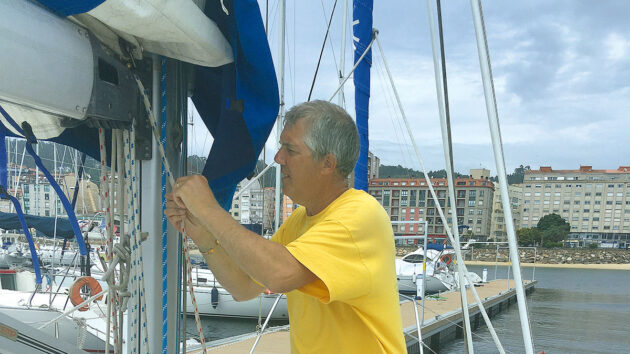
The first advice when attempting this job is to learn some new swear words – you may need them! The ‘single line’ reefing system within our Seldén boom is slightly misnamed. There are in fact two lines to each reef, but it is operated by only a single reefing line running back to the cockpit. The reef can be put into the sail by pulling and winching in the single line that runs back to the cockpit courtesy of a ‘car’ that runs up and down inside the boom.
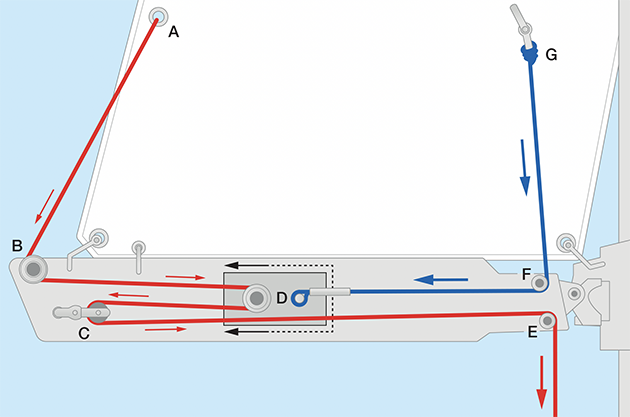
Illustration of the single line reefing system on the Lingards’ Moody S38. Credit: Sudden Impact Media
The diagram (above of our reefing system shows the following points: A. The line that pulls down the leech (rear) of the sail. This is a continuous line that runs to the cockpit through points B to E (but not in that order!); B. This is a turning block attached to the aft end of the boom end fitting; C. This is a turning block fixed inside the boom end fitting. Fortunately, it can be removed (from our boom at least) without removing the boom end fitting; D. This is a car that slides forward and aft within slots within the boom, courtesy of four small wheels (not shown) at each corner. This car holds a turning block, through which the aft reefing line passes. The luff (forward end of the sail) reefing line is permanently attached to the forward end of the car; E. The leech (aft) reefing line enters/exits the forward end of the boom via the turning block shown and from there back to the cockpit; F. The luff (forward) reefing line runs from the car and through this block at the forward end of the boom. G. Finally the luff reefing line attaches to a reefing cringle at the luff (forward end) of the sail.
To put a reef in the sail we pull in the reefing line at the cockpit. This pulls down the leech (aft) end of the sail towards the boom. It also pulls the boom car aft which in turn pulls the luff (forward) reefing line to the boom. When winched in, both luff and leech reefing points are pinned in tight to the boom and sail area is reduced.
It should be noted that there are other reefs and a line to tension the foot of the sail which also runs inside the boom, making things a little tight in there. At the end of each season we detach the leech and luff reefing lines from the sail and tie stop knots at the end of them. We then pull in the reefing lines to the cockpit. The boom car is pulled aft along the boom until the stop knot stops the luff line from running through block F. The leech line pulls through until its stop knot prevents it from running through block B.
Ooops! When we were about to bend the main sail on in the Pobra anchorage in Galicia, Paul pulled through the reef line from the cockpit towards the mast so that the lines could be affixed to the sail as it was hoisted up the mast. He pulled up the luff (forward) reefing line through block F, as he has done – but he then did what he’d not done in previous years, which was to absent-mindedly and very stupidly undo the stop knot in the reefing line at block B before he was ready to attach it to the sail.
And so, as the boom car (D) was being pulled forward on its wheels by Paul pulling out the luff reefing line, the leech reefing line without its stop knot was drawn into the car, falling off the block on the car and sitting somewhere in the middle of the 5m boom and was completely inaccessible. Even with a very powerful torch and binoculars we couldn’t see it, and so going fishing for it with a hook was out of the question as there are too many other lines running through the boom that could be snagged.
How we recovered the reefing line
So what did we do when Paul had finished swearing at himself and calmed down? We consulted Google. Several sailing forums have threads on this subject. However, advice rendered did not yield the answer; the main thrust seemed to be that if you can’t reach the reefing line you have to drill out the very sturdy rivets and remove the boom car.
However, this needs care as when you draw out the boom car (D in the diagram), its small wheels have a habit of pinging off and going overboard. You also need a professional-sized rivet gun to replace the end fitting. So, Paul downloaded a diagram of the system and developed a plan.
He put it into action as follows:
- The errant reefing line was pulled out of the aft end of the boom. We would now have to somehow thread it back.
- Neither of us could get our hands into the forward end of the boom, where they could see but not reach the car (D), but Paul wanted to draw it back to the opposite end (rear) of the boom.
- The sail bag (into which the sail drops when lowered) has batons running its full length, just around 60cm shorter than the boom. So, a pipe was taped to one of them to extend it, a mousing line taped to the end and it was pushed forward down the boom (keeping the extension pipe at the aft end as we didn’t want to lose that inside the boom!). We managed to pull the mousing line all the way from the aft to forward end of the boom and secure it.
- The mousing line was tied around the forward reefing line, therefore enabling us to pull the reefing car to the aft end of the boom. The first attempt failed as the mousing line had gone around another line within the boom, so the whole baton was withdrawn and reinserted. The second time successfully allowed us to pull the car almost to the end, stopping just short of block C. To create more space in the boom end we removed block C, which was left dangling below the boom end with the reefing line still running through it.
- The end of the reefing line now had to be put back into the boom and upwards through the block in the car. This was achieved using a wire coat hanger. The end few inches were bent at 90° and the reefing line was loosely attached to it using the plastic-coated wire tie wraps from bread bags or similar (we do keep a stock on board). After a few attempts and more swearing the reefing line appeared above the block. Next came the careful use of a three-pronged fishing hook, tied on strong line and taped to a thin bamboo. Being ever so careful not to slip and catch another line in the boom, Paul caught the errant reefing line, along with another line! Not too much swearing later the hook was removed and the errant reefing line retrieved!
- All that remained was to thread the reefing line up through block B, TIE A STOP KNOT, push the car slightly forward and reattach block C (using a thread locker, we don’t want to see that sucker pulled into the boom!).
- Finally we could pat ourselves on the back for being so clever and persevering in the face of the doom found on the forums (while trying to forget just how stupid one was just a few days before!) This all took three hours, allowing for time spent venting frustration by walking away rather than doing damage.
We’ve both used bailer twine to deliver calves, and maybe that was our advantage. We are not expert riggers and maybe some will know of a better way, but at least this worked for us.
■ To find out more about the Cruising Association visit www.theca.org.uk
Fitting reefing points and luff slides to a sail
While restoring his bargain £900 Quarter Tonner, Rupert Holmes shows how he added luff slides and two reefs to a…
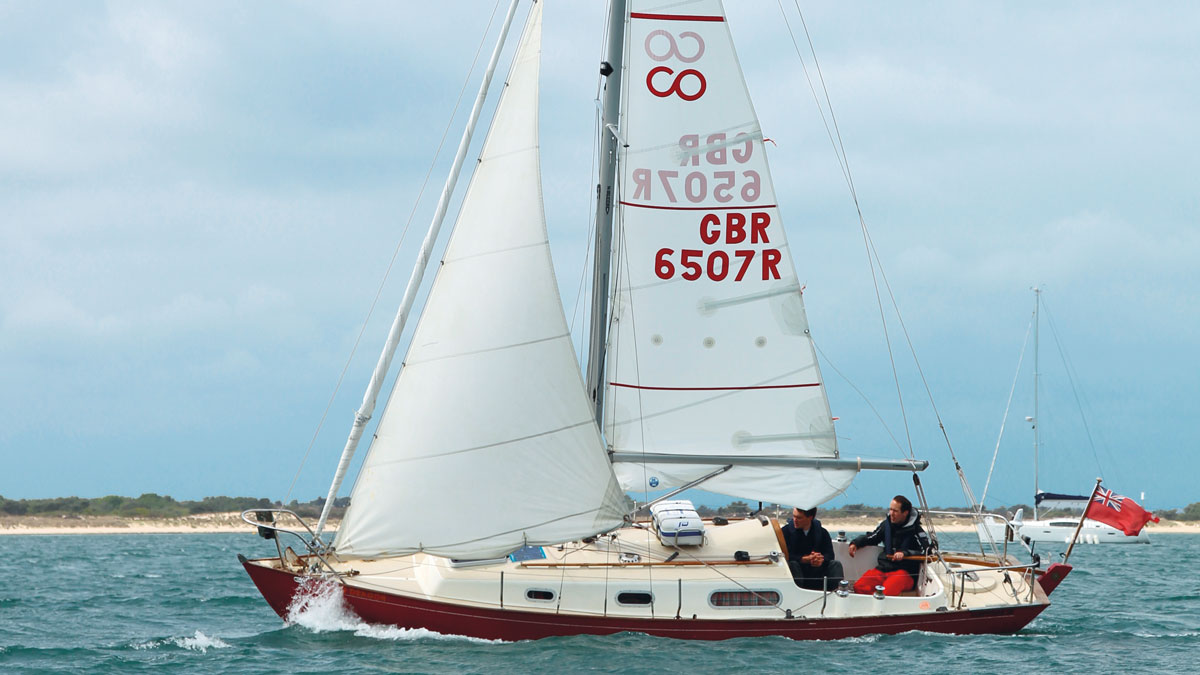
Slab reefing: Guide to sail shape & preventing sail damage
David Pugh explains how to keep in shape for all conditions with a comprehensive guide to slab reefing techniques
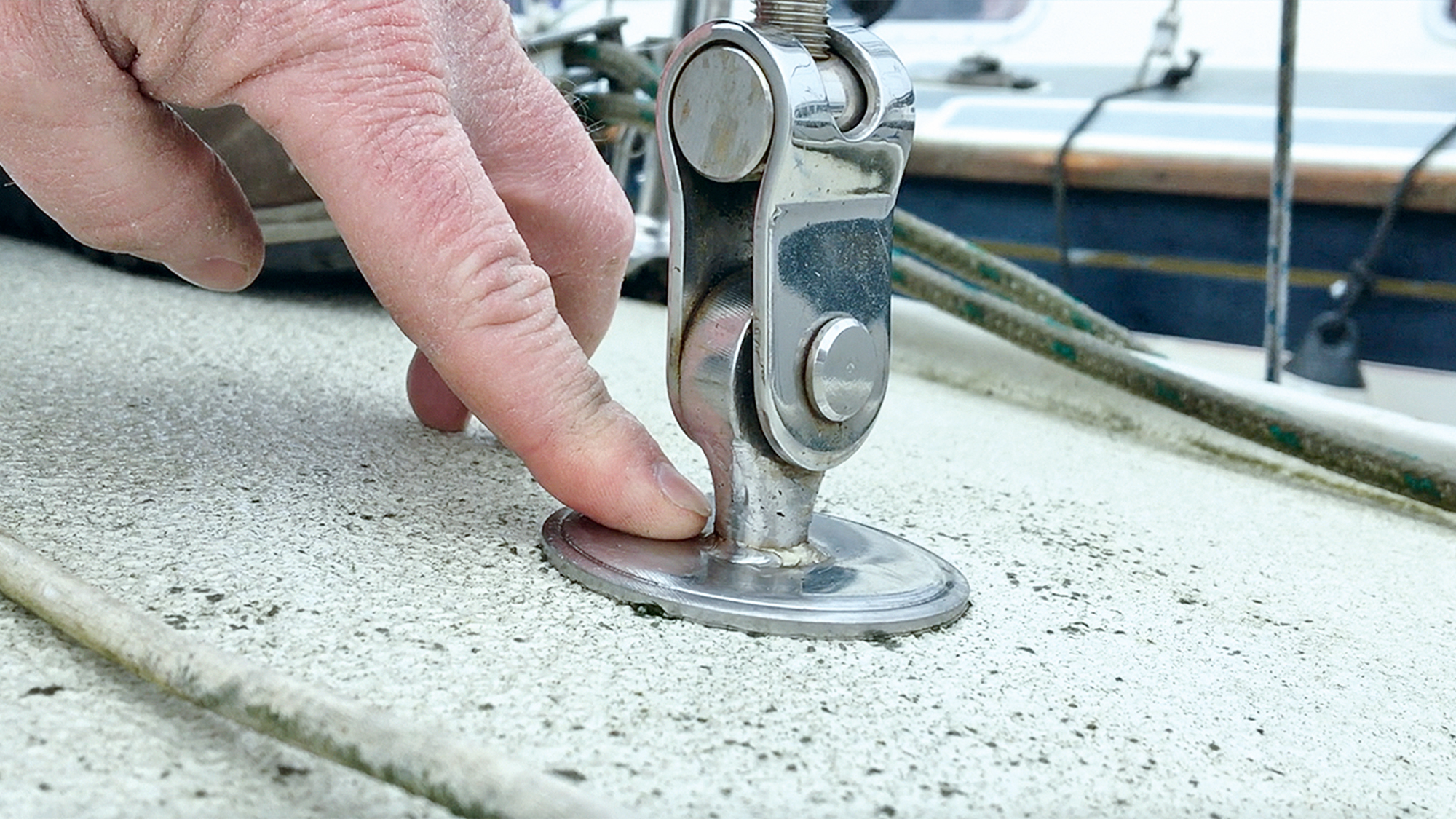
Fend off rigging failure: the most common problems and how to prevent them
Most sailors will probably have seen or experienced a stranded wire, or a failed swage, or the catastrophic resulting from…
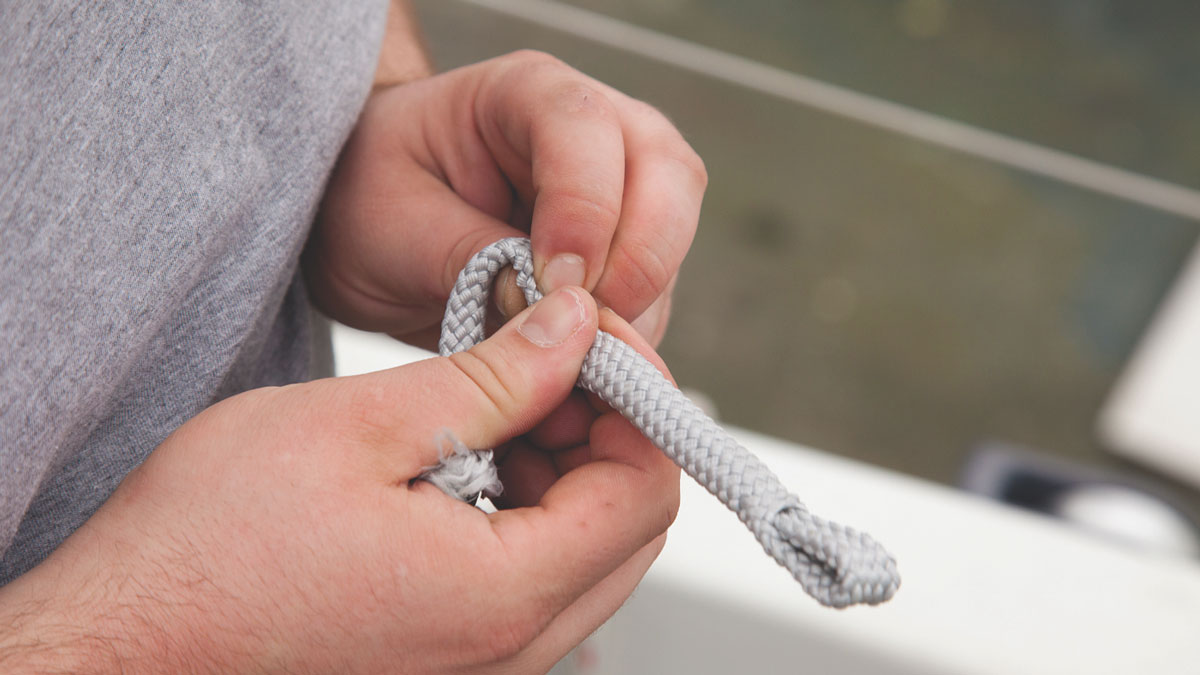
How to replace your running rigging: The essential DIY guide for older cruising yachts
Replacing old, tired lines is a critical job for any sailboat owner. Follow this step-by-step process for a full running…
Want to read more articles about boat maintenance?
A subscription to Practical Boat Owner magazine costs around 40% less than the cover price.
Print and digital editions are available through Magazines Direct – where you can also find the latest deals.
PBO is packed with information to help you get the most from boat ownership – whether sail or power.
-
-
-
- Take your DIY skills to the next level with trusted advice on boat maintenance and repairs
- Impartial, in-depth gear reviews
- Practical cruising tips for making the most of your time afloat
-
-
Follow us on Facebook, Instagram, TikTok and X