




Ali Wood gets some top tips from sailmakers on choosing and caring for your yacht’s most valuable assets
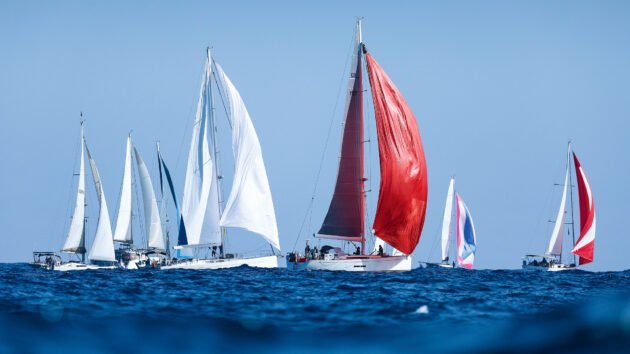
The new season’s approaching, and your sails are in tip-top condition, right? You’ve had them laundered and the UV strips checked; no frays or mildew, the canvaswork’s gleaming…
What? You haven’t done that?
Don’t panic! Not all of us are as organised as our sailmaker would like us to be, but there’s still time to check them over, and if needs be, get them cleaned and patched.
The sail is supreme
Sails are the biggest investment you can make on a yacht.
New ones are costly, but if you look after them, they’ll look after you for years and even decades to come.
Sail design and cloth have changed significantly in recent years, particularly with headsails, and there are more choices than ever before.
So whether you’re looking to buy new sails or just want tips on how to maintain them, here’s some advice from the industry.
A typical sail wardrobe – then and now
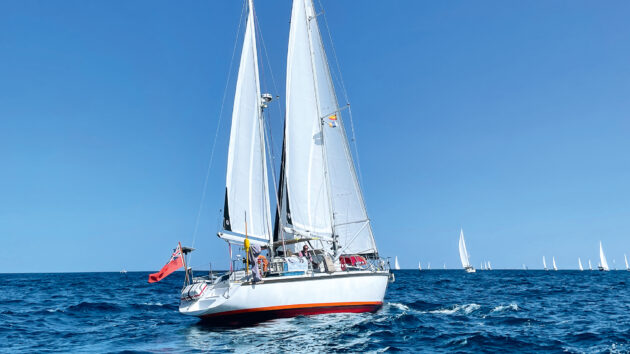
Ketch rigs, such as this one seen at the ARC start, are not so common these days. Photo by Ali Wood
The last century has seen a lot of evolution in rigs: from square sails to schooners, and in the 1960s, the adoption of sloops and cutters. Sailors realised one mainsail worked better than two, so yawls and ketches were abandoned.
Foretriangles, however, typically remained split into a jib and staysail, especially on cruising boats, where a single headsail was too big and unwieldy for crew to handle.
From the 1970s to the 2000s, a sloop with overlapping genoa became the standard rig: 135% for cruisers, with an overlap of 150-180% for racing boats, which contributed significantly to boat speed but made tacking a serious challenge.
Modern sloops with fractional rigs have the forestay mounted a distance below the masthead, allowing a smaller jib that doesn’t overlap the shrouds.
This makes tacking and trimming much more efficient and, with the advent of modern roller-furling, means you can do away with carrying extra sails, as sailmaker Daryl Morgan explains.
“Traditionally, on a sloop, you might have had a mainsail, No1 genoa, No2 genoa, working jib, storm jib and a spinnaker.
Nowadays, cruising sails are geared towards making life easier, so you’d typically just have a mainsail, a furling genoa and a cruising chute.”
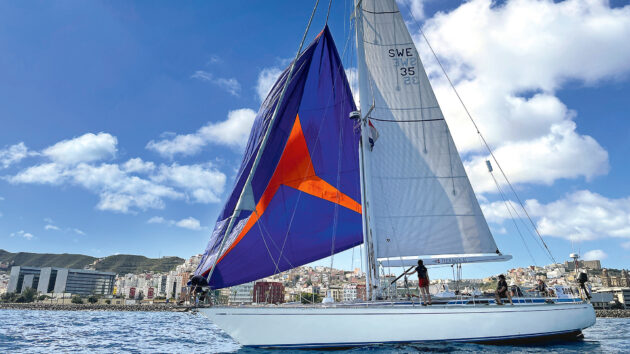
An asymmetric cruising chute doesn’t require its own pole, although some people use one. Photo by Ali Wood
Daryl made his first cruising chute in the mid-1980s; back then it was called an MPS (multipurpose sail).
“The fundamental difference between a spinnaker and a cruising chute is that the spinnaker is symmetrical; the two leeches are the same length. A cruising chute is asymmetrical; the leading edge, or luff, is longer than the trailing edge (ie the leech).”
A cruising chute is optimised for a 140° to 150° apparent wind angle and, unlike a spinnaker, doesn’t need a pole to set it efficiently, meaning none of the faff of spinnaker guys, pole hoists and downhauls.
Nailing your mainsail
Mainsails can be fully or partially battened, or have no battens.
While full battens allow the sail to be built with a roach, sails without battens will have a hollow (concave) leech.
“Battens result in a significant upgrade in performance, ease of handling and stowing,” says Paul Lees, founder of Crusader Sails. “Ignore the myths about vast expense and being unable to de-power.
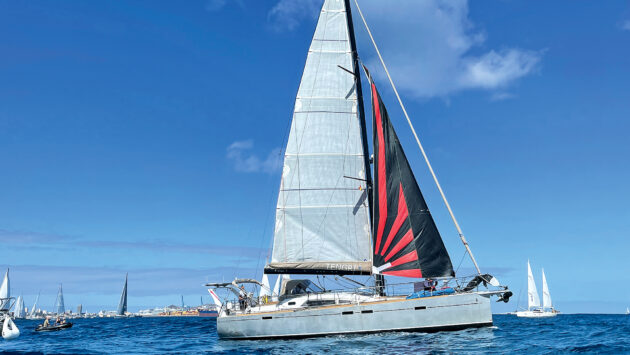
This yacht has a fully battened main and is flying an asymmetric from a separate forestay, with an additional asymmetric in a sock on the deck. Photo by ali Wood
Modern hardware, lightweight and stiff round battens follow the moulded shape of the sail rather than torturing in the camber with massive compression.”
A fully battened sail can be up to 6% larger, and this stiffness increases longevity, reduces flutter and general abuse.
A fully battened mainsail with a set of lazy jacks and stack pack arrangement means that when the sail drops it’s guided down into the boom bag out of the way; it’s not going to fall off the boom and flop all over the place, which is particularly handy if you’re sailing single-handed.
A lot of sails are hybrid these days, for example with one or two top battens at full length and the lower ones (where the sail is less likely to flog) at 40%.
The rise of furling mainsails
Owain Peters, technical director at Kemp Sails, finds that sailors are increasingly asking for in-mast furling mainsails with full-length battens, but this might not be possible depending on mast design.
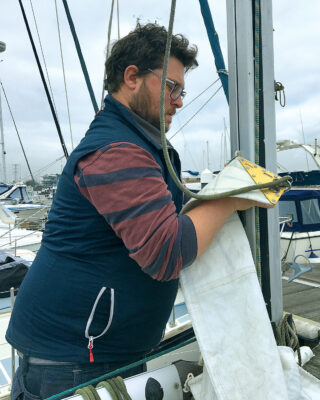
This mainsail is hanked on but increasingly cruisers are exploring in-furling mainsails. Photo by Ali Wood
“It comes down to the tensioning of the mandrel, which is the furling spar inside the mast,” he says.
“Seldén masts will work with any length battens because the mandrel has its own top swivel, and is tensioned independently of the halyard, but masts from most of the French and European manufacturers including Sparcraft, Isomat and Z-Spars will give you a more limited choice.”
It’s also worth noting that the shape of a furled mainsail, depending on the mast slot, may be less efficient when compared to traditional reefed mainsails.
Another option for the mainsail is in-boom furling, which offers more control over sail shape and tension. The advantage of this is that the sail can be reefed at any point allowing for fine adjustments and easy handling.
Vectron, a mix of polyester and Vectran (a multi-filament yarn spun from liquid crystal polymer) is a light and durable choice, or you could opt for a finely woven, high tenacity polyester.
Laminates, on the other hand, aren’t suitable for furling mainsails.
Delamination can increase the risk of chafing when furling and unfurling, and they’re also vulnerable to UV through the slot in the back of the mast, and prone to mildew build-up when the sail is rolled.
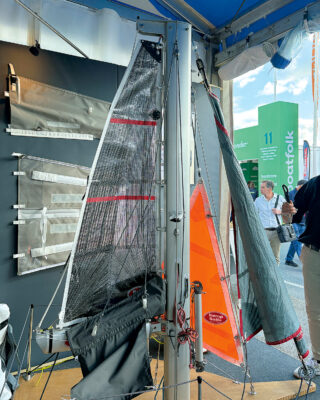
Southampton Boat Show is a good place to look at sail material options. Photo by Ali Wood
Headsail
Furling headsails are fitted as standard these days on yachts, and if your system is reaching the end of its life, it’s worth looking at what’s available, not just replacing like for like, advises PBO’s Rupert Holmes.
“You may be buying a more expensive system than necessary. There’s little point in paying a premium for a double luff groove and removable drum if you never race fully crewed.
Having said that, twin grooves may be useful for setting twin poled out headsails for cruisers intending to cross the Atlantic.”
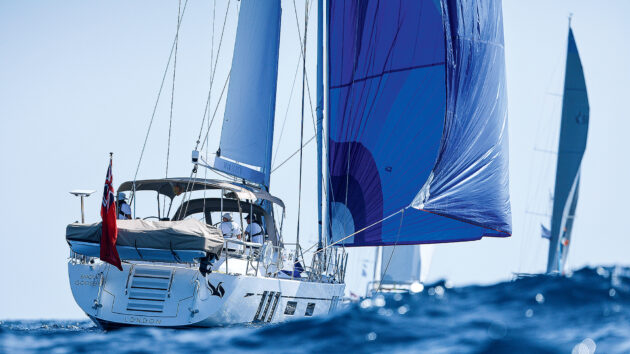
Having the right downwind sail can make a huge difference when on a transatlantic, like this yacht doing the ARC. Photo by Paul Wyeth / WCC
Choosing a like-for-like replacement may also mean you miss out on more recent developments that can improve sail shape and reliability such as the Facnor FD (flat deck) that uses webbing at the drum rather than rope, increasing the luff length of the sail.
“Seldén’s Furlex systems are well proven and, like the Facnor FD, start by taking the bulk out of the middle of the sail, which helps improve shape when it’s part reefed,” says Rupert.
Harken’s furling systems are now in their fourth generation, and include Ocean furlers, which make furling easier at the expense of a marginal aerodynamic loss.
Sizing headsails
When it comes to sizing headsails, the mast overlap is described as a percentage.
For a roller furling headsail, 135% is a good all-round size, and will cover 5 to 25 knots. The lighter the wind, the larger the overlap.
With hanked-on sails, you might carry a No1, which is a 150% overlap, a No2, which is 140%, and a working jib would be 80%. It’s important to fly the right headsail for the conditions, says Daryl Morgan.
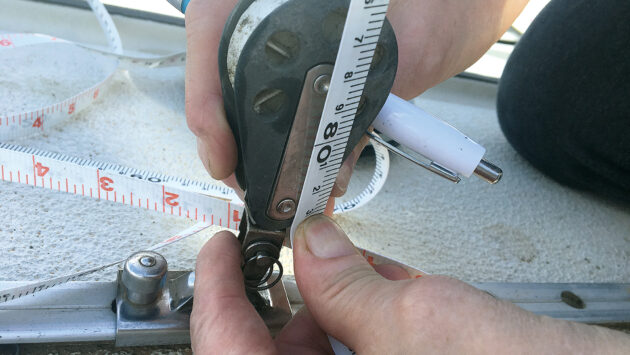
A sailmaker will measure-up and help you decide what size overlap your genoa should have. Photo by Ali Wood
“A boat will reach hull speed very quickly if you have a No1 up in 15 knots, but you’d be excessively heeled and struggling to go upwind well; it would be uncomfortable. With a No2 the boat would be more upright, point better, and be far more comfortable.”
A roller-furling headsail, on the other hand, although smaller than its biggest hanked-on predecessor, can do all this without the need for sail changes.
Of course, the more you furl the sail, the less efficient the sail shape is, so you need to find that ideal mid-point.
Downwind sails for racing
Downwind sails have changed the most in the past few decades. No longer is it a simple choice between a spinnaker flown from a pole, or a cruising chute tacked to the stemhead or a short bowsprit.
There’s now an array of lightweight asymmetric sails to choose from, including the much talked-about Code 0, which first made its appearance in the 1997-98 edition of the Whitbread Round the World Race (now known as the Ocean Race).
This large, free-flying headsail was built to fill the gap between a conventional spinnaker and an upwind headsail.
Code 0 was for the tightest (closest) wind angles, compared to Code 1 Reacher, with Codes 2, 3 and 4 at progressively broader angles. Crucially for a Code 0, the mid-girth was set at 75% of the foot length.
By comparison, a genoa has a mid-girth of less than 45%.
Downwind sails for cruising
While the geometry of racing sails is confined to the limitations of the class, there are no rules for cruising sails.
A cruising girth of 60-65% and a foot length of 140-165% is ideal, though smaller and flatter means closer angles.
Furling systems are now available for downwind sails, usually attached to a bowsprit or forward attachment point, meaning you can get them away without having to lower them to the deck.
Owain Peters explains that modern rig design has pushed cruising sails to fill the gap between upwind headsails and conventional spinnakers.
“We’ve seen a move towards larger mainsails and smaller foretriangles, and self-tacking headsails have become popular too,” he says.
“These changes have simplified handling, particularly upwind, but they have led to a problem. When you bear away, a small, close-sheeting headsail twists open and loses its drive.
“In light winds you’ll often be slower on a reach than upwind, yet unable to hoist a spinnaker or cruising chute until the wind is abeam. This leaves a wide angle between a fetch.”
So what’s the answer?
Not so much a downwind sail as a ‘crosswind sail’ – Code 0s and their cruising variants have been developed to plug this gap.
While it still comes down to choosing between symmetrical or asymmetrical, there is a far greater range of asymmetrics (A-sails) than ever before.
These range from what are essentially large, lightweight genoas (made of 3oz polyester, rather than spinnaker nylon) to gennakers and cruising chutes for deep downwind angles.
“At Kemp we offer sails to cover the whole spectrum but even with all our expertise and experience, we’ve yet to come up with one sail that does everything. We will announce it as soon as we have changed the laws of physics!”
The Parasailor
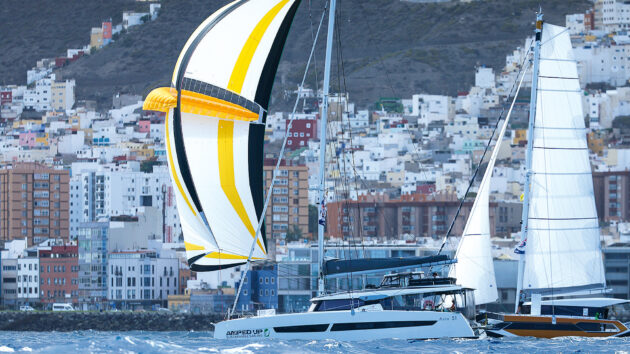
A Parasailor being flown at the start of the ARC+ rally in Gran Canaria. Photo by World Cruising Club
The Parasailor is a quirky-looking spinnaker that looks like it’s wearing a cap, with the ‘visor’ being a paraglider-style wing.
Traditional foresails have a tendency to push the bow into the water as they drive forward, increasing the risk of rolling and pitching.
However, the aerofoil wing on the Parasailor – which contains dozens of small inflatable air pockets – generates lift, allowing you to ride over the waves.
Storm jibs
Not every boat carries a storm jib these days, but Paul Lees of Crusader Sails believes everybody who sails the English Channel and further afield should definitely have one.
“Storm sails are proper safety equipment, like flares and liferafts. When it’s cold, wet and windy and getting a long way from home and you’re on your last reef, proper storm sails seem very cheap at that time.”
Made for winds of 35 knots or more, storm sails will set and perform better than deeply reefed sails.
Instead of hoisting the main, you can fly a small triangular trysail, which has a ‘droopy clew’ sheeted independently of the boom so you don’t need to remove your mainsail altogether.
A storm jib reduces the centre of effort, meaning less heeling, and can double as an inner staysail for use in windy areas. You can also get a Gale Sail, which allows you to deploy a storm jib over a furled genoa.
Sailcloth and cut
We’ve covered the different types of sails, but the cloth you choose will make a huge difference to the sail’s performance and longevity; often with the two being at odds with each other.
Different sailcloths also lend themselves to different cuts. Crosscut panels (usually of woven polyester) run horizontally across the sail.
A radial cut construction (usually made from laminated sailcloth) more closely follows the sail’s load patterns, while a membrane cut, the most advanced option, is made up of individual panels glued together, with the seams being stronger than the laminate itself.
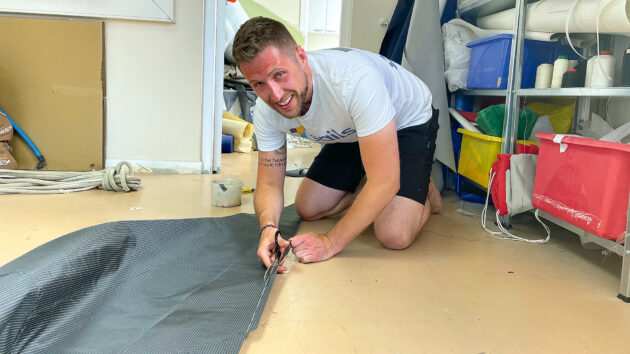
A sailmaker, such as Dan at T Sails, will advise on the best cloth for your cruising. Photo by Ali Wood
A sailmaker can help guide you as to the best cut and cloth for your boat, budget and type of sailing.
It might be, for example, that you have a crosscut mainsail and radial cut headsail.
Your least expensive option will be a woven polyester. It’s tough and will last a lifetime, but the sail will eventually stretch and lose its shape.
“You’ll be able to abuse it like you wouldn’t any other type of material,” says Daryl Morgan, “but over time it will get fuller and deeper.
“Will it make the boat go forward? Yes. Can you use it in 5 and 20 knots? Yes. But 20-knot performance will be terrible!”
Your next choice is a hybrid woven sail, and then you’re looking at cruising laminates, where various scrims (made up of different types of yarn) are glued together, with the two outer laminates being encapsulated in woven polyester.
“There are lots of varieties including Kevlar, carbon and Dyneema,” says Daryl. “The bigger the boat, the bigger the loads, so the more exotic the material you use in the laminate.
The downside of laminates is that they’ll let go at some stage. A woven cloth will never let go. It’ll lose its shape, but you don’t get catastrophic failure.”
For downwind sails, the cloth will be much lighter, typically a spinnaker nylon with good stretch properties and tear resistance.
A 1.5oz, 65gsm cloth will set in anything between 3 to 15 knots, and is good for cruising, though lighter cloths are available.
Choosing sails for ocean voyaging
With vast oceans to cross, bluewater sailors can often find themselves thousands of miles from the nearest sailmaker, and there’s no quick fix if their sails blow out.
In this instance, quality and longevity will need to trump performance, explains Daryl.
“When people start doing events, they tend to go for a laminate for its weight-saving advantage and performance.”
However, if you’re doing a round-the-world, or passage of 2,000 miles or more, you want a durable, repairable set of sails.
“The average sailmaker in Tahiti is not going to have a specialist hot-glue machine, ultrasonic tape, and sticky-back Kevlar or carbon fibre repair material. When things go wrong, you don’t want a laminate – having any kind of exotic aramids such as carbon or Kevlar is asking for trouble.
“A woven sailcloth, on the other hand, is just going to hang on in there. It will handle some flogging and misuse, with the added bonus that you will get from A to B safely and on time.”
Industry insight: Paul Lees and Andy Cross of Crusader Sails talk sail care
Washing sails really isn’t something you can do on your living room floor.
It’s a process that needs to be done ever so gently and at very low temperatures because you can damage the sail if you go too hot.
It’s not like with industrial sheets, where they can get folded and put through drying rollers; heat drying will turn sails into Ryvita.
We air-dry the sails and there are various treatments for preventing mildew and keeping the anti-chafe on the seams.
We can lubricate the sails so they’re slightly slippery and roll up nicely – this is at a significant extra cost, but we do see the results. They improve and protect the sail.
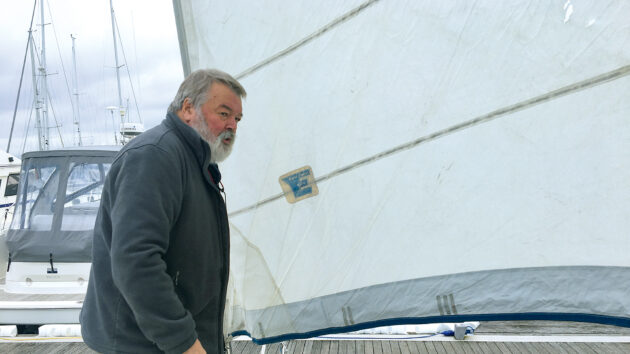
Crusader’s Paul Lees takes a look at PBO’s old Project Boat headsail. Photo by Ali Wood
One of the things people do is leave their sails up over the winter, usually in the vain hope of a quick sail on Boxing Day, but there are surprisingly high levels of UV during the winter, and there’s always an outbreak of mildew.
November is a classic month for mildew and verdigris growth [the blue-green patina you get on metal hardware] because you get warm, sunny days and cold nights.
If you’ve a cruise planned, send your sails to your sailmaker early, and particularly in winter.
We’ll take a look, and if we see horrendous scuffs and things, we might say, ‘Sir, look at your spreaders, you might have a sabre-toothed tiger up there.’
The rig setup is really very important when it comes to setting the sails properly.
Andy Cross at Crusader Sails. Photo by Ali Wood
Avoiding flogging is also really important, and the old ‘stitch in time’ philosophy.
You do find that people have a little tear and don’t do anything about it or maybe they just stick tape over it and hope for the best, but maintenance is key.
We’ve got one customer’s 18-year-old sail and it’s fine, and then we’ve got another, who’s left his sail up, and he’s had to buy a new sail.
Industry insight: Owain Peters of Kemp Sails
How do you prolong the life of your sails?
The sun and marine environment are incredibly aggressive on anything that’s left out. Imagine what we’d look like if we were left in the sun for 10 years: all the weathering we’d experience!
UV is the primary danger.
Modern fibres such as polyesters and aramids are prone to damage, so it’s important to have sacrificial protection.
For example, having a UV strip, or a hoistable sun-sleeve over the headsail to protect it when furled. For the mainsail make sure you have a boom cover.
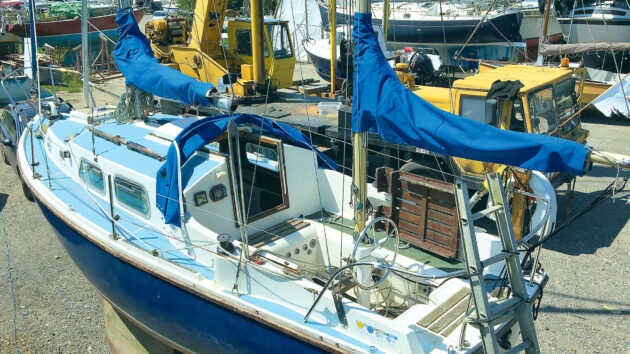
Boom covers protect the mainsail and can help prolong the sail’s life. Photo by Ali Wood
Can you wash sails at home?
It depends what the sails are made of.
If it’s woven cloth, it’s possible to do it yourself; the matrix of the weave attracts pollen, and stuff will grow on it.
It can be removed with a brush and mild detergent, but it’s a labour-intensive job and most people don’t have the area to do it.
Canvaswork on the other hand – things like sprayhoods and packaways – can be done in the bath.
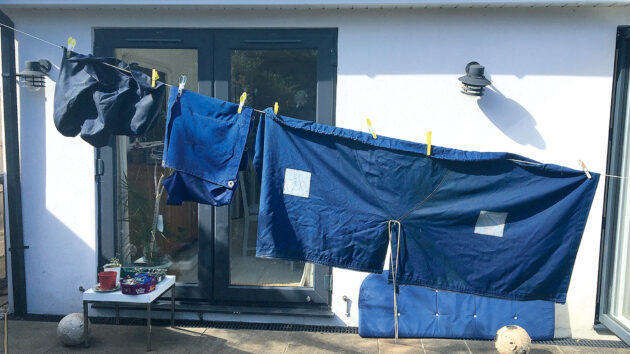
While canvaswork can be washed at home, few people have the space for washing sails. Photo by Ali Wood
With laminated sails, the cut edge exposes the internal fibres, and that allows water to ingress and mildew to grow on the laminate matrix.
Laminates can look horrible and you can’t necessarily do anything about it once the growth is inside. I mention this because it’s about managing expectations.
While we can clean the outside, if there’s growth on the inside of a laminate sail, it won’t come back looking as good as a woven sail.
There’s an interesting distinction between harbours exposed to prevailing south-westerlies – Salcombe, for example – and those such as Chichester where the wind is blowing and depositing everything from the land.
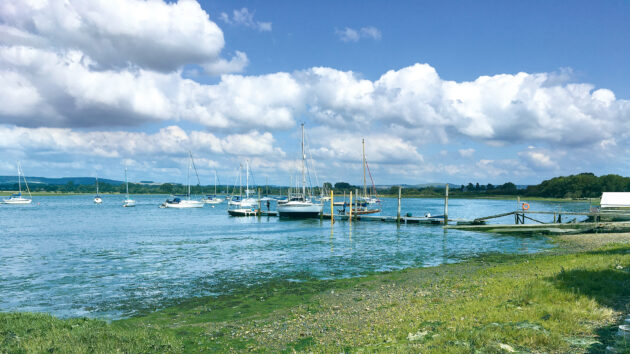
Sails in harbours such as Chichester are more susceptible to pollen. Photo by Ali Wood
In the latter, you’ll see much more growth in the sails.
In Poole, we even see soot deposits and that creates a feeding ground for everything growing. It’s unsightly, but it’s not the cause of degradation.
UV and weathering are the main causes of degradation; that and a small amount of dried saltwater.
If you get salt in the sail it can act as a grinding paste every time you move the sail, and that can cause damage quite quickly on a microscopic level.
How often should you service sails?
A scheduled maintenance every winter is desirable, but every couple of years is probably fine for most people. We offer a health check, which is like an MOT for your sails.
We lay them out over the loft floor and inspect them, highlighting major defects which need attention right now, and minor things that are worth doing, but you could leave a year or two.
For example, chafe where the sail is being dragged over the spreaders or where the guardrails and stanchions are interacting with the UV strip.
We’ve got a database with all the failure modes and have codes for the different types of damage.
Sail damage is generally indicative of a sail being old: for example, a split, a seam popping, or the stitching failing.
What kind of damage do you see?
The first thing to get damaged is the UV strip.
If it’s threadbare and fragile it’s used-up, and not offering protection. No fabric should be delicate enough that you can tear it by hand. All of these things are instant red flags.
Spinnakers are different; these get torn all the time, but you shouldn’t get tears in your average mainsail or headsail. The cloth has to be sufficiently degraded for that tear to be able to propagate.
When a customer brings in a sail for a UV strip replacement, but it’s old and knackered, we’ll advise them to save their money for a new sail in a year or two. It would be disingenuous to fit a new UV strip to an old sail.
But we have arguments with people over that. They’ll say: “No, it’s done me fine for 25 years.”
Twenty five years is a very long time for a sail!
Can you help with repairs at sea?
People are using Starlink now to send us videos of their sail damage and we can give them advice over the phone on what can and can’t be done remotely.
We also sell sail repair kits, although any repair done on the fly is just to get you home until a sailmaker can get it under a sewing machine.
A lot of world cruisers now carry a sewing machine. There’s a portable one called Sailrite which does the right kind of stitching and has the right thread, but you do need to know how to use it and it’s quite a weight.
There’s also a sticky-back sailcloth called Insignia which will cover a multitude of sins in the short-term. You stick it back to back on the sail and around the corners and away you go – but again it’s only a stop-gap.
Tears need patching, which will create a reinforced area, but the danger then is that you create a stronger part there, leading to weakness elsewhere.
Also, you’ve got to stitch it, and on an older sail, this creates a perforation from which the next tear can propagate.
We have to be very careful about what warnings we issue when advising on repairs.

Cruising chute or spinnaker? We compare both sails on the same boat on different points of sail
Many cruising sailors favour a cruising chute over a spinnaker – but how do the two sails compare on different…
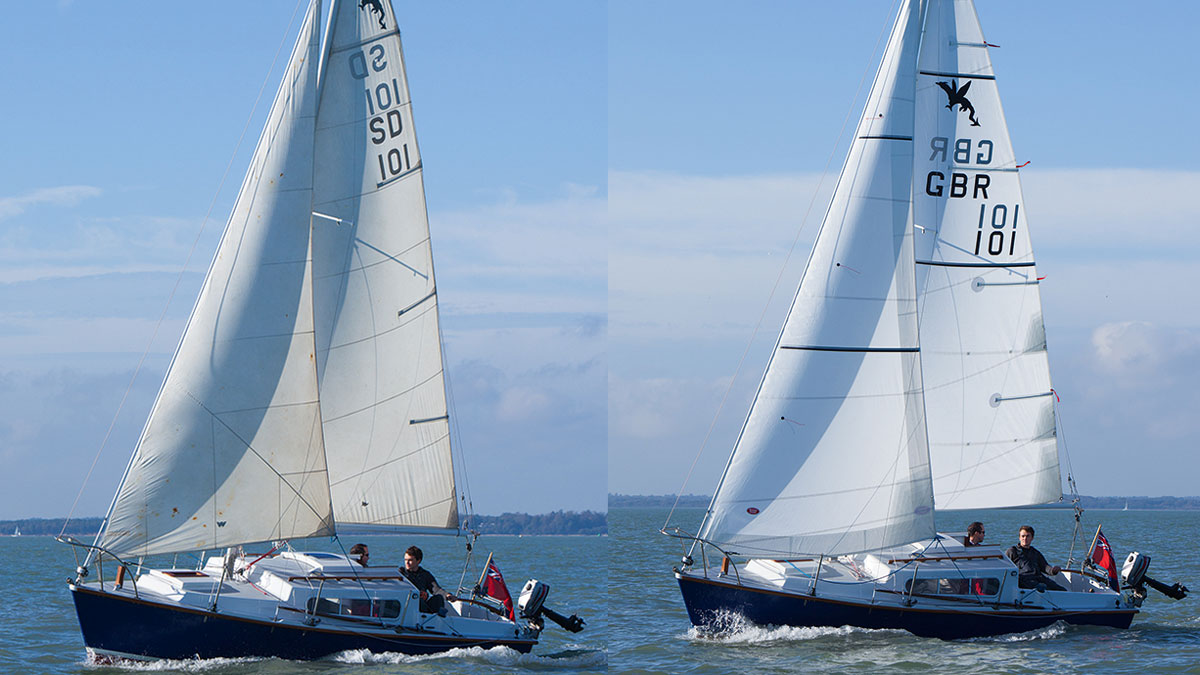
What difference do new sails make?
New sails are a big investment – but are they worth it? The PBO team compared the old with the…

Motor sailing: how to add power to your sails
Whether you’re supplementing the engine with the sails or vice versa, using them together can make a lot of sense…

Boat sails: how to make them last longer
David Bond gets professional tips for prolonging the life of his boat sails
What kit have you been impressed with while sailing your boat?

Follow Practical Boat Owner on Facebook, Instagram, TikTok and X