


The Grand Cormoran is a camper-cruiser capable of handling heavy weather. David Harding puts the boat through its paces
The Grand Cormoran: capable camper-cruiser

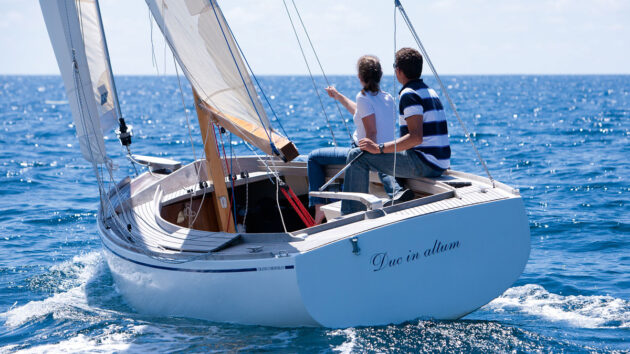
When Francois Dervin had a wooden Cormoran built to his own design in the 1950s, he sailed it in Arcachon, south of Bordeaux. He eventually passed it on to another naval architect, Philippe Gueroult, who specialised in the design of commercial motorboats.
Having learned to sail in the Cormoran, Gueroult decided he wanted something similar but bigger – and thus was sown the seed (or should it be laid the egg?) for the Grand Cormoran.
After two years of cooperation between a team including Gueroult, ACCF and the sailmaker Victor Tonerre, the Cormoran’s big sister emerged in 2006.
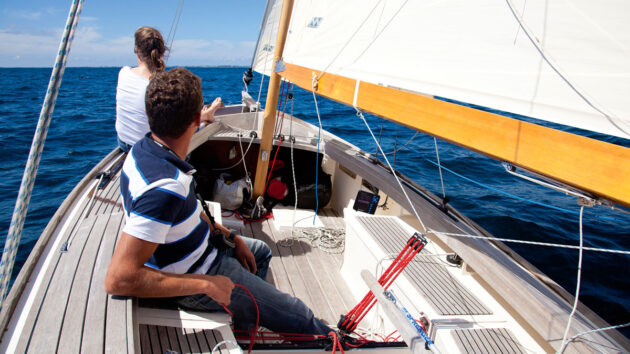
In open-boat form, the Grand Cormoran has a large cockpit with a flat, clear sole and ample stowage in side lockers and beneath the foredeck. Credit: David Harding
Apart from being designed from the outset to be built either with a cabin or as an open boat, the Grand Cormoran differs in having a rudder stock that’s vertical rather than in line with the raked after end of the keel. The rudder is also further aft, to allow space for the prop of the outboard motor in its inboard well.
Significantly, the centreplate is further aft as well – so far aft, in fact, that from a quick look at the drawings you can only imagine the boat will carry lee helm in light airs.
This she does, to allow for the fact that weather helm will develop as the wind builds. If a boat with such a long boom had neutral helm when upright in light airs she would be impossible to handle on a breezy reach.
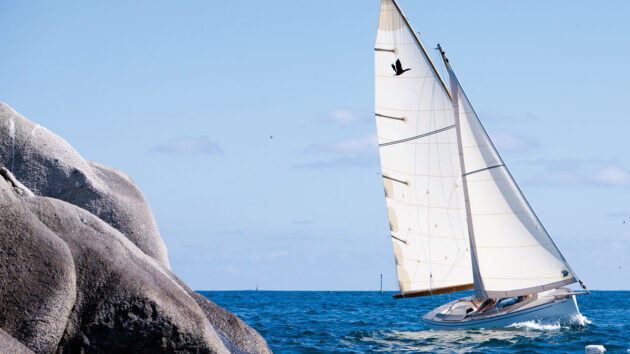
Sailing past the rocks of the Men Daniel off Le Guilvinec. Credit: David Harding
To help offset the light-air lee helm you simply do what you would naturally do anyway, only to a greater extent: induce heel. Whether you will be able to achieve sufficient heel to neutralise the helm depends on the weight of your crew as well as on how you trim and sail the boat.
On our eight-mile beat west from Loctudy, we started in a zephyr that gradually built during the day. After a lunch-stop in Lesconil, we continued to Le Guilvinec in 10-12 knots of conditions in which the boat was balanced to the extent that she would sail herself upwind with the tiller unattended.
Fine-tuning could be achieved through leech tension and traveller position.
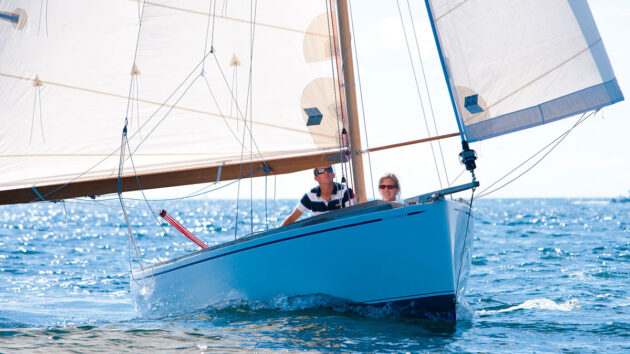
With wings spread downwind, she slides along at a good pace. Credit: David Harding
The running backstays aren’t needed in most conditions but were useful to grab hold of when hopping to and from the accompanying RIB, as I did countless times during the day.
Those favouring a higher-tech rig can have a mast made from Douglas fir with strips of carbon forward and aft – as did the owner of the cabin version that we stopped and saw en route.
Making up to 5.2 knots and tacking through around 95°, the Grand Cormoran is no slouch for a gaffer of this size, is fun to sail, has stacks of stowage and, with her wide, uncluttered sole, would make a great camper-cruiser with the addition of a boom tent.
Details
Price (from approx, open version):£33,945
Length on deck:5.90m (19ft 4in)
Length including bowsprit:6.60m (21ft 8in)
Beam:2.35m (7ft 9in)
Draught:0.5m-1.5m (1ft 8in-4ft 11in)
Weight:1,050kg (2,315lb)
Ballast:360kg (794lb)
Sail Area:34.0sq m (366sq ft)
RCD Category:C