


Nick and Wendy Tyler’s advice on avoiding collisions, based on their own experience

Everyone who sails should know the International Regulations for Preventing Collisions at Sea (ColRegs) and be prepared to adhere to them when
necessary or possible.
When we first started sailing, we took the RYA Essential Navigation and Seamanship course. We learnt the lights, day signals and buoyage, and bought a good quality chartplotter, a decent VHF radio and an AIS transceiver, which was the best money we could have spent on collision avoidance equipment.
But, over years of ocean and coastal cruising, it has been fascinating to adapt our original attitude of slavish rule-following to meet the needs of the situation.
1: COMMUNICATE
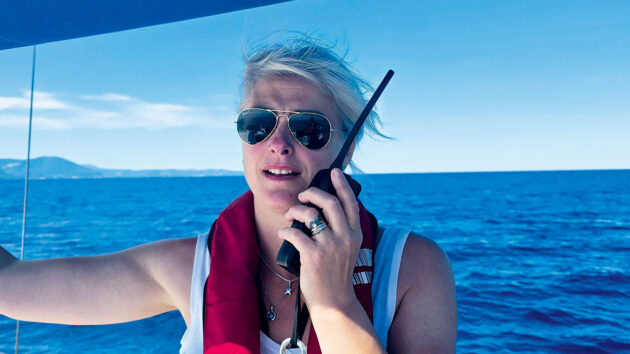
Practical ColRegs: As soon as you perceive a hazard, communicate with the other vessel. Credit: Katy Stickland
It still amazes us that, mid-ocean, you can find yourself on a collision course with a big boat. In the middle of the night with a big swell and shortened sails, you´re going nowhere fast, and then, on the chartplotter, you see a 65,000-ton ship bearing down on you at 18 knots. The first reaction is disbelief: isn’t the ocean big enough? But then self-preservation overrides disbelief.
We got on the VHF radio and called them up at about five miles away.
Us: “Are you aware of our position?”
Them: “No – where are you?”
Us: “About five miles in front of you.”
Them: “OK, we see you now!”
Us: “What are your intentions?”
Them: “We’ll alter course to maintain a CPA (closest point of approach) of one mile”
Us: “Thank you for your consideration – have a good watch.”
It is a weird feeling to watch a huge ship alter course to miss little old us, but the feeling of relief that the short conversation brought was profound.
2: SIZE MATTERS
In the bay of Cadiz, around 1100 on a hot day, we were motoring (no wind) and being pestered by two Spanish fishing boats between us and our destination. They had a habit of coming within a mile of our bow at 10-12 knots before turning towards or away from each other with no concern for any other boats.
Then…incoming… a large cruise ship hove into sight, bound for Cadiz. From three miles away, our AIS/chartplotter showed a closest point of approach of about 200m.
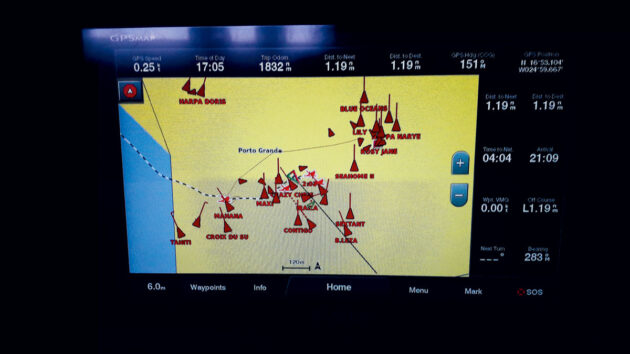
Practical ColRegs: AIS in a busy anchorage. AIS is a very useful navigation tool, but it is not infallible. Credit: Nick and Wendy Tyler
We called the cruise ship up on VHF radio and asked, “What are your intentions?” The answer? “To avoid those two pesky fishing boats!” We laughed, promptly turned 180° and got out of the way of all three hazards; the fishing boats panicked and raced out of the way of the cruise ship.
The alacrity with which they were able to get out of the way of the cruise liner suggests they weren’t trawling. We closed with the cruise liner and followed it through the clear passage it had created.
3: STAND-ON DOESN’T MEAN ‘RIGHT OF WAY’
Our first experience of this was in Croatia. We were sailing back to port when a line of a dozen identical German-flagged sailboats came towards us from our port side. There was not a sail in sight, and all were motoring home at the end of a hard day’s racing.
Knowing we were the stand-on vessel, we expected them to change course and go round our stern. But they didn’t. As we closed, we saw that they were motoring on autopilot and were all down below, drinking.
We had to ease the sails and watch the ad-hoc (and rather irresponsible) party go past our bow before we could carry on with our gentle sail home.
More recently, sailing south from one Caribbean island to the next, reefed down with the wind behind the port beam and travelling at around 4 knots, we were hailed by an approaching 50-footer from about one mile away.
He was virtually head on, tight to the wind on a starboard tack doing 8 knots. Over the radio, we heard: “Please adjust your course to pass port-to-port, I AM the STAND-ON vessel!”
We acknowledged his request and turned to starboard, to the extent that if we went any further round, we’d have had to gybe to sail directly west. Sadly, there was a current against us which very nearly matched our speed, and we could not reach his port side in the short time left. Nor could he get any further upwind.
So we told him we were going starboard-to-starboard and let him stew. Given the sailing conditions, it was not possible to achieve his request, and if he had not been so convinced of his own right of way, neither of us would have had to get stressed.
We think people who are race-trained forget that our common enemy is the sea, not each other! Racing rules give skippers the right to push other boats out of their way. Cruising rules do not!
4: NEARBY LIGHTS…
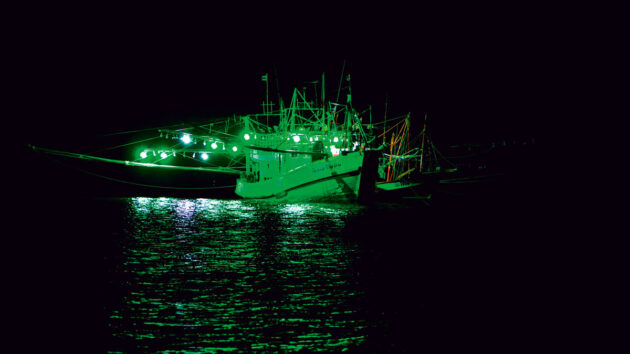
Practical ColRegs: Deep-sea fishing boats are often lit up, so you may struggle to see the boat’s navigation lights. Credit: Alexey Stiop/Alamy
Despite having studied our lights and signals flash cards diligently, we’re often overwhelmed by the number and brightness of boat lights. Large cargo ships have their deck lights on which obscure their navigation lights, making it hard to tell which way they are pointing.
Happily, they’re usually on AIS, so they do not present too much of a hazard – although a crowd of cargo ships circling off Gibraltar waiting to be allocated to an anchoring point gave us a sleepless night, as we had to weave in and out of them.
South of Madeira, at around 2200, we were getting far too close to a deep-sea fishing boat that was shining its spotlights in the sea and its deck-lights on the workers. There was no chance to distinguish its navigation lights, and it was neither on AIS nor responding to VHF radio calls.
We only had our tri-light on at the masthead as we were sailing, and reckoned that they would be blind to such a dim warning. We turned on the navigation lights, steaming light, deck light and cockpit light, just to be seen, but they just kept getting closer.
In the end, we resorted to getting a powerful torch, alternately shining it at their helm and then onto our sail. We knew we had been seen when their zillion-watt searchlight was turned on us, and we had spots before our eyes for the next half hour.
At the last minute, they changed course and missed us by 100 yards!
…AND VERY DISTANT LIGHTS
Night sailing is exciting. Apart from the amazingly calm spectacles of bioluminescence and the Milky Way, a dog-watch has its own moments of panic. The important thing to remember is that it is impossible to judge the distance to any given light.
When sailing east across the Atlantic, a bright single white light appeared on the horizon. We checked the AIS, but no ship was shown. We turned 10° to starboard to avoid the oncoming ghost ship; 20 minutes later, the light was quite high above the horizon, and the helm sheepishly admitted that he was trying to go port-to-port with Venus!
Some sailing friends have confessed to doing the same, and also to calling the moon on VHF radio, as a rising moon can look suspiciously like a cruise liner coming over the horizon.
PRACTICAL COLREGS: IN CONCLUSION
The ColRegs are a good guide to avoid collisions at sea. But in our experience, it’s more important to reduce the risk of collision by whatever means possible.
Cruising boats are not racing, we are not within reach of a safety boat, and there is no point in raising a protest flag when your home is sinking.
Our own personal ‘ColRegs’ can be boiled down to the following: communicate with other vessels as soon as you perceive a hazard; do not sail towards a light of any sort; use the AIS, but do not rely on it as infallible; and do whatever you can to ease the danger to both vessels.
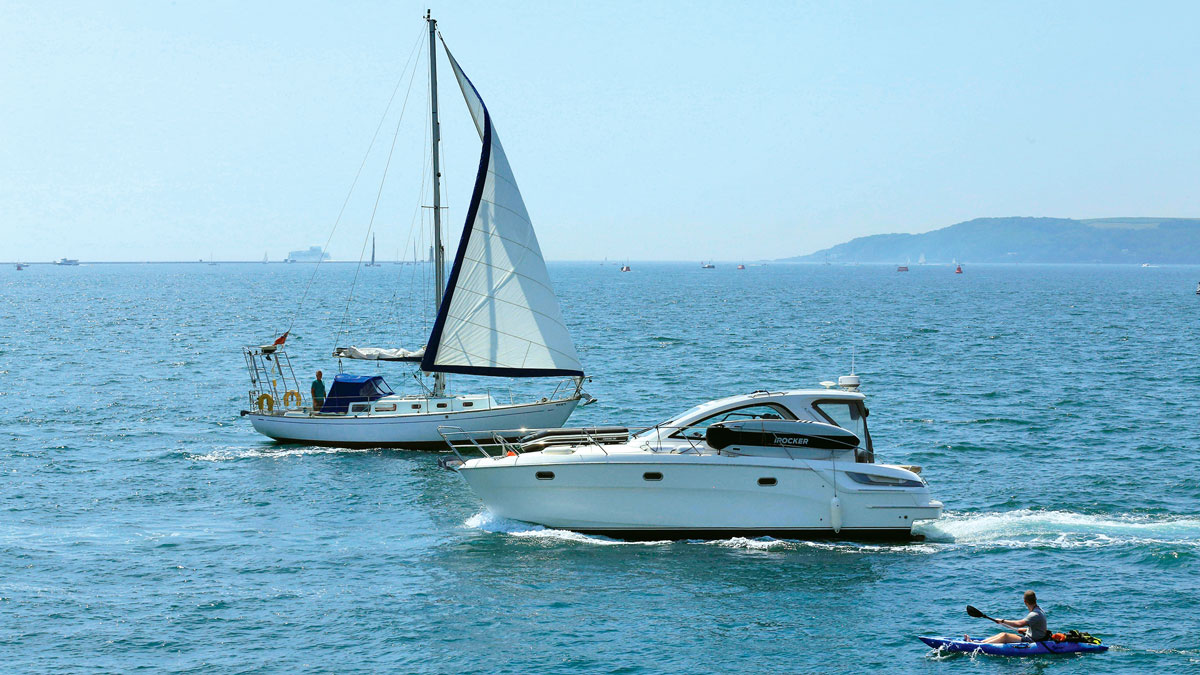
Avoiding boat collisions: understanding COLREGS
If you’re at the helm, can you spot a risk of collision with another boat? Do you know when to…
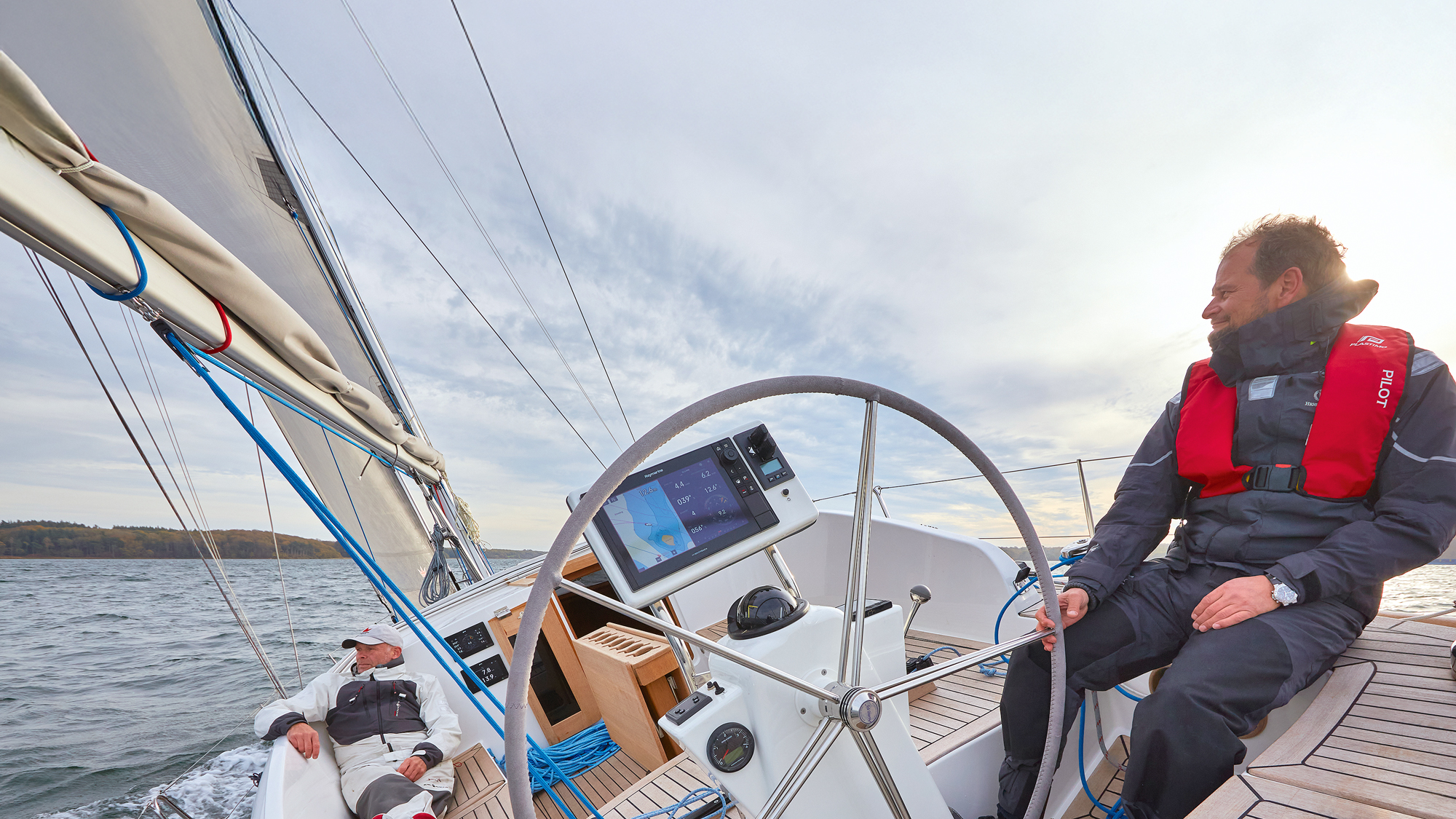
Get the most out of your chartplotter with these setup tips
How often do you stop and really sit down with your chartplotter? Navigators are necessarily tunnel visioned once under way:…
6,000 miles solo in a £1 boat: lessons learned from an Atlantic Circuit
The wind was coming on like my brother Alex had warned me it would, as I approached the north side…

How to sleep sailing shorthanded
John Apps stresses the importance of sleeping sufficiently on long-distance single-handed passages, and explains how to snatch safe naps without…
What to read more seamanship articles like Practical ColRegs for cruisers?
A subscription to Practical Boat Owner magazine costs around 40% less than the cover price.
Print and digital editions are available through Magazines Direct – where you can also find the latest deals.
PBO is packed with information to help you get the most from boat ownership – whether sail or power.
-
-
-
- Take your DIY skills to the next level with trusted advice on boat maintenance and repairs
- Impartial, in-depth gear reviews
- Practical cruising tips for making the most of your time afloat
-
-
Follow us on Facebook, Instagram, TikTok and Twitter