



Nick Tyler takes the guesswork out of broadcasting fog signals

Rule 35 of the Colregs requires that a vessel in restricted visibility (fog, smoke etc) should sound its fog horn in specific patterns every two minutes depending on its current status. And although the rule is only strictly applied to vessels over 12m, it also says that smaller vessels should make some kind of noise every two minutes as well.
My friend and I were discussing this in a local hostelry one cold winter’s night, and we both wondered about the practicality of this. He has a 28-footer that he regularly sails single-handed, and my wife and I are new to this sailing lark, and weren’t quite sure what to do with one of those aerosol horns beloved of football fans when we found it in the locker of our first boat.
In fog, we wondered, why would a skipper want to stand with a stopwatch in one hand, and an air-horn in the other, while peering into the mist trying to find their way to safety? Surely there has to be a better way?” My friend wondered if a small processor and relay could be used to automate the horn. You can buy something that does roughly this, but being PBO readers, we’d rather make it ourselves and save our money for more important things, like sails.
I’d spent three years designing electronics in 12V automotive lighting and am also quite familiar with the Microchip family of microprocessors, so rather rashly I told my friend I could knock him up a prototype in a couple of weeks. We decided we should put the relay in a ‘magic box’ which could be screwed to an inner bulkhead. Our magic box also had to have a four-position rotary switch to represent the four cases suitable for a vessel under 12m in restricted visibility.
- Manual – the box would not sound the horn, but the skipper might choose to.
- Motoring – sound one long blast
- Sailing – sound one long and two short blasts
- Drifting* – sound two long blasts *The actual wording is ‘under way but not making way’. We figured ‘drifting’ probably covers it without being too technical.
There’d be two terminals for power in (red) and battery –ve (black), and two relay terminals to control the horn. The 12V power should come through a circuit breaker on the distribution board, and the relay terminals could, if necessary, be wired to a separate, dedicated, high-current circuit. Also, the relay terminals should be wired in parallel with a ‘big red button’ near the helm, so all the other sound signals that may be required at times can be made.
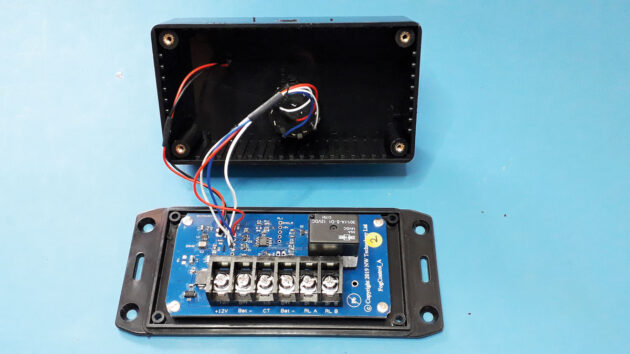
The printed circuit board made up and connected to the switch. Credit: Nick Tyler
But then it occurred to me that fog horns are very loud, and therefore power-hungry. The appendix in the Colregs suggests that fog horns for small boats should be around 115dBA (about as loud as a police siren). A quick web-search of available ‘boat horns’ turned up current ratings between 4A and 25A, which means a big relay, heavy-duty wires and some meaty way of attaching the wire to the relay terminals.
So the size of the relay and terminals came to dominate the size of the box. I found it would all fit quite nicely into a Hammond 1591CFLBK, which is a nice black plastic box complete with flanges, perfect for bulkhead mounting – though it’s not watertight. It was then a matter of designing a circuit board to go in the box. The logical circuit was fairly simple; then all that remained was to make one.
Although it would be quick and simple to make this circuit from strip-board, I was able to draw it properly onto a printed circuit board, and ordered the boards at £5 each from a prototype supplier. They came in a week from the other side of the world. I had to put all the parts on the bare boards myself, though – which took an evening.
Easy Software for a DIY fog horn
Meanwhile, I wrote the software which was almost laughably simple. The processor (Microchip PIC12F1572) has a built-in oscillator, which is not very accurate but more than good enough for our purposes. Using the free Microchip Code Configuration tool, a regular tick-timer was implemented, which generates an interrupt 10 times a second.
The interrupt sets a flag, and the processor spins forever waiting for the clock to go ‘tick’. When it sees the tick has occurred, the processor ‘knows’ that 100ms has passed and it is therefore time to update the two-minute counter. The switch position is checked on every tick, and the number of ticks is counted to make the various horn intervals.
After two minutes’ worth of ticks, the counter resets, and it all starts over again. Fortunately, these tiny microprocessors do not get bored, go to sleep, get seasick, drunk or otherwise fail to do what they’re asked. All in all, it was about four days’ work over, two weeks and a total cost of around £30 each. I made one for me and one for my friend, so now all we have to do is find an old horn in a boat jumble…

Sailing in fog: tips to keep you safe
Fog looms large as one of the things sailors most fear – but circumstances mean it often can’t be avoided.…

Trapped in thick fog with my 8-year-old daughter whilst on passage to France
Navigating through fog is frightening. At 91 years of age my sailing career is over, but I can’t grumble as…

Blind navigation: how to find your way in restricted visibility
Is blind navigation a foggy notion for Yachtmasters, or a useful seamanship skill? PBO investigates

Tidal races, overfalls, and headlands: how to prepare for challenging waters
Sailing around a headland in the British Isles will nearly always involve an encounter with tricky tidal races and overfalls,…
Want to read more articles like DIY automated fog horn for £30?
A subscription to Practical Boat Owner magazine costs around 40% less than the cover price.
Print and digital editions are available through Magazines Direct – where you can also find the latest deals.
PBO is packed with information to help you get the most from boat ownership – whether sail or power.
-
-
-
- Take your DIY skills to the next level with trusted advice on boat maintenance and repairs
- Impartial, in-depth gear reviews
- Practical cruising tips for making the most of your time afloat
-
-
Follow us on Facebook, Instagram, TikTok and Twitter