


Paul Hayes is shaken by a shakedown sail in the Bristol Channel when his junk-rigged Coromandel springs a leak, loses its mast and suffers a snarled prop
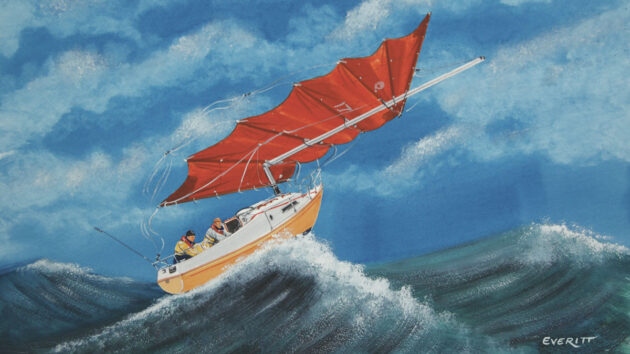
It was the start of our club summer cruise and my first command as skipper of the magnificent junk-rigged Coromandel, Missymoto. The shakedown sail came after I had spent the last year getting her ready.
Alongside the rest of the club flotilla – six cruisers, two Wayfarers and a couple of Luggers – we slipped out of Lydney Docks in the half-hour window provided by the racing water of the upper Bristol Channel and into the top of the tide.
It was a lovely early morning in July for our shakedown sail, a faint mist being burnt away by the rising sun. The plucky Wayfarer sailors whisked away while the cruisers of various shapes and sizes set sail to catch what little wind was available and began to make way. We set our fully battened rig and gracefully went backwards, failing to stem the tide.
The rest of the fleet disappeared towards the Severn bridges. I was perfectly content, bobbing about in my own boat on our shakedown sail; however, my crew, Martin, being of the breed of rufty-tufty dinghy sailor used to sitting on boats at an acute angle, was becoming restless – so the engine was called into action.
We chugged off, and with the help of the now ebbing tide were soon waving to the puzzled harbour master at Lydney Docks, who had thought he’d seen the last of us an hour before. We caught the tail end of the fleet and probably looked the part even though we owed our position entirely to the motor, which in the outboard well was conveniently invisible to the casual observer. We were headed for Cardiff, 35 nautical miles away.
As the tide picked up speed outside Portishead, so did the wind: the sea became lumpy. This made for an uncomfortable time with a following sea pushing us along, but the situation rapidly deteriorated into intensely horrible as I looked into the cabin and realised I could see the Bristol Channel. My beautiful boat was filling with water… we were sinking!
I leapt below and began bailing out with bucket and pump. Martin started the engine again and turned back towards Portishead and out of the tide into calmer water, where we could drop anchor and work out what was wrong. The action of starting the engine revealed the cause of the crisis – a repair on the engine bulkhead by a previous owner had been blown away by the following sea, and water was pouring through to the bilges and into the cabin. The ‘repair’ looked as though it was a patch held together by gaffer tape.
We anchored up, and after 20 full buckets of muddy water had been disposed of, the boat was dry again. We spent the night in Portishead Marina and, with the aid of a thick plastic patch cut from a spare water container, Martin made a Sikaflex sandwich reinforced with nuts and bolts so we were watertight again.
In company with another of our flotilla who had spent the night in Portishead, we made it across to Cardiff and rejoined the fleet. They had had a hard time of it, especially the Wayfarers who had endured eight hours of tough sailing, so we kept our tale of derring-do to a minimum.
The continuing unkind weather meant that the next day, we were only able to edge across to Barry and prepare for a voyage over to Somerset, aiming for Watchet. As usual we were last, and as we drifted past a dinghy club we had to endure the annoying experience of being treated like a kind of exotic racing buoy as they whizzed around us taking photographs. We affected the aloof gaze of sailors heading for far horizons, and then plopped into the welcoming mud of Barry Harbour.
Next morning was set fair and we drifted toward Watchet, enjoying the sunshine and continuing our familiar role as vanguard to the fleet. As we settled into the splendid marina of Watchet Harbour the wind picked up overnight and we were trapped for two days, but the sun remained so we lounged and did the things one does on club cruises.
A decision was then taken by those in charge: conditions were improving so we would make for Cardiff as we were to start our return to Lydney the next day. And so, on a sunny Thursday morning, we sailed out of Watchet’s warm embrace and into a horrid, lumpy sea.
For the first time the wind was on our quarter, not on the nose, and we were flying along – 6 knots through the water, and more! We were gradually gaining on the fleet. Our beautiful Chinese tan sail filled the horizon, and a warm glow filled my heart.
As we plunged down yet another trough and rose to meet the wind, the horizon suddenly appeared bright and clear. I must have blinked, and in that split second, the mast had snapped clean off and disappeared over the side to starboard, taking the sail and rigging with it.
My incomprehension was rapidly overtaken by the need to secure the boat, which was now chucking us and everything below all over the place. Martin clawed back the rigging, sail and mast, and together we secured it to the coachroof. Nobody was hurt: we were just a few miles south-west of the island of Flat Holm, about five miles from Cardiff, the boat itself was sound and the engine would see us back.
A Prop Snarled By Rigging
She started first time – a lovely sound – but when I put her into gear, she stopped. She started again, I put her into gear and she stopped again – this time permanently. A junk rig has lots of rigging: we had failed to secure it all and had now snarled the prop. We would have to cut the remaining rogue rigging.
Martin’s knife was inaccessible beneath his foul-weather gear and lifejacket, while mine was somewhere in the chaotic pile below. However, in a pocket by the sink was a pair of nail scissors: with these, three rigging ropes were parted from the prop, but enough remained to keep the prop locked. We now had no steerage in a lumpy sea with a stiff wind blowing us on to Flat Holm. I called the Swansea coastguard and explained the situation. They said they would deploy the Barry lifeboat. Could I give them our position?
I paged through our handheld Garmin GPS, but instead of displaying our position the screen showed a low-battery warning. The coastguard asked again as I played for time. I switched it off and back on; thankfully, the warning disappeared and the GPS position declared itself. As laconically as I could manage, I revealed where we were.
The Barry lifeboat was a welcome sight, and it’s impossible to thank the crew enough – they could not have been kinder. I went forward as instructed to receive the messenger line, the precursor to a larger, stronger, hawser-like rope. Luckily, I caught it first time and hauled the tow rope on board to attach to a cleat.
This was followed by the drogue anchor, which was duly passed to Martin to be deployed when instructed to stop us fizzing about while under way. Even so it was a bit of a wild ride, but we were towed safely into the approaches to the Cardiff Bay Barrage and met by Pete, a fellow member of Lydney Yacht Club, on his boat.
He towed us into the lock, presented us with a welcome glass of ‘a thing most needful’, then continued the tow into the Cardiff Yacht Club moorings, the cheering line-up of the rest of the fleet. I’m not sure if they were cheering our safe arrival or the fact that our shakedown sail was over and they wouldn’t have to wait for us any more.
We still had the dispiriting task of bringing a mastless boat back home – 50 miles via Bristol Docks, under engine. The mast was subsequently welded and repaired, and Missymoto now sails off the South Coast.
Lessons Learned from our disastrous shakedown sail
- Check old repairs. The engine bulkhead repair was a disaster waiting to happen. The mast had a circular score mark around it which I had noticed, but to which I paid no attention. That is where it snapped clean off.
- Understand how your engine works. I had no idea about shear pins – I do now!
- Sailing knives are useless beneath layers of clothing or buried in the cabin. They must be immediately accessible.
- All navigation and communication equipment must be constantly checked and spare batteries must be readily to hand when needed

Coping with a dismasting & rig checks
Faced with a sudden dismasting in 40-knot gusts, Rupert Holmes explains how he and his crew saved his boat, and…

Fouled propeller fix: top tips for solving the problem at sea
What should you do when you catch a line or fishing net and your prop becomes fouled? Ali Wood looks…

Boat towing: lessons learned from assisting a dismasted yacht in the Atlantic
Ali Wood meets the ARC+ crew who battled squalls and rough seas to tow a dismasted yacht to safety

Dismasted on a delivery trip: How we fixed it and lessons learned
Rob Crabbe recalls the rig of a new yacht breaking on a delivery trip from Dartmouth to the Southampton Boat…
Want to read more articles like ‘We were sinking, mastless, and adrift’: The crucial lessons learned from my shakedown sail?
A subscription to Practical Boat Owner magazine costs around 40% less than the cover price.
Print and digital editions are available through Magazines Direct – where you can also find the latest deals.
PBO is packed with information to help you get the most from boat ownership – whether sail or power.
-
-
-
- Take your DIY skills to the next level with trusted advice on boat maintenance and repairs
- Impartial, in-depth gear reviews
- Practical cruising tips for making the most of your time afloat
-
-
Follow us on Facebook, Instagram, TikTok and Twitter