


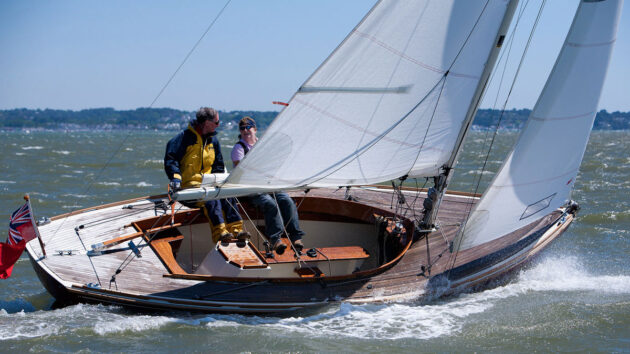
With her centreboard, big cockpit and inboard engine, the classic-lined Tofinou 7 is a stylish and versatile day-sailer. David Harding reports
Tofinou 7: a French tradition

There are plenty of eye-catching traditional dayboats sailing in rivers, harbours and estuaries around our coast. Many of them have a long and fascinating history, having evolved to suit local conditions or to fulfil very specific roles, and are unlike anything built since.
Just look at some of the classes that race so enthusiastically in Cowes Week, for example, such as the Daring, Redwing, Victory, Sunbeam, Swallow and, of course, the X One Design, which celebrated its centenary last year with 145 boats on the entry list.
These classes, and others unique to local areas, are part of our maritime heritage. Britain wouldn’t be the same without them.
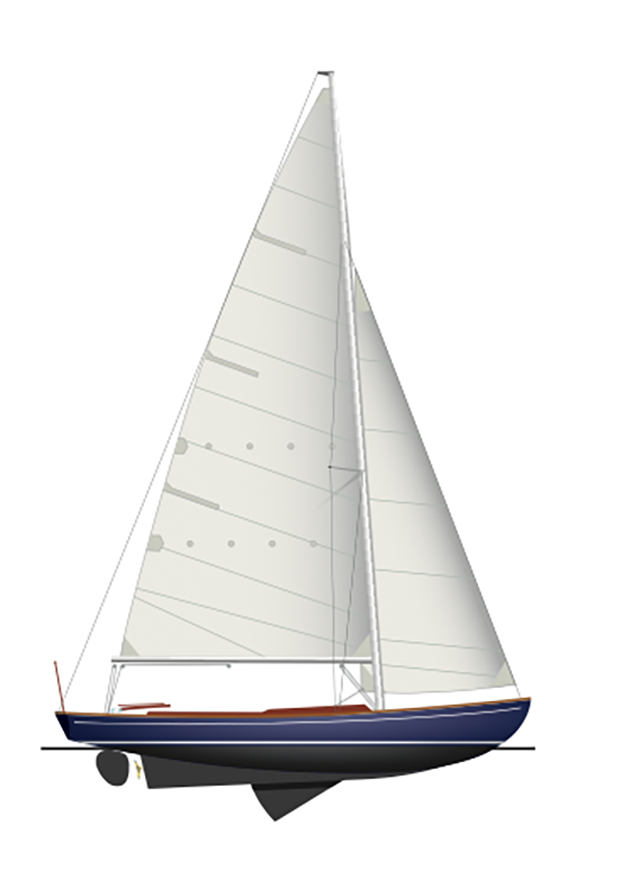
Tofinou 7 side view
At the same time, venerable old ladies like this aren’t always the most practical of craft for the owner who wants a multipurpose dayboat. They tend to be of traditional, painted-timber construction, often with wooden spars as well. Some are slow by modern standards, though that has no bearing on the competitiveness of the racing.
Stowage and shelter can be limited, keels fixed, and, if the wind dies, you need to paddle or get a tow home. In short, someone who doesn’t enjoy scraping, painting and varnishing (or paying someone else to do it) might not find themselves drawn to these wooden classics, especially if they have no desire to race in a One Design fleet.
What’s the point in buying something that’s wet and slow, that draws as much as a cruising yacht, and that doesn’t even have an engine?
The case of the Tofinou 7
Plenty of people share this view. That’s why some of these designs have spawned glassfibre variants that are true to the original, either in detail or in spirit. Let’s say, for example, that you like the XOD but fancy something a little bigger.
You would prefer a centreplate so you can slip over the shallows, anchor off the beach and paddle ashore, or dry out if the mood takes you.
A small inboard would be handy so you can go a bit further without worrying about getting home again: it would make all the difference if you could chug along at 5 knots at the press of a button. Some dry stowage would be good and, if there was room for a couple of people to sleep under a cockpit tent, you could even head away for the occasional weekend.
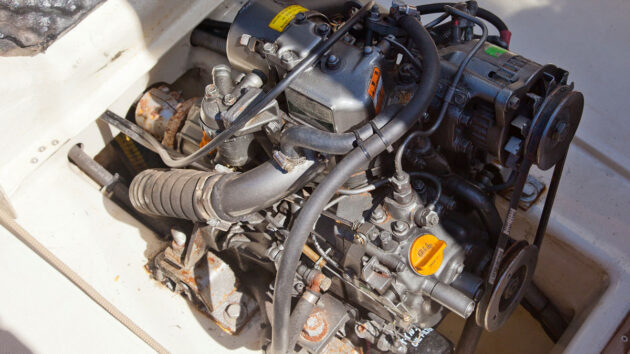
Inboard power is provided by the single-cylinder Yanmar diesel. Credit: David Harding
At this stage, it’s taken as read that you favour the traditional approach and don’t have sizzling performance at the top of your priority list – though you like boats that sail properly and, if you happened to come across one or two others, there’s no guaranteeing that you wouldn’t be tempted to indulge in some friendly racing.
So, what’s on offer? One obvious candidate is the Tofinou 7. Unfortunately, if you’re a supporter of what remains of the British boatbuilding industry, she’s French.
On the other hand, she’s in very much the same vein as some of the British offerings and is based on a one-off built on the Île de Ré in 1929. It wasn’t until 50 years later that Philippe Joubert decided to take a mould off the hull; then one thing led to another, and now hundreds of Tofinous are sailing in France, Belgium, Spain, Italy, Switzerland, Britain and elsewhere in Europe.
They still congregate on the Île de Ré for the Blue Wind Cup, an event that regularly sees 40-plus boats dried out on the beach or anchored a few yards offshore between races.
Gallic style of the Tofinou 7
With an overall length of 7m (23ft), the Tofinou 7 weighs 1,300kg (2,566lb) and can be trailed behind a large family car or a 4×4.
Raising the galvanised steel, wedge-of-cheese-shape centreplate reduces her draught from 1.1m (3ft 7in) to 0.5m (1ft 8in), so she will sink into the mud or sit happily on a beach at a few degrees of heel. The cockpit is large, there’s room to sleep on the sole boards either side of the centreplate case, and kit that needs to stay dry can be stowed in the compartment beneath the foredeck.
At the other end of the cockpit, opening the locker beneath the aft deck reveals the fuel tank, battery and more stowage. This is a very nicely finished boat by any standards.
The owner of the eight-year-old example I sailed assured me that the immaculately varnished mahogany trim hadn’t been touched since the boat was built. Although the timber gives the boat a pleasantly woody feel, there’s not a daunting amount of it – just enough to give the varnish brush some exercise now and again.
The teak decks also add a touch of class and help explain why this isn’t a budget-priced boat.
Satisfying sailing
As you would expect, the Tofinou’s behaviour is thoroughly gentlemanly under sail. In a gusty 15-22 knots of wind in Poole Harbour, we dropped a slab in the main and made upwind at a comfortable 4.5-5 knots, provided we sailed reasonably ‘full and bye’: as with many boats with long shallow keels, it’s no good trying to point into next week.
The rudder stayed pleasantly light, and we took remarkably little spray on board. Most surprising to me was her sensitivity to fine-tuning and weight distribution: every tweak of the sheets had an effect, and she most definitely liked the crew weight in the right place.
Although the 380kg (840lb) of lead in the bilges makes her reassuringly stiff and she’s simple to sail single-handed, there’s no substitute for sitting on the high side when it comes to developing power on the wind. That’s why Tofinous normally race four-up.
Downwind, we raised the plate – it’s a gentle tug on the lifting line – but there weren’t any XODs trying to follow us across the shallows and finding they couldn’t make it, as has been known to happen. Another way to reduce drag, upwind or down, would be to line up the two-bladed fixed prop behind the deadwood. If you’re not racing in class, go one better and fit a folder.
Classy kit
Everything on the Tofinou 7 looks well specified and solidly put together: there’s a chunky Samson post on the foredeck, plus a bow-roller and a couple of fairleads. A 2:1 purchase makes it easy to hoist the mainsail, and the jib (with its 2:1 sheets to obviate the need for a winch) rolls away on a Bartels furling gear.
Access to the engine is simple: hinge back the box and you can get all round it. The fiddled, teak-covered box top doubles as a handy table or a foot-brace for the helmsman.
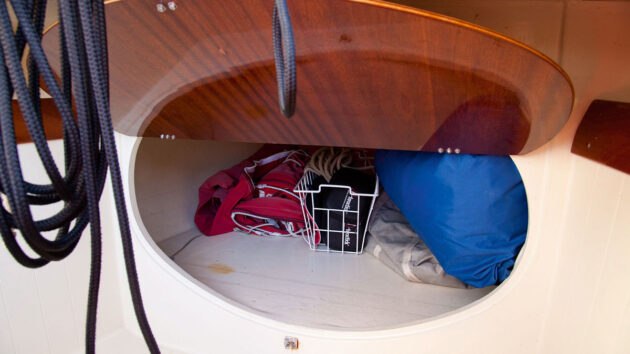
The space under the foredeck provides ample dry stowage. Credit: David Harding
Mouldings form the box itself and much of the structure inside the hull. The minimal amount of hardware is generally modern and efficient.
Evidence that the traditional and modern can work side-by-side is the cluster of belaying pins at the foot of the mast next to the stainless steel Andersen winch.
PBO verdict
You can buy boats that are bigger, faster and less expensive than the Tofinou 7, but that’s not the point.
Here you have a stylish, practical, nicely built and well-established dayboat-cum-weekender that’s perfect for exploring harbours and estuaries and hopping along the coast in reasonable weather.
She could have been designed for places like Poole and Chichester: sometimes what works on one side of the English Channel seems to work just as well on the other, and the Tofinou 7 is a prime example.
Details
LOA:7m (23ft 0in)
Beam:2.25m (7ft 5in)
Draught - plate up:0.5m (1ft 8in)
Draught - plate down:1.10m (3ft 7in)
Displacement:1,300kg (2,856lb)
Ballast:380kg (838lb)
Sail Area:24.4sq m (263sq ft)
RCD Category:C
Engine:Yanmar 9hp diesel