


The Corsair Dash 750 promises speed around the cans on the race course but is this trimaran suitable for those who spend most of their time day sailing and weekending too? David Harding went to find out
Corsair Dash 750: Can a folding trimaran beat high-performance monohulls?

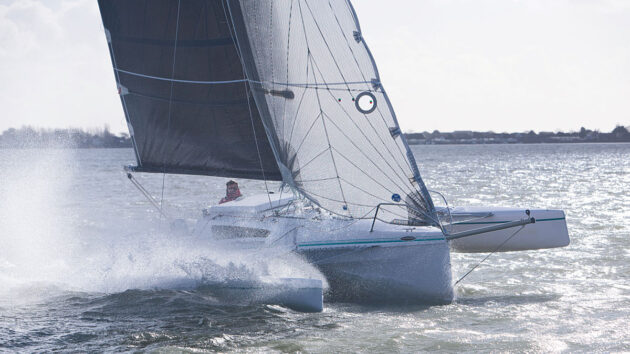
As the number of trimarans around our shores increases – thanks in no small part to the success of Corsair and Dragonfly – more people have an opportunity to see what three hulls can do. For some, this might mean reassessing preconceptions. Trimarans don’t go to windward, right?
Wrong! While out on a photographic mission in my RIB, I coincided with the end of a race from Cowes to Poole. It was blowing around 20 knots from the south-west, so the fleet – which included an Elan 40, an X412 and a J/109 – had been hard on the wind all the way down the Solent and across Christchurch and Poole bays.
Which of these efficient, well-designed and well-sailed monohulls was first home? None of them, because about 20 minutes in front was a Farrier F31 trimaran sailed by a husband-and-wife team. Three hulls and two people had sailed the rest of the fleet into a cocked hat.
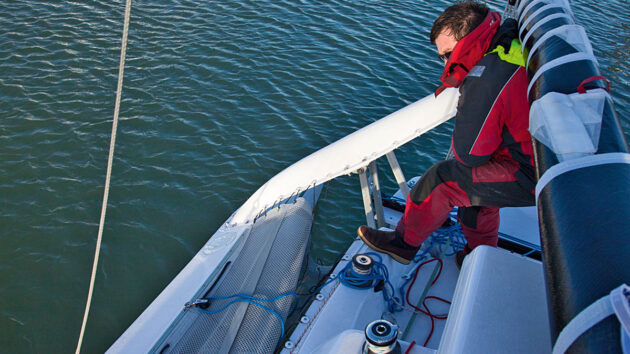
Folding the floats in, alongside the main hull, is quick and easy. Credit: David Harding
So we now know they can go upwind, but surely small trimarans are no good in rough conditions and open water? A Norwegian team have previously chosen a Corsair 31 for their successful circumnavigation of the globe on the Arctic Ocean, taking in the Northeast and Northwest passages and the Bering Strait in one season. The Corsair was selected as the only suitable boat fast enough to make it during the short Arctic summer before the ice closed back in. She could even be hauled ashore to avoid the pack ice when necessary. Try that with a heavy, deep-keeled monohull.
Fast and flat
When you’re skimming along effortlessly at double-figure speeds, leaving barely a ripple on the water, it’s sometimes hard not to wonder why the vast majority of people still sail around in boats that go upwind at five or six knots on a good day and are kept not-very-upright by a lump of lead or iron on the bottom (and, in the case of race boats, by the efforts of a crew hiking on the weather rail).
I do a lot of racing in boats like this and as a challenging, absorbing, competitive and sociable sport it’s hard to beat. In terms of efficient use of wind-power and people-power, however – well, it’s best not to think about it.
One of the great things about sailing is the amazing diversity of boats. All (well, perhaps not quite all) have their place, including those with one hull – monomarans, as I sometimes call them. I just happen to believe that sporty multihulls, such as the Corsair Dash 750, deserve a much bigger place than they currently have. And before anyone says that they need a big place because they’re so wide, don’t forget that they can be folded in a matter of minutes so their beam comes down to no more than that of a monohull of the same length.
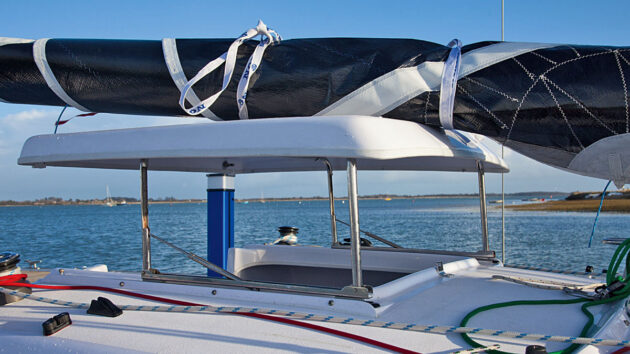
A pop-top provides standing headroom at the aft end of the saloon. Adding a sprayhood offers more protection. Note the mainsail rolled around the boom. Credit: David Harding
To find out more about the Corsair Dash 750, I went out on an occasionally bright and decidedly breezy day in Chichester Harbour. We were about to set off when a jet-black sky heralded the arrival of a squall, so we waited for it to pass and saw later that Cambermet had recorded a peak of 37 knots.
With the squall moving off to the east, we headed out from the marina into a wind that was hovering in the low 20s and gusting to just shy of 30 knots on occasions. Although our plan had been to spend most of the time in the harbour given the forecast, it seemed a shame not to see how the Dash would cope in more open water, so we started by beating out of the entrance and down the channel to the beacon on Chichester Bar.
It was fine, if perhaps approaching the upper end of what was sensible under full sail. We made upwind through the chop at between 6.5 and 8 knots, the speed increasing rapidly in the flatter patches and if I sailed a few degrees lower. The motion was surprisingly comfortable, the three fine bows slicing cleanly through the waves and throwing minimal spray aft. Most of the water that hit us came up through the trampoline, but then we were both sitting on it. We could have stayed in the cockpit to keep dry.
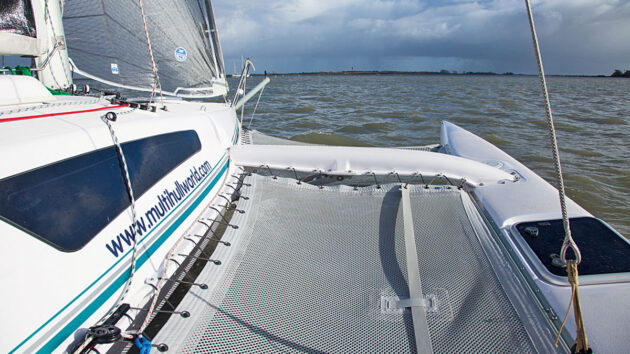
View from the helm: you can steer from the windward trampoline. Credit: David Harding
Tacking was more positive than I had expected in those conditions, the compass indicating an angle between tacks of around 90° although that was very approximate because our focus was outside rather than inside the boat. A draught of 1.9m (6ft 3in) with the daggerboard fully down gives a good pivot point and plenty of bite upwind.
After a few tacks we turned downwind and scorched back up the channel at 15–17 knots. In a monohull the waves would probably have helped. In the Dash we reckoned they were slowing us down, and that proved to be the case. In the flat water inside the harbour we wound the boat up a little harder and went through the 18-knot barrier. With both of us on the windward trampoline we couldn’t watch the log or spare any hands for the hand-held GPS, but we recognised the 18-knot buzz.
Cutting a Dash
With the south-westerly wind being perfect for high-speed reaches in the Emsworth Channel we couldn’t resist the temptation to enjoy a few blasts up and down. Then we saw another squall approaching and, thinking it better not to be caught in 37 knots with everything up, elected to drop the main until it had passed.
As the centre of blackness appeared to be heading for the mouth of the harbour, we beat (or rather reached) a retreat towards Emsworth. The edge of the squall still managed to hit us while we were rolling the main away around the boom and we found ourselves outside the channel, ploughing a furrow through the mud. A quick gybe and a tug on the daggerboard’s lifting line got us going again, around the corner and tacking up towards Hayling Bridge.
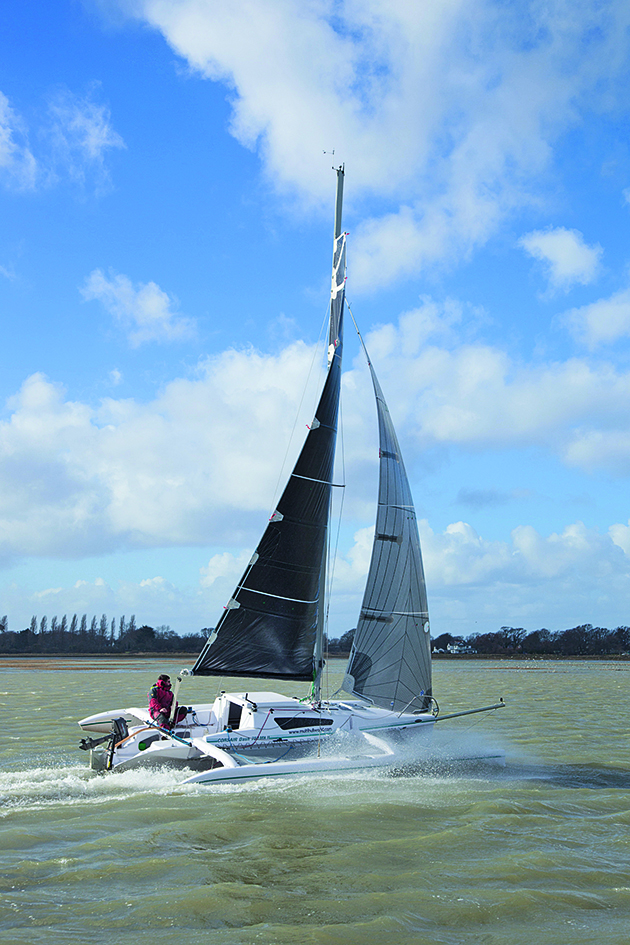
The Corsair Dash 750 is RCD Category C. Credit: David Harrding
So here was a trimaran, under jib only and with the daggerboard partially down, short-tacking up a narrow channel through moored boats in 25 knots of wind. Who says trimarans lack manoeuvrability?
After the squall we left a few rolls of the main around the boom while I jumped into the RIB to take the photos. Then I hopped back aboard and we ran downwind so as to give ourselves some proper upwind testing under full sail again.
The most noticeable feature was the way the boat accelerated from 7 knots to 9.5 knots on the wind given the slightest gust or change in apparent wind angle. It would be useful to sail with another similar boat to work out the best angles for optimum VMG. Be that as it may, she was enormous fun and highly responsive. Then we reached up the channel in the lee of Thorney Channel towards Thornham Marina, the two of us no longer even trying very hard yet clocking an effortless 12-14 knots most of the time. It felt as though we had come to a standstill if the log dropped into single figures.
Detailed design on the Corsair Dash 750
The most important thing about the Dash is the way she sails. If a boat is designed to perform and doesn’t, there’s little point in looking at any other aspects of her design.
Doing justice to the other aspects would take far more space than we have, so we can only canter through them here and say that she has a daggerboard rather than a centreboard because Corsair prefers the simplicity and ease of maintenance: remove the baseplate under the mast step and the board lifts straight out. Being swept aft, it will come up if it hits the bottom at a gentle pace. At speed, it wouldn’t. The rotating, wing-section alloy mast is supported by diamonds and by Dyneema shrouds swept back to a point on the floats roughly midway between the cross-beams (‘akas’ if we’re speaking tri). The rig is made in-house, at the yard in Vietnam, and can be lowered by one person in about 15 minutes.
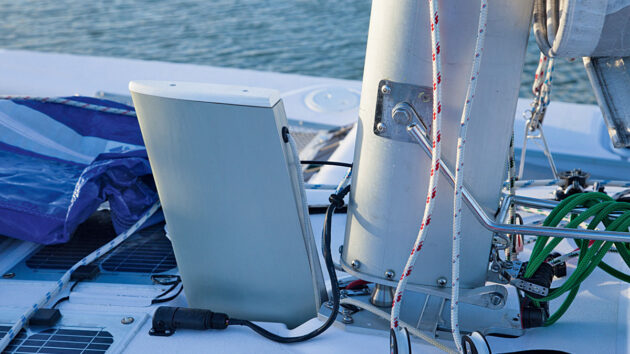
The base of the rotating mast and the top of the daggerboard. This just shows half the board’s chord – it’s roughly double what’s seen here. Credit: David Harding
Unlike the Dragonflies, with their floats that rotate about a vertical axis and swing forward to reduce the beam (thereby increasing the boat’s overall length), those of the folding Corsairs tuck in alongside the main hull by rotating about a horizontal axis: they move downwards and on to their outer sides, lifting the main hull out of the water an inch or two and providing plenty of form stability for motoring even with the rig raised in breezy conditions. It’s a beautifully engineered and extremely quick and easy system to operate.
This way the overall boat-length remains the same but the outsides of the hulls are in the water, so will need antifouling if you keep the boat folded in a marina. It’s reassuring that both the heeling force and the tension in the shrouds place the folding mechanism in compression to hold the floats in their sailing position. The securing bolts do very little work.
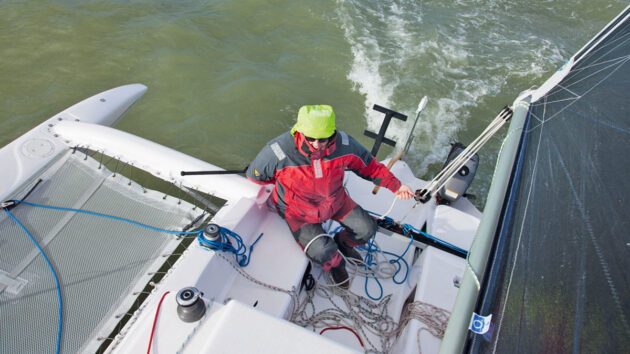
Steering from inside the cockpit. Credit: David Harding
One interesting point about the hardware elsewhere – which is generally up to spec apart from the underpowered 2:1 mainsheet traveller – is the absence of cleats. Except on the bow, D-rings are used for the mooring lines. They’re probably lighter and more economical, but they make life more fiddly. I wonder whether the principal reason for their use is that nothing can catch on them.
Inspection hatches in the floats allow you to reach the bolts securing them to the cross-beams in case they ever need to be detached. In between, a Lewmar deck hatch gives access to the space in the centre of the floats that’s useful for stowing warps and fenders. Other kit can be stowed in the open-fronted lockers in the cockpit, the aftermost of which are handy for petrol tanks. A 5hp outboard is more than adequate in most conditions.
Accommodation on the Corsair Dash 750
Features included a pop-top to give standing headroom aft, a galley that slides out from under the cockpit to port, four full-length berths with a heads under the starboard side, and reasonable stowage.
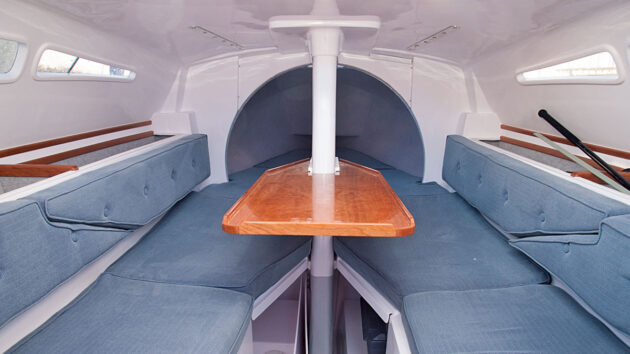
The accommodation isn’t exactly luxurious, but provides all the basics. Credit: David Harding
A typical monohull of similar length would offer more, but that’s a price you pay for sailing upright and getting home in half the time – or sailing for the same time and going twice as far. If this is too much in the way of luxury, you can choose the Sprint 750, which is essentially the same boat but with just two berths beneath a blister coachroof.
Verdict on the Corsair Dash 750
I wasn’t surprised to hear that, in a major regatta, a Corsair Dash 750 sailed by a crew of three completed the course in every race faster than a brand new 12.8m (42ft) full-on racing monohull with a professional crew.
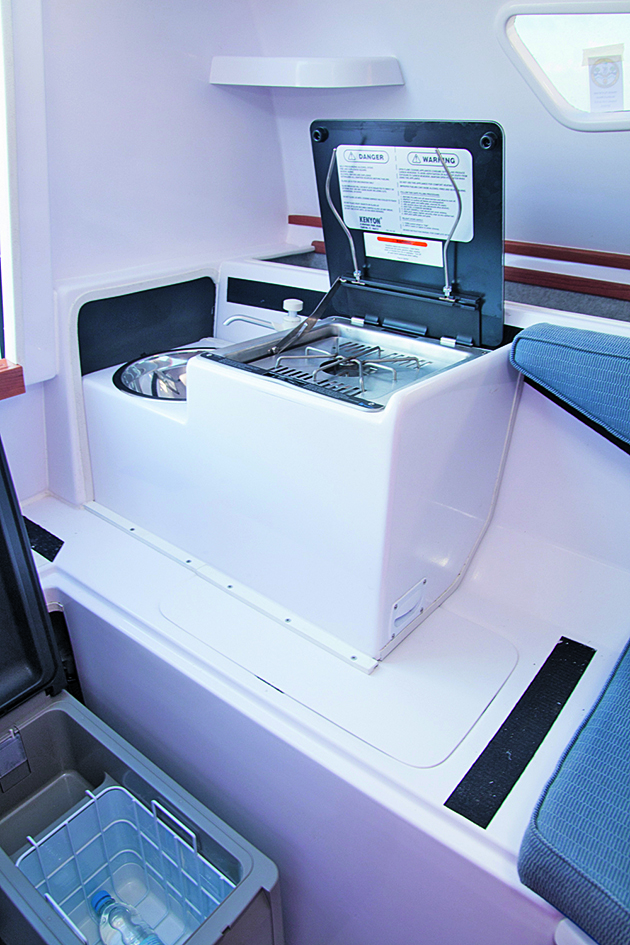
The galley slides out from under the
port side of the cockpit. Credit: David Harding
The Dash was then hauled onto her trailer, de-rigged and taken back home that evening. The next day, had the owner wanted, she could have been cruising with her partner in another part of the country. Makes you think, doesn’t it?
Details
Price when originally launched:From £56,500
LOA:7.39m (24ft 3in)
Beam (sailing):5.46m (17ft 11in)
Beam (towing):2.50m (8ft 2in)
Draught - centreplate up:0.30m (1ft 0in)
Draught - centreplate down:1.90m (6ft 3in)
Weight:875kg (1,925lb)
Sail area (main and headsail):38.18sq m (411sq ft)
Engine:4-8hp outboard
RCD Category:C
Designer:Corsair Marine