


Choosing the best inflatable can be tricky, but the catamaran-style Aircat 285 promises to offer a stable, high-performance alternative to traditional designs. Jake Frith put it to the test
Aircat 285: does this inflatable tender offer a stable, high-performance alternative to traditional designs?

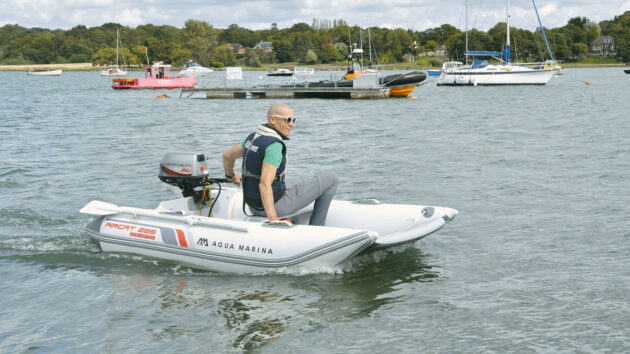
Many cruising sailors have very strong feelings about inflatable tenders, and I’m no different. For those of us on a swinging mooring, our tender is usually both the first and last boat we spend any time in for any given sailing trip, giving it a disproportionate leverage when it comes to making or breaking a weekend on the water. The Aircat 285 and its larger sister, the 335, look like a very new shape in the inflatable tender market.
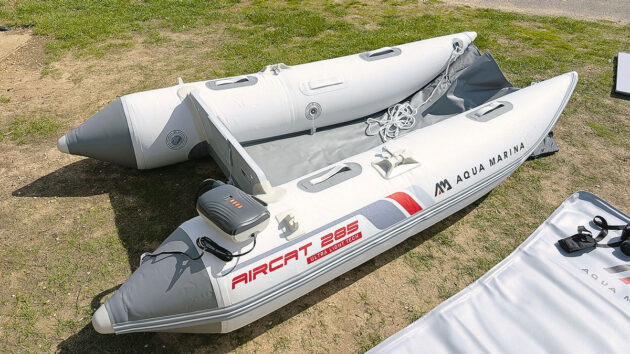
The 285 was easily inflated with a battery-powered pump; a hand stirrup pump comes as standard. Credit: Jake Frith
With a silhouette something like that of a racing Zapcat, these attractive craft combine what looks like excellent on-beach loading possibilities from the low landing craft style bow, along with the promise of higher performance than we’ve come to expect from more traditional designs.
Inflating the boat was easy, particularly with the Meridian Zero NRG battery-powered pump rather than the supplied hand stirrup pump. The tubes are split into two compartments on each side and the floor is a separate, higher-pressure dropstitch compartment, providing lots of buoyancy in the event of one punctured compartment.
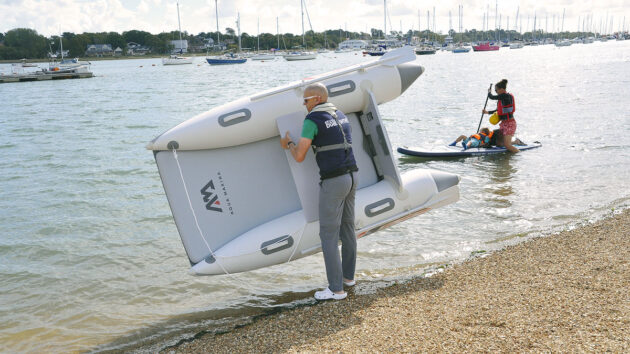
At 30kg, the 285 can be easily carried to the water. Credit: James Turner
Like all these kinds of boats, we started by inflating the main tubes until they looked like almost the right shape, but pretty flaccid, then inflated the floor in place to half pressure, then topped off the main tubes to their recommended pressure, finishing by topping off the floor to full pressure.
Despite a lack of inflation instructions, this resulted in a board-stiff, but pleasingly lightweight boat with no creases or overly stressed-looking joints. With no outboard, the boat at 30kg was light enough to sling over one shoulder and walk with it 30m into the water.
How well does the Aircat 285 row?
While almost nobody rows an inflatable boat anywhere, ever, rowing them is always the first thing I try. Even modern outboard motors can’t be expected to deliver faultless reliability.
The Aircat 285 is rowable. Just. But the bar on this is quite low, as some modern rubber ducks are almost impossible to row. Designers seem to make the common mistake of adding a solid (plank-type) thwart that sits too high atop the tubes. This places the rower’s backside at very much the same height as the oarlocks (also known as rowlocks), which is ergonomically challenging.
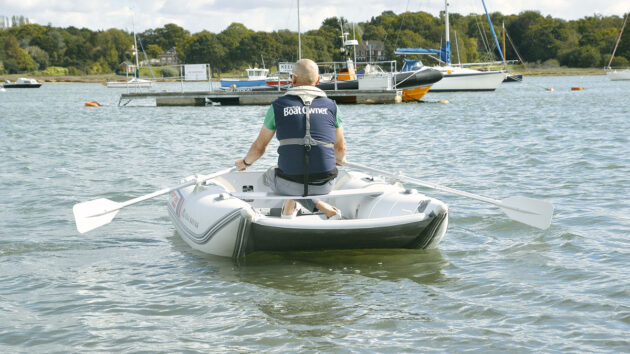
Rowing is uncomfortable due to the oars’ short inboard length and the oarlock position. Credit: James Turner
Manufacturers, Aircat included, try to get around this self-inflicted misery by making the oars’ inboard length incredibly short, which results in a ghastly sort of wrist and forearm-only rowing action with elbows behind the body and very poor leverage, hence haphazard progress in any headwind or headtide. The oarlock positions on the 285 feel far too close to the thwart, forcing the rower all the way forward on the thwart, which then threatens to tip them off the boat.
If I had an Aircat 285 or any one of the dozens of similarly afflicted designs, the fix is easy and cheap. You just need a movable thwart that sits on the floor as far up or down the boat as feels right – either an inflatable thwart of a diameter 3-4in smaller than the boat’s tubes, or something else less fancy, like the upturned plastic vegetable box that I once used in a Zodiac for this purpose.
With the rowing ergonomics tweaked a little, it feels like it would row pretty well as – unlike a lot of inflatables – it tracks straight and true without trying to spin on you, thanks to its catamaran hull form.
Adding power to the Aircat 285
The Aircat 285 is rated for outboards up to 5hp, so I took my trusty 5hp 4-stroke Mariner out for the next phase of the test. While from a distance the Aircat looks a bit like a Zapcat, there the similarity ends.
The Zapcat (a South African conceived surf racing boat) was a very clever piece of marine technology, which thanks to separate inflatable ‘hijackers’ underneath, is effectively a tunnel hull, and with asymmetric hulls with their vertical inboard sides, is allegedly able to out-corner a Formula 1 car in terms of G-force. The Aircat has a flat dropstitch floor rising towards the bow, and two tapered symmetrical tubes, set slightly lower than the floor.
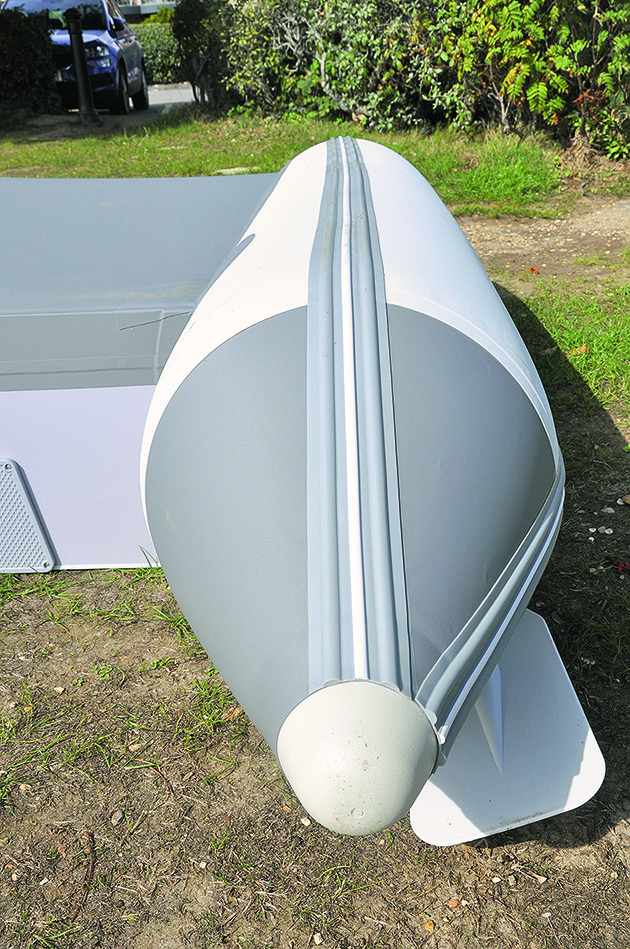
Rubbing strakes on each tube help protect the material when grounding. Credit: James Turner
The Aircat’s tubes, being its lowest point and therefore the first area to ground, have rubbing strakes along each bottom dead centre. Having been in several Zapcats, I can attest to them being ‘wet’ boats. I wondered if the Aircat, sharing the same open bow architecture, would behave similarly. The short answer is that when driven into a small headchop, the Aircat is drier than it looks like it ought to be – it has a lot of bow rocker so it’s not as wet as you’d think.
If your boat lives on a gnarly, exposed swinging mooring on an estuary, I don’t think I could recommend the Aircat over something with a more enclosed bow design, but I’d recommend a solid tender anyway in those situations. For those with more sheltered moorings, such as on the river Hamble where we conducted our test, the Aircat’s open bow provides lots of benefits.
Loading a nervous dog off the beach onto the bow was a doddle. Pushing the (rubber-capped) sponsons under engine straight onto a marina pontoon with a bit of engine thrust made the boat an incredibly sure-footed platform. This would make getting either very young or old people off the tender and onto the pontoon much easier than with a traditional inflatable, and the same could be said for any bulky or heavy inanimate items.
Pros and cons
In terms of performance under the (maximum allowable) 5hp motor, one-up, it’s actually quite good fun in a skittish, ‘I wouldn’t fancy any more power than this’ sort of way, and we managed a few short bouts of full planing one-up. With a second person aboard, planing became unattainable, but it’s definitely an efficient hull form, with higher performance than more traditional monohull designs.
The Aircat 285’s stiffest competition is undoubtedly its own big sister, the Aircat 335. The 50cm longer boat is only 3.5kg more (33.5kg versus the 285’s 30kg), and is £130 dearer.
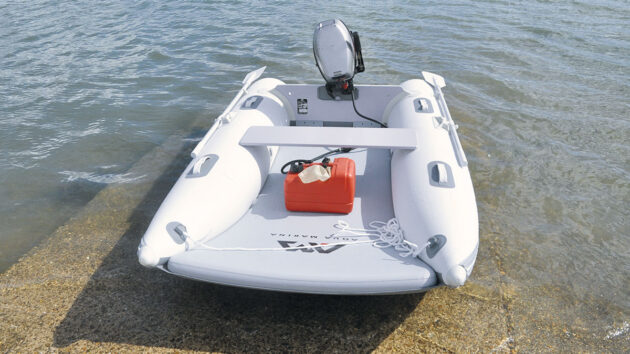
The open bow offers many benefits; it is easy to load. Credit: James Turner
I suspect the longer boat would row a bit better, will, of course, accommodate more people, plus it takes outboards up to 9.9hp which I strongly suspect would bring two-up or even three-up planing performance within reach.
In terms of downsides, the only big one for me was the white tubes. These boats don’t appear to be available in other, darker colours, and it did become noticeably grubby despite only launching twice; all easily washable, I’m sure, but that’s extra work none of us need.
Details
Length:2.85m /9ft4in
Width:1.60m/3ft 3in
Maximum Payload:400kg/880lb
Net Weight:30kg/66lb
Air Chambers:4+1
Contact:aquamarinauk.co.uk