


Which are the best marine fridge options, front-opening, top-loading or a cool box? PBO gets top tips for cold storage onboard from Boat Galley expert Carolyn Shearlock
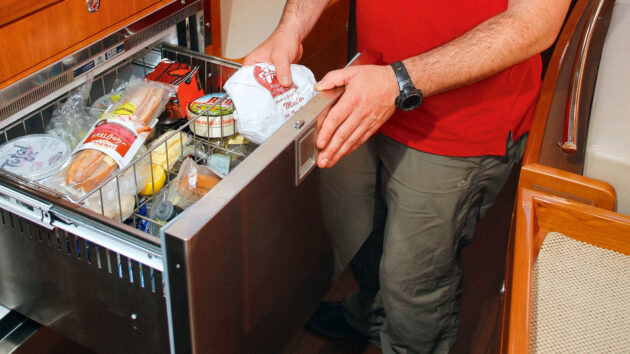
A marine fridge has become an essential onboard item.
The realisation that keeping food cold is a natural preservative has been around for thousands of years, although our distant ancestors had no idea why it worked.
Ancient civilisations in Egypt, China and India filled caves with mountain ice or compacted snow as ‘cool boxes’ for the summer, and it became big business.
Nowadays, thanks to a series of key discoveries between the 17th and 20th centuries, we now have four main types of cooling available for off-grid use: passive, thermo-electric, absorption (LPG) and compressor.
All can prove very effective in the right environment, and there are a range of marine fridge options on the market. Some people even make their own!
What type works for you will ultimately depend on the onboard space available, and how long the cooling is needed.
History of the compressor fridge
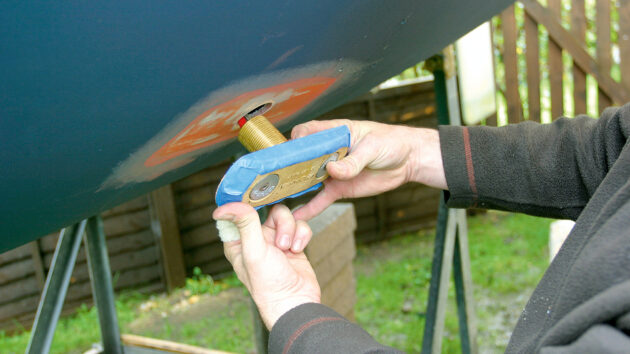
Compressor fridges in very small boats moored off grid can be made more efficient by adding a keel cooler. Here’s one being fitted. Photo by Jake Kavanagh
Credit for the first practical demonstration of the principle behind compressed gas refrigeration is given to the Scottish physician William Cullen, who in 1748 noticed that spilt ether evaporating from a thermometer caused the temperature to fall.
Building on that concept, later inventors such as Jacob Perkins (1834) and Carl von Linde (1876) developed the science of compressors and gas liquefaction respectively.
These led to Fred W Wolfe inventing the first home refrigerator in 1913, with William C Durant taking the idea to mass production in 1918.
C0mpressor fridges today
Nowadays, the compact nature of electric motors, deep-cycle lithium batteries and near-silent compressor technology has allowed for small marine fridge freezer units to run indefinitely from a 12V supply.
The compartments, with the capacity usually expressed in litres, come in three main types:
- front-loading, with a door that opens into the cabin
- drawer, with a pull-out drawer
- top-loading, where access is from the counter.
All three have their pros and cons, mainly around efficiency and access, with advocates for each design.
Some boaters will have one or more of each type, if space allows: front-loading for the drinks and snacks, drawer and top-loading for provisions, or fishing catch preservation.
Compressor fridges do need constant access to dependable low-voltage power, and some boaters have installed small units that run from a dedicated solar panel and deep-cycle battery set-up.
Most models will also have an ice or freezer compartment.
The pros:
- Temperature can be set
- Efficient cooling
- Usually capable of 12V/24V/240V operation
- Available in portable ‘hybrid’ versions
- Low energy draw
- Top or front loading
- Freezer compartment
The cons:
- Heaviest of the marine fridge designs
- Compressor on cheaper models can be noisy
- Generally more expensive than other technology
Gas absorption
This fridge type uses liquefied petroleum gas (LPG) to generate the same principle of evaporation, using heat from a gas flame to boil off and re-condense a refrigerant liquid (often a mix of water, ammonia and hydrogen).
While as marine fridges these can be quite efficient, using only a relatively small amount of bottled gas, they are usually found only on inland craft as they are very susceptible to tilting.
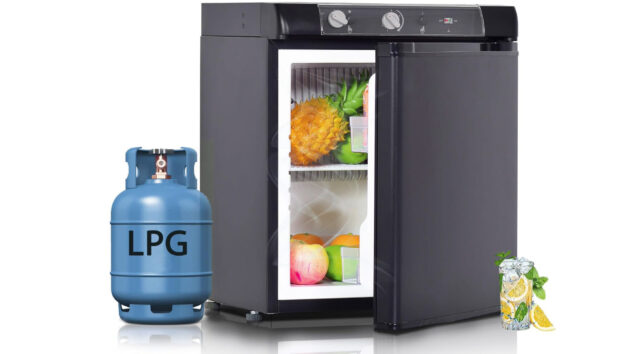
The 40lt three-way camping fridge chills down to -10°C using either 12V, 240V or LPG. It runs silently as there is no compressor, but this type is best suited for inland craft. RRP: £294. Photo by Virifrigo
While there are several manufacturers to choose from and bottled gas is widely available when cruising, this type is usually mainly intended for caravans, RVs, canal boats and campsites.
(Not to be confused with compressor versions using propane as the refrigerant.)
The pros:
- No compressor noise – completely silent
- Ease of obtaining bottled gas
- Relatively efficient – (a 6kg gas bottle should last three weeks)
- Less expensive than a compressor fridge
- Three-way versions can run on 12V DC, 240V AC or LPG
The cons:
- Must be kept level for effective operation
- Must be used in a well-ventilated compartment
- Flame must be lit for the fridge to work
- Fridge sometimes needs running on mains power first
Thermo-electric marine fridges
This type uses the Peltier effect, where cooling is created by running an electric current across two different types of conductors.
Heat is drawn from inside the compartment and passed to the outside via a fan.
By reversing the current, the unit can become a heater instead, gently warming the food inside.
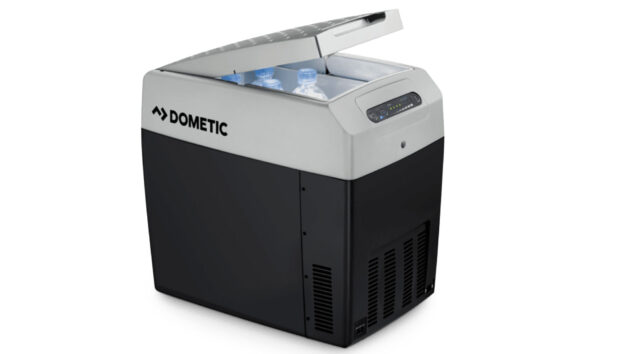
The Dometic TropiCool TCX21 can refrigerate down to 27°C below ambient temperature, and heat to +65°C. When in 12V/24V mode, electronics protect the boat’s battery from overdischarge, and there is a priority circuit for 240VAC use. RRP: £190. Photo by Dometic
However, unlike a compressor fridge, an exact temperature can’t be set, and there is no freezer compartment, either.
Instead, the unit brings the inside temperature down to anywhere from 15°C to as much as 30°C below the external ambient temperature.
On a hot summer’s day, for example, the most effective units may be able to get close to the temperature of a domestic fridge (typically 5°C).
With no need for heavier compressors, thermo-electric technology is usually the preserve of portable cool boxes, with the low-energy fans running nearly silently during operation.
The pros:
- Portable
- Usually much quieter than a compressor fridge
- Low energy consumption
- Simple tech – few failure points
The cons:
- Needs securing on board in a seaway
- Temperature can’t be set
- No freezer compartment
- Only suitable for shorter-term cooling
Passive cooling
With passive cooling, no power source is required.
Instead, the refrigeration relies on that thousand-year-old technology of pre-loaded ice blocks.
The box is well insulated and loaded with food that has also been pre-chilled in the home refrigerator.
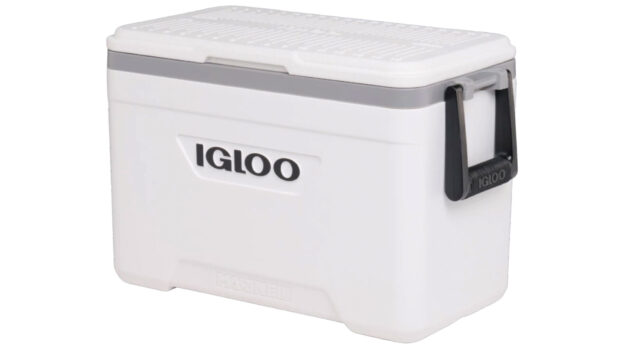
Igloo Marine’s Ultra coolbox has a 23lt capacity and has UV protection for long periods in a cockpit. The top also doubles as a seat, and the interior is stain- and odour-resistant. RRP £80.00. Photo by Igloo Marine
A good tip is to pack the box tightly with food or bottled drinks to displace as much warm air as possible, then to position the ice blocks on top.
This helps the cold air to sink through the contents and improve the chilling effect.
The pros:
- Basic design, no tech to fail
- No power required
- Highly portable
The cons:
- No active cooling
- No freezer compartment
- Limited refrigeration time
Compressor fridges: top or front-loading?
A big question when fitting a marine refrigerator is what design to go for.
Space may be a factor – especially on a small boat – with some already configured for a front-opening marine fridge, certainly the most common type on inland craft.
The doors can usually be swapped for a choice of either left or right opening.
Top loaders are more often found in long-distance voyaging vessels, taking advantage of the cold naturally wanting to sink to the bottom of the insulated enclosure.
Cool boxes are popular for open RIBs and day-sailers, usually plugging into a dashboard 12V socket.
Expert marine fridge advice from the Boat Galley
Good advice for using a fridge comes from the highly experienced US-based cooking author Carolyn Shearlock, who runs the Boat Galley website.
She and her husband have been cruising for over 17 years, mainly in the hot and humid climates of Pacific Mexico, Florida and The Bahamas.
Carolyn sources as many fresh local products en route as she can, so efficient live-aboard refrigeration is a mainstay of her cruising lifestyle.
‘I had a top-opening marine fridge/freezer on our first boat, a Tayana 37, and a front-opening one on our second, a Gemini 105M (34ft) catamaran,’ she told PBO.
‘Both had their good and bad points, but overall, I preferred the top-opening for hot climates. (Temperatures averaged +90°F/32°C for more than 6 months of the year.) Food inside simply stayed colder.
Every time I used the front-opening fridge, substantial amounts of cold air would escape and I never could really figure out a way to stop that from happening.
I liked the front opening better for being able to see things at a glance, but for the top-opening I got around that issue by using lots of crates and baskets and having a very defined plan of where everything went.’
Not everything needs to be kept cold, Carolyn advises, and knowing the difference can free up a lot of space.
What doesn’t need refrigeration?
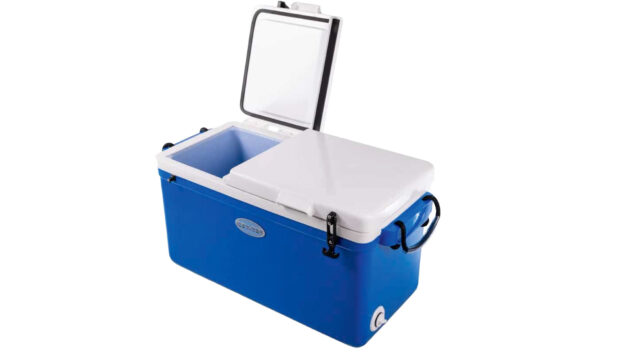
The Icey-Tek 70lt Dual Lid Long Cool box has two lids for easier access, using one lid as a seat while the other is open. Velcro seat cushions are also available. RRP £230. Photo by Icey-Tek
‘Most fruits and vegetables do surprisingly well at room temperature, often for a week to several weeks,’ Carolyn says.
‘They’ll last longest if they were never refrigerated to begin with, but even produce from a refrigerated grocery store can move to room temperature. Just plan to use it a bit sooner.
I kept very little produce in the refrigerator. Moving it out frees up more space than almost anything else you can do.
Condiments such as ketchup, mustard, BBQ sauce and jam are the other big ones. Americans refrigerate a lot of things that no one else does, and most of them are perfectly fine at room temperature.
Even at over 100°F (38°C) in the Bahamas in summer, I kept condiments unrefrigerated for months without a problem.’
Probably the biggest surprise for most people is not chilling eggs and mayonnaise.
‘Eggs keep for weeks at room temperature,’ Carolyn explains. ‘The only trick is flipping the carton every few days to keep the membrane moist and the yolk centred.
Mayo doesn’t need refrigeration either, so long as nothing ever touches the contents after contact with other food. The simplest method is to use a squeeze bottle to keep out bacteria.’
What does need refrigeration?
‘Butter, cheese, and any temperature-sensitive medications need to stay cold,’ Carolyn says.
‘These are the things that genuinely earn their space. Meat and seafood belong in the freezer, as it holds a steadier temperature, and consistency matters most for food safety.
That said, a boat freezer is small — you can’t live out of it for three weeks.
We kept frozen meat on hand and filled the gaps with canned meat, which needs no refrigeration at all.
Alternating between the two got us through weeks at a stretch without restocking.
Foods such as milk, yoghurt, drinks, and white wine are the things most of us naturally want cold, although there are some ways to extend shelf life for some of them outside the fridge.’
Carolyn’s top tips: Top-loader marine fridges
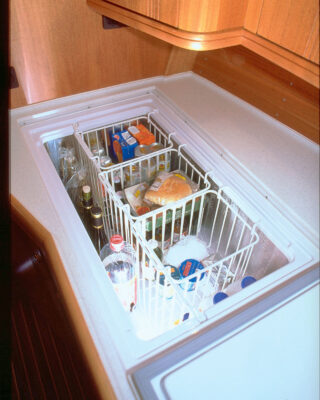
Top-loading is preferred by blue water sailors as it’s better at retaining cold air when opened, but finding items needs a system of stacking. Photo by FuturePLC
Know where the coldest areas are
Some foods such as meat need to be kept very cold, Carolyn advises, but other foods, such as produce, just need to be chilled.
The coldest place in a top loader is near the bottom and against the chiller plate. Cold air sinks, so the top part of the refrigerator will be warmer.
What’s important?
Prioritise the contents based on how you cruise. Do you need a six-pack of chilled beer always available, or just a small compartment for ice for the gin?
‘In the middle of a tropical summer, with temperatures over 100°F and no air conditioning, cold drinks were a big priority for us,’ Carolyn says.
‘We used canned meat and canned vegetables to have room in the refrigerator for a large drink stock.
In the winter, when we spent more time anchored off a sizeable city, we used fewer drinks and I had access to lots of fresh produce, so I changed the priorities’.
Make dividers for your marine fridge
Once you know what will go where, Carolyn suggests making some dividers from rigid foam and duct tape. This can be done without a major redesign of your marine fridge.
‘You can adjust the relative cold by making some holes in the divider so that the cold air can pass through,’ she says. ‘Don’t make too many all at once – make one or two, wait a couple of days to see what happens and then make another if necessary.’
Use lots of bins
After some early mistakes where most of the contents were turned to ice, Carolyn now uses an arrangement of various sizes of bin.
‘You need to sort food by category, such as meat, cheese, produce, and drinks,’ she says.
‘Then use bins to keep similar things together in appropriate places, such as the coldest, or least likely to freeze.
In general, you want bins to have solid bottoms and no holes in the lowest inch or so of the sides to contain any spills, but holes higher in the sides are good for cold air circulation. Metal bins conduct cold the best, followed by hard plastic, then soft plastic.
So, soft plastic containers, particularly ones with lids, are good for things that you don’t want to get too cold.’
Less hunting = less power
The items used most often should be the easiest to reach, whilst others will be in their ideal temperature zones.
Carolyn also suggests wedging the bins together so they don’t move around in a seaway.
However, she admits that getting the contents properly ordered may take a little time and experimentation, which is probably easier for a liveaboard or long-term cruiser.
‘Don’t be surprised if all the pieces don’t fall in place at first for organising your top-loading refrigerator,’ she says.
‘It may take a little re-adjustment, but in the long run having consistent places for everything will decrease marathon ‘hunting sessions,’ which will also save battery power.’
Front-opening marine fridge tips
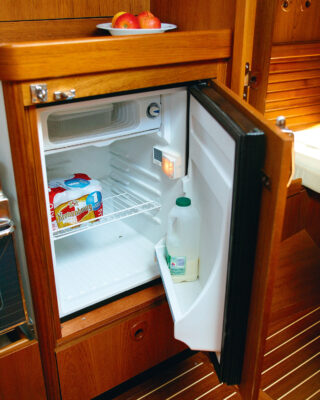
Side opening, usually with a reversible door, remains very popular for coastal cruising vessels, as everything is easy to see. The downside is the cold air ‘falling out’ every time the door is open. Photo by Graham Snook/Future
The average cruising boat will usually have a small, front-opening refrigerator of around 40-50lt capacity, considerably less than a domestic version (200-300lt).
However, Carolyn says it is possible to go for up to three weeks between grocery runs, simply by stocking your marine fridge wisely. She advises:
Keep only what’s needed immediately
You don’t need to stock the fridge for the whole trip at once.
Instead, only store what needs to be chilled, mainly because it’s been opened.
Boxed UHT milk is a good example, so keep one open carton in the fridge and replace it from non-chilled stores when used.
If you make yoghurt, create small batches at a time rather than a big tub.
Cool another way
A marine fridge doesn’t need to hold an unlimited supply of cold drinks, just enough for the day.
A net bag dropped off the back of the boat, a few feet off the bottom, chills cans and bottles without using any electricity at all.
It works at anchor and frees up cold storage for things that need it.
Small packaging saves space
Buy vacuum-sealed meat and remove unnecessary outer packaging before putting it in the fridge. Simple, but it adds up.
A tiny fridge run with a real system doesn’t feel like deprivation. It feels like control.
And that changes everything about how you think about provisioning, about passages, about how far you can go without worrying about what’s in the galley.
That’s what the right system does. And it’s more achievable than most people think.
Our thanks to Carolyn Shearlock whose website (theboatgalley.com) offers online courses for potential blue water cruisers, including Eating Well with a Tiny Fridge.
If you want to give up on electrically assisted cooling completely, then her book (paperback or PDF download) Storing Food Without Refrigeration will give you plenty of ideas. You can also sign up for her free blog.
Best boat heaters – diesel, solid fuel or warm air central heating?
There are many ways to stay warm afloat, whatever your budget. Ali Wood chooses the best boat heaters

Best boat cooker: 10 alternative options for gas-free cooking
Gas cookers used to be the standard choice on almost every boat, but there are good reasons why they are…

How I made my own DIY fridge
Richard Hare describes how he built the ply/epoxy fridge during the reconstruction of his Westerly Konsort galley

How to make a boat fridge: step by step
Keith Calton converts an under-seat locker into a bespoke boat fridge for under £450
Want to read more articles about marine fridge options?

A subscription to Practical Boat Owner magazine costs around 40% less than the cover price.
Print and digital editions are available through Magazines Direct – where you can also find the latest deals.
PBO is packed with information to help you get the most from boat ownership – whether sail or power.
-
-
-
- Take your DIY skills to the next level with trusted advice on boat maintenance and repairs
- Impartial, in-depth gear reviews
- Practical cruising tips for making the most of your time afloat
-
-
Follow us on Facebook, Instagram, TikTok and Twitter
PBO web categories