


Can a completely stripped-back 37-foot budget yacht deliver the pure sailing performance modern cruisers actually want? From the PBO archive, David Harding sails the Varianta 37 in the Solent to find out
Varianta 37: a boat that goes back to basics

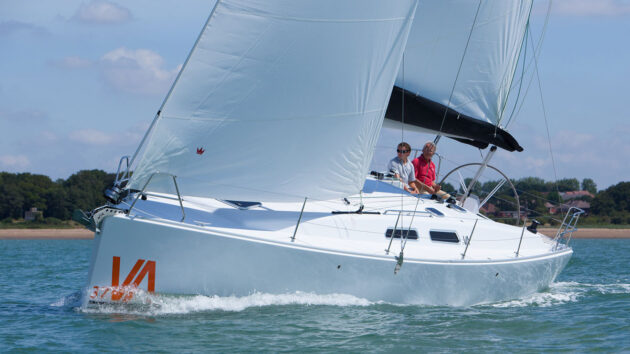
All boats are not created equal, but generally the bigger the boat, the more money you will spend. This is where the Varianta 37 bucks the trend.
Today’s typical buyer wants modern lines, modern space (big aft cabins in broad sterns) and a bigger boat. The trouble is that by the time you have started with even a pretty ordinary 37-footer and added a few goodies, you’re likely to be looking at a hefty price tag when buying new.
Varianta’s solution was simple: build a basic boat. For basic, read very basic. Build it simply and leave off all the bells and whistles that people can add later. Offer a 37-footer at a price nobody else can get near.
If that sounds like a familiar approach, it might be because it’s what Michael Schmidt did with Hanse Yachts back in the 1990s. Schmidt set up in Greifswald, eastern Germany, after German reunification, buying the moulds of discontinued models from Scandinavian yards and building them to almost unbelievably low prices.
When I first sailed the Hanse 291 back in the mid-1990s, it cost less than £30,000. Since then, Hanse has become a household name in the boating world. Schmidt is no longer involved and the Hanse Group has grown enormously along the way; when it acquired Dehler, it also inherited Varianta and produced the Varianta 18, 37, and 44 models, all of which are now only available on the second-hand market.
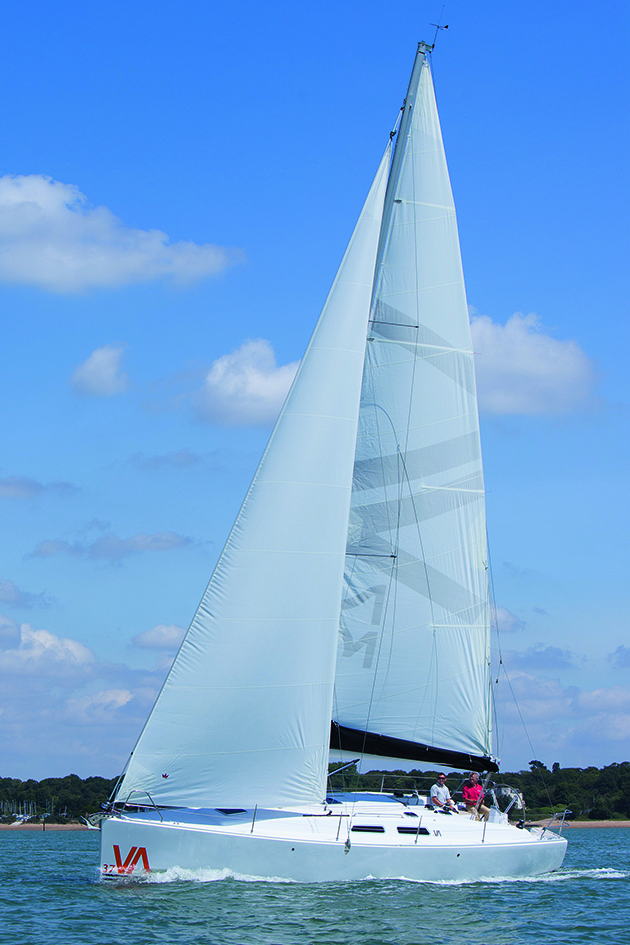
Her plain livery can’t disguise the Varianta’s sporty lines. She
could make a handy club racer or fast weekend cruiser. Credit: David Harding
The Varianta 44 was launched in 2011, but few were sold in the UK. The Varianta 37 was launched in late 2013-early 2014, and an owner could collect a standard specification yacht and get away with spending less than £80,000. For that you would have no hot water or shower, no headsail reefing system, no instruments (except a compass), a 20hp Volvo with a fixed prop, two winches and no sprayhood, anchor or windlass. You are graciously provided with a winch handle. You could sail it away – just.
Cutting right back on the bolt-ons is one way of keeping the price to a minimum. At the same time, the builder is keen to stress that nothing has been compromised in terms of structural integrity. The hull is a solid laminate, which has much in its favour and is cheaper and simpler than building with a core. The keel is cast iron. Iron can’t compete with lead as a keel material, but it’s a lot less expensive and boats with iron keels are still capable of sailing very nicely.
The sails are – well, let’s just say they’re built down to a price because that’s what the sailmaker was asked for. There’s another crucial ingredient. The hull has been seen before. It was designed (by Judel & Vrolijk) for the Hanse 370 back in 2006, then used again for the Hanse 375, which remained in production until 2011. It has already been paid for. Nonetheless, since the idea wasn’t simply to relaunch the Hanses under another name, the hull was mated with a new deck, cockpit and coachroof moulding. The new boat needed to look different.
A new keel has been used, too: the original L-fin no longer exists so a T-bulb (6ft 5in/1.95m) is now bolted to the hull, or a shallower (5ft 3in/1.60m) L-fin if you insist. That, then, is the Varianta formula: minimise development costs, build in the simplest possible way and leave off anything that can be left off. Then supply an extras list from which buyers can choose.
No frills Varianta 37
When I first saw the Varianta 37 in Düsseldorf in January 2014 I thought she looked like a boat that had been taken off the production line halfway through fit-out. You see an expanse of white deck moulding with a few bits of hardware here and there. Something else you can’t help noticing is that she doesn’t look fashionably new, because the stern is not the widest part of the boat and most of its relatively modest width is taken up by a single large wheel, the bottom of which is accommodated by a cut-out in the cockpit sole.
Unless you’re determined to have a boat with an ultra-wide stern and twin wheels for whatever reason, this really doesn’t matter. What matters is that you can have a 37-footer with a well-proven performance hull for less than the price of a typical 32 or 33. Given her pedigree, I can’t help hoping that people won’t buy her merely because of the price tag and just float around in her. That would be a waste of a good hull.
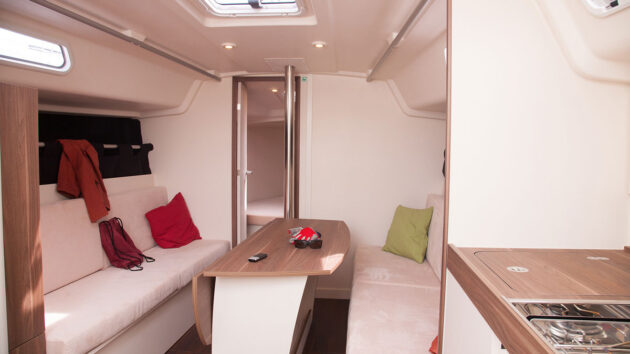
Pale laminates and walnut trim create the light-and-dark feel below decks, where the layout is geared principally towards weekending. Credit: David Harding
I had to wait until summer 2014 for the first Varianta 37 to arrive in the UK. As did most owners, Inspiration Marine added a few bits to their own boat, starting with the Cruising Pack. That gives you extra hatches and portlights, bigger batteries, shore power, hot water and shower and a headsail-reefing system.
Other extras included a sprayhood, lazyjacks and mainsail cover, anchor windlass, instrumentation and spinnaker kit.
Staying on track
All of these extras are academic if the boat doesn’t do the business, so we waited for a day with a bit of breeze (unusually hard to find during most of July) and headed out for a sail. In this case, a bit of breeze meant 10-14 knots from the north, so we were sailing in flat water and never enough pressure to take the boat anywhere near the edge of her comfort zone.
Nonetheless, it was clear that the Varianta 37 wanted to go: she felt smooth and powerful, with easy manners, a beautifully direct feel through the wheel and just enough weather helm to give the helmsman something to work with. While these were conditions to make life easy for any boat, there’s no doubt that this one is a natural born sailer.
One cost-saving measure was the use of a 106% headsail rather than the self-tacker used on the Hanse, because a short length of track on each coachroof is cheaper than a self-tacking arrangement. It’s also much nicer to sail with (unless you’re tacking every 100 yards in 25 knots of wind), generating significantly more power and not losing most of its drive as soon as you crack the sheet an inch or two. It’s one economy that really helped.
As standard the wheel is 51in (1.3m), with a 59in (1.50m) option as fitted to the test boat. Bigger is infinitely better if you want to sit comfortably outboard, watch the jib luff and see where you’re going. If getting around it is more of an issue you’ll have to settle for the smaller one.
Since the boat comes as standard with just a pair of Lewmar 40 self-tailers on the coachroof, single-handing means moving to the forward end of the cockpit for the tacks. It’s quite doable if you ease a little mainsheet so the boat doesn’t round up on the new tack, but having the optional Lewmar 45s on the aft end of the coamings makes life easier.
Reaching the mainsheet, anchored to the cockpit sole just forward of the wheel, is no great problem for the helmsman either. Life would be easier – and mainsail trim a good deal more efficient – with the addition of a mainsheet track. It feels strange sailing a boat of this size and nature without a traveller. In the conditions we had it was less crucial than it would have been in lighter or heaver airs, but performance was inevitably compromised.
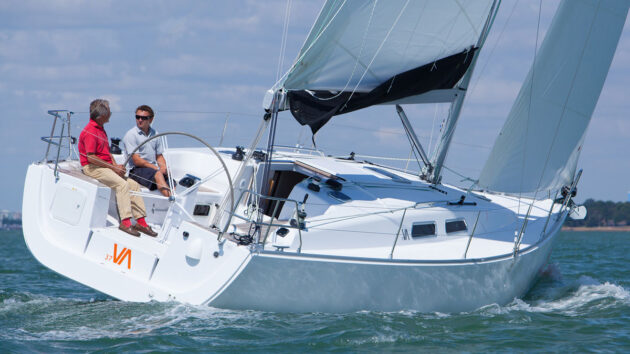
A 106% headsail rather than the self-tacker was standard. Credit: David Harding
I kept wanting to ‘track up’ or ‘track down’. It was a bit like riding a bicycle with only one gear along the level: fine until the wind changes. That’s one of three essential additions if you want the boat to perform to anything like her potential. Another is a folding prop. For a boat like this to drag around two fixed blades is sacrilege. We were clocking about 6.3 knots upwind and tacking through little over 70°. Fitting a folding or feathering propeller would let her off the leash.
And that brings us to the sails. Spending a bit more (no need to change sailmaker) would give you sails that would make the boat faster, more responsive and easier to manage, especially after a few months because they would hold their shape better. All the basic controls are led aft to banks of Spinlock clutches: main and headsail halyards, the two (continuous-line) reefs, outhaul and kicker. Aluminium plates are apparently bonded into the deck and coachroof to accommodate any extra hardware – to handle things such as spinnaker gear or extra halyards, for example. Apart from looking rather bare, the deck works well enough.
A slotted aluminium toerail is screwed into the hull-to-deck joint just inboard of the gunwale. Handrails are stainless steel – there’s no wood on deck. Rigging for the Z-Spars mast is taken right outboard. A deep anchor locker, formed as part of the deck moulding, will accommodate a windlass.
My principal criticism is lack of non-slip on the hatch garage, the aftermost end of the coachroof and the cockpit coamings. The coamings especially would be lethal when wet. While we’re back here, the cockpit is on the wide side, as people often seem to like it. That leaves room only for vestigial, narrowing side decks towards the stern and makes leg-bracing impossible except for the long-limbed right at the cockpit’s forward end.
The coamings are high, however, so it still feels more like a cockpit than a dance floor. Without a guardrail on the stumpy pedestal, there’s nowhere for instrumentation in front of the helmsman: displays are in the aft end of the coamings each side. An instrument pod over the hatch would be an alternative or a useful addition. Most of these things could be added.
Other niggles include the lack of a finger-catch in the lifting section of the sole forward of the wheel that gives access to the rudder head for the emergency tiller (yes, the wheel is abaft the rudder). The space here is also ideal for stowing oddments in the absence of coaming lockers. It even accommodated a DSLR camera with a telephoto lens. The fact that the lid of the shallow locker to port lifts nowhere near far enough to stay open on its own is either irritating or a safety feature depending on how you look at it. A simple strop would be the answer.
Returning to the sailing, there was little serious testing to be done in those conditions. The Varianta 37 went nicely considering the sails, propeller and lack of traveller. She performed all the standard manoeuvres without question, hove to comfortably (it’s easier without a self-tacker), gybed round with no fuss and generally behaved herself.
Inspiration Marine’s Andy Hind, who is looking after the Varianta and who knows how to sail, assures me that she goes nicely in a blow. While I’m still hoping to find out for myself, I suspect he’s right.
Accommodation on the Varianta 37
On descending the companion steps you’re greeted by white bulkheads (most of the joinery is in laminate-faced ply) and a white moulded headliner. Offsetting the white is walnut laminate for the trim, table and galley worktop and dark sole boards in a wood-grain finish.
Despite the white it’s perhaps less bright than you might imagine because of the small window area. Structurally, there’s a tray- moulding up to the base of the lockers in the saloon. The moulding also forms the bunks in the forecabin and twin aft cabins. The rest of the interior is built in plywood. Little if any of the end-grain appears to be sealed.
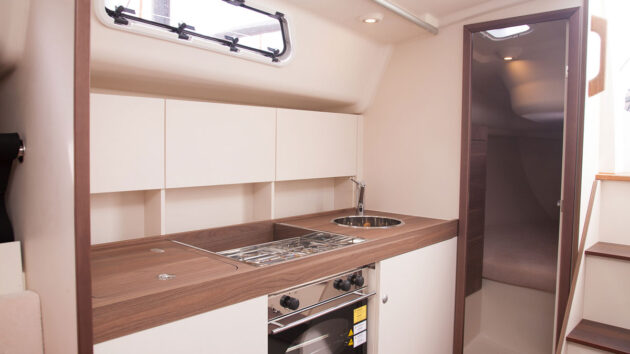
A linear galley with reasonable, if simple, stowage but no dedicated worktop. Credit: David Harding
At the bottom of the companionway is a sizeable open space abaft the saloon table, with the linear galley to starboard opposite the heads and shower compartment. The only option below decks is to fit out the second aft cabin, to port abaft the heads, so it mirrors the cabin to starboard. As standard the port ‘cabin’ is just an empty space. If you don’t need it as sleeping accommodation you could cut out the bottom of the locker above and use it for stowage. If I only wanted one aft cabin, I would like to see the heads moved aft to create a more appealing saloon, but that’s not an option.
Stowage throughout is simple. There’s not a drawer in the boat. Fiddled troughs in the galley would accommodate cutlery and oddments. Outboard of the settee berths each side is open stowage in the style of a pilot berth – fine for slinging kit-bags into. Apart from the unsealed end-grain, the visible structural elements are reassuring.
The sole-boards above the keel lift to show that the bolts pass through large galvanised plates. Another large plate is under the compression post. Elsewhere the boards are screwed down, except over the two strum boxes. Engine access is reasonable.
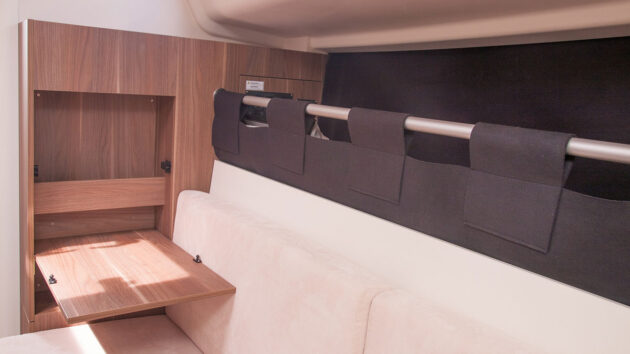
A small chart table hinges down from the forward side of the heads bulkhead. Credit: David Harding
To get at the front you simply undo two barrel bolts and slide the whole companionway step assembly forward. It doesn’t get any simpler than that. Panels give access to each side of the engine from the aft cabins, though getting at the gearbox would be more of a challenge because the mouldings are pretty tight against it. Diesel is in a PTFE tank under the starboard aft cabin. Water is under the forecabin berth, leaving most the space amidships for stowage.
Verdict on the Varianta 37
In terms of value for money, the Varianta looks hard to beat. Unlike some budget-priced offerings, however, she’s designed to sail. Buying her just because she’s cheap for her length would be to miss the point and be a waste of a rather sweet hull. If you threw a bit of money at her you could turn her into a club racer – or, within some constraints, pretty well whatever you choose. In a way, Varianta is doing what Hanse started by doing all those years ago with sporty budget boats. Will the idea catch on now? I’d say there’s every chance.
Details
Price when new in 2015:£78,157
LOA:11.35m (37ft 3in)
LWL:10.05m (33ft 0in)
Beam:3.75m (12ft 4in)
Draught - standard fin:1.95m (6ft 5in)
Draught - shallow fin:1.60m (5ft 3in)
Displacement:6,900kg (15,212lb)
Ballast: 2,300kg (5,070kg)
Sail area (main & foretriangle):72.5sq m (781sq ft)
Displacement/length ratio:189
Sail area/displacement ratio:20.31
RCD category:A
Engine:Volvo D1-20 saildrive (D1-30 option)
Headroom:1.90m (6ft 3in)
Designer:Judel & Vrolijk/Hanse Group
Builder:Varianta