



Following a trip across France via the Canal Latéral à la Garonne and the Canal du Midi, Richard Hare shares his experience of how to tackle locks and the etiquette that should be observed
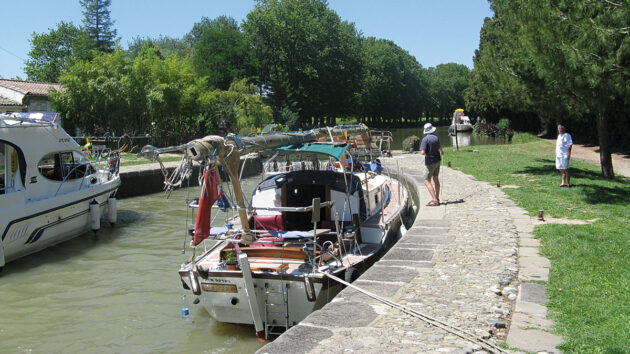
The Garonne canal locks are long, one boat only, but on the Canal du Midi they’re tubby, oval affairs capable of accommodating four leisure boats, two abreast – and, unlike on the Garonne, most Midi locks are manned, but knowing how to use canal locks is still essentual.
In mid-summer lock etiquette calls for patience and good humour if frayed nerves are to be avoided. A privately owned yacht will find itself sharing locks with holiday charter boats, skippered quite often by folk with little or no previous boat-handling experience. They’re disparagingly referred to as ‘bumper boats’ but don’t worry, they’re well-fendered.
Since a privately owned boat is likely to be the only one in a group it’s helpful if we indicate which position we want to take in a lock – because of the mast – and there’s no harm in coaxing holidaymakers into letting you take it (more on this later).
With lock-keepers, it helps if we exercise whatever French language we have – even if it’s failed O-level like mine. Arguments between under-pressure high-season lock-keepers and private boat owners are infrequent and would serve no useful purpose anyway. If we’re adamant that we don’t like the position we’re offered it’s best to move back to the bank promptly and politely, wave another boat forward, and start afresh with the next lock load.
How to use canal locks: Going up…
Going uphill is trickier than going down, as we have to deal with the powerful surge of water as the lock fills. It’s hard work, too, in high summer, and if losing weight is what you want, then this is a good way to do it. Some lock-keepers go easier on us than others and, to be fair, their decision is likely to be governed by how long the queues are building up on either side.
Midi locks can look fearsome when in mid flood but the flow is more passive and unidirectional in these oval-shaped locks than it is in the unnatural shape of a modern rectangular lock.
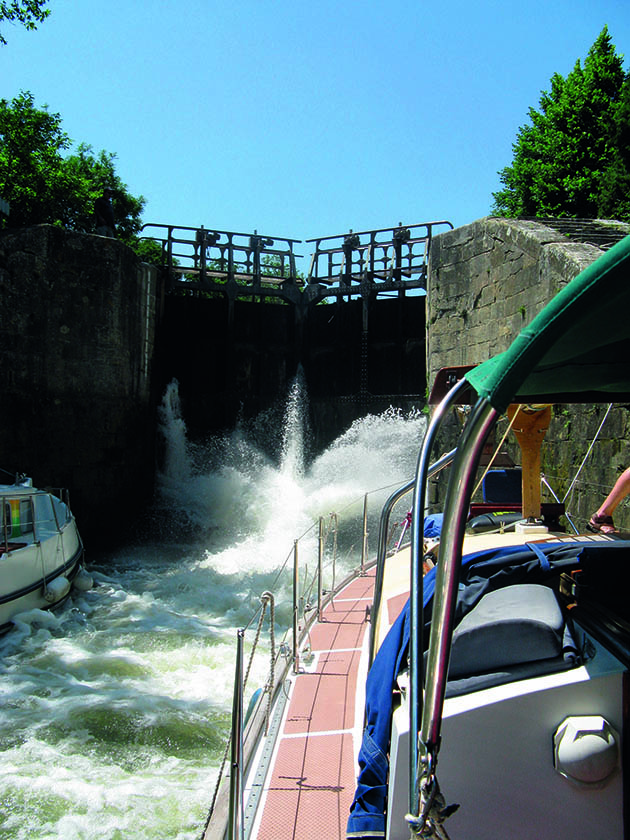
Canal du Midi locks can be filled quickly but the bark is worse than the bite. Note the taut for’ard warp middle right of the photo. Credit: Richard Hare
Just as all boats behave differently at sea, so they also do on ‘land’. Ours, a long keel bilge-keeler, is affected predominantly by the water currents below. Others – motor launches and fin-keelers – are more affected by the wind.
If the bow is to be prevented from being forced away from the lock wall by sluice-gate surge, the bow warp must be kept bar-taut for the entire duration of the ascent.
While there are numerous approaches for an uphill sequence, a typical one for the two of us goes as follows:
- Locks have traffic lights and if, on the approach, it shows green then we go straight in. If it’s red there’s usually the option of pulling over onto a staithe, or
even just milling around, holding station. For a keel boat, the latter is usually the case, as the depth will not always allow a sea boat to come alongside a staithe, let alone a bank. Ultimately, it’s a case of ‘suck it and see’. Always approach banks slowly because there might be something nasty lurking below. - Irrespective of whether we go straight in or not, I put Janie ashore before entering the lock. If the staithe option isn’t doable, I’ll nose the bow into the bank (keeping the keel in deeper water) so that she can hop ashore. A fender-step hanging from one of the bows is very useful as it can be quite a drop down onto a sloping bank.
- Having previously laid the for’ard warp along the side deck, with the coil placed on the cabin nearby for me to reach, Janie then waits lockside for the boat’s arrival. Meanwhile, I have my aft warp coiled in readiness in a cockpit locker.
- With the gates open we strive to take the same position in each lock – that’s aft and starboard. Not only does our fendering reflect this, but it also helps if we can stay with a group of other boats for a series of locks. Holidaymakers seem to like this too, and it promotes the development of camaraderie. It also removes much of the anxiety of having to start afresh with a different set of boats each time.
- To increase the likelihood of retaining our aft/starboard position we move our yacht out into the canal, in a dominant position, and then let or encourage three holiday boats to enter the lock. Once they are nearly settled we slip into our familiar position to the rear although, inevitably, not always to starboard.
- Under her momentum, and with her engine in neutral, our yacht glides gently into the lock. With the gates abeam I move up onto the side deck and throw the prepared for’ard warp up to Janie. She then takes up station at the for’ard bollard she’d selected and I bring the boat to a stop by using reverse thrust. Allowing a boat to stop by snatching at her for’ard warp is inadvisable because the stern springs out and bows grind against the wall.
- With a quick turn and a single hitch around the for’ard bollard Janie nips back to grab the aft warp that I throw up to her. She drops this over my bollard and returns the bitter end for me to control from the cockpit.
- So, safely secured, the for’ard warp is from then on managed lockside by Janie, the aft warp from the cockpit by me.
- Securely moored alongside the lock wall, it’s vital that both warps are kept bar-taut as the water rises.
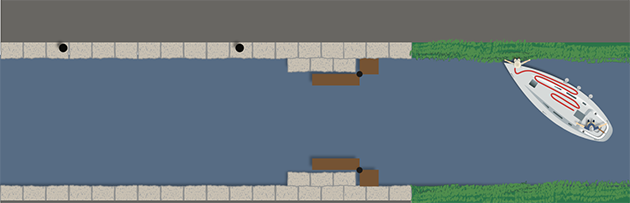
How to use locks: Going up step-by-step
Copyrighted Practical Boat Owner
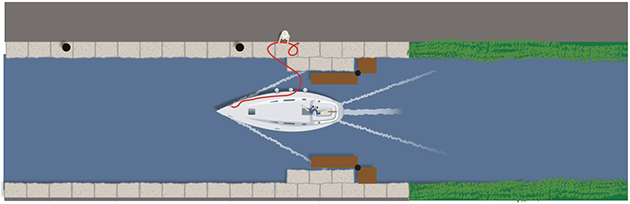
1. The skipper noses the bow into the bank (keeping the keel in deeper water) so that a crew member can hop ashore.
Copyrighted Practical Boat Owner
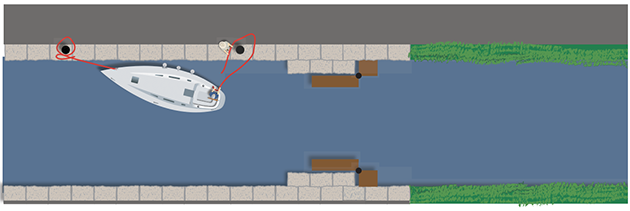
2. The skipper moves up to the side deck and throws the prepared for’ard warp up to crew, who then takes station at the for’ard bollard.
Copyrighted Practical Boat Owner
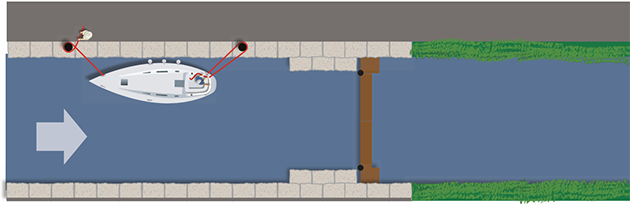
3. With a quick turn and a single hitch around the for’ard bollard the crew nips back to grab the aft warp.
Copyrighted Practical Boat Owner
4. So, safely secured, the for’ard warp is thereafter managed lock-side by the crew, the aft warp from the cockpit by the skipper.
Going downhill is easy
Going downhill is easy – yachts motor into a full lock and then sit on tranquil water while its level falls. There’s no need to put crew ashore beforehand because they can step ashore lockside.
Ensure, though, that fenders are low when you enter – and here, dangling mineral water bottles with an inch or two of canal water inside them saves hundreds of pounds’ worth of remedial work to gelcoats and paintwork. It’s a trick shown to me by a Cornish fisherman in Royan, before my first canal passage, and I’m always surprised that no one else seems to know about it. I feel indebted to him whenever I hear the salutary crackle of Volvic bottles against granite curbstones.
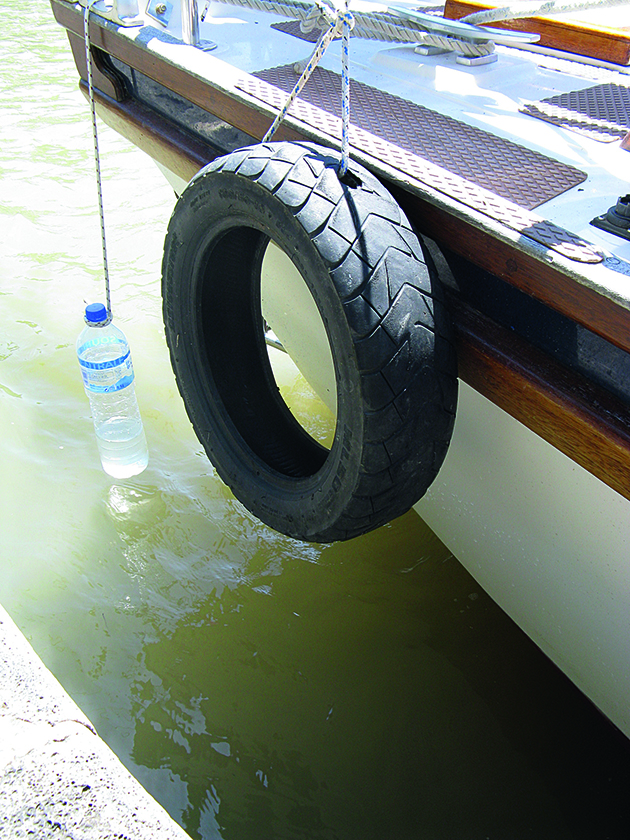
Fenders positioned for ascent and descent are useless with low freeboard locks; hence the use of mineral water bottles. A clove hitch keeps the bottle in place. Credit: Richard Hare
Fender positioning is always an issue but, as a rule, the more we have of it, the better. The dilemma, however, is how far up the hull should they be? Fenders
positioned to protect a hull as a yacht rises or falls in a lock are likely to be useless when the water is at full height.
Enter mineral water bottles: with the lids on tight they’re virtually indestructible – just try stamping on one.
As with going uphill it helps to take the same position in a lock, but it’s not so critical, because lock emptying is passive. Unlike ‘going up’, both warps are doubled back and managed easily from on deck.
How to use canal locks when going downhill: step-by-step
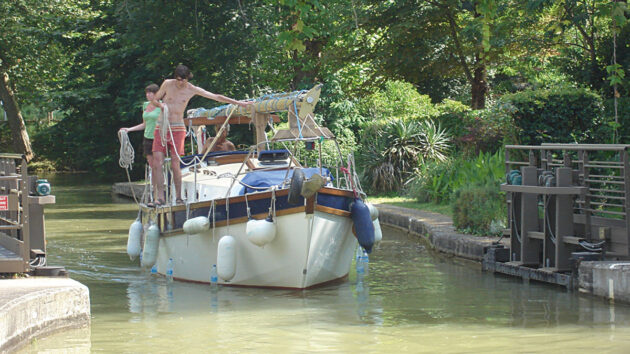
Credit: Richard Hare
1. With crew ready to step ashore, the boat glides in neutral into position.
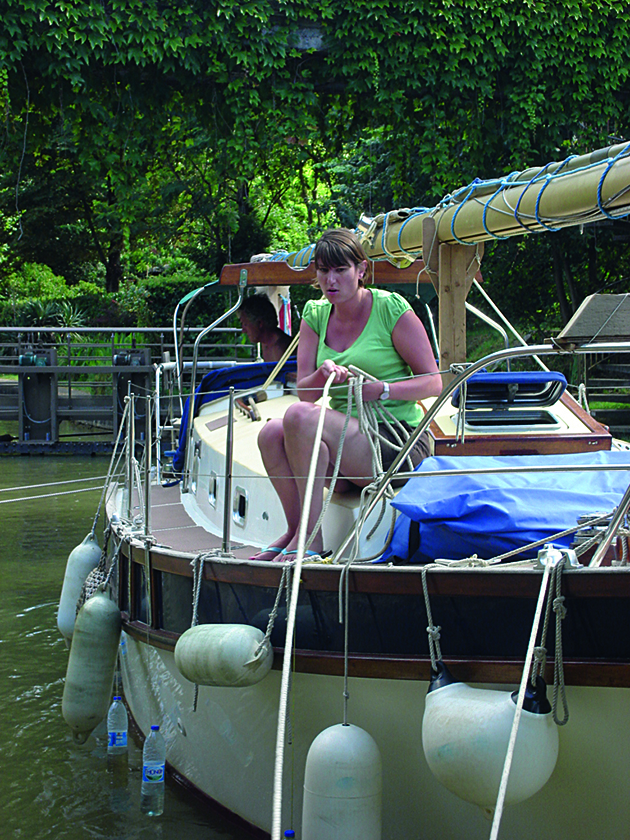
Credit: Richard Hare
2. Warps taken over the guardrail may be what’s needed in deep locks but…
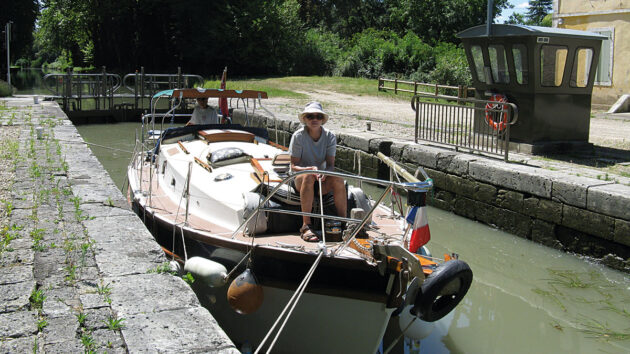
Credit: Richard Hare
3…they’re usually best taken through a fairlead when the water level begins to drop.
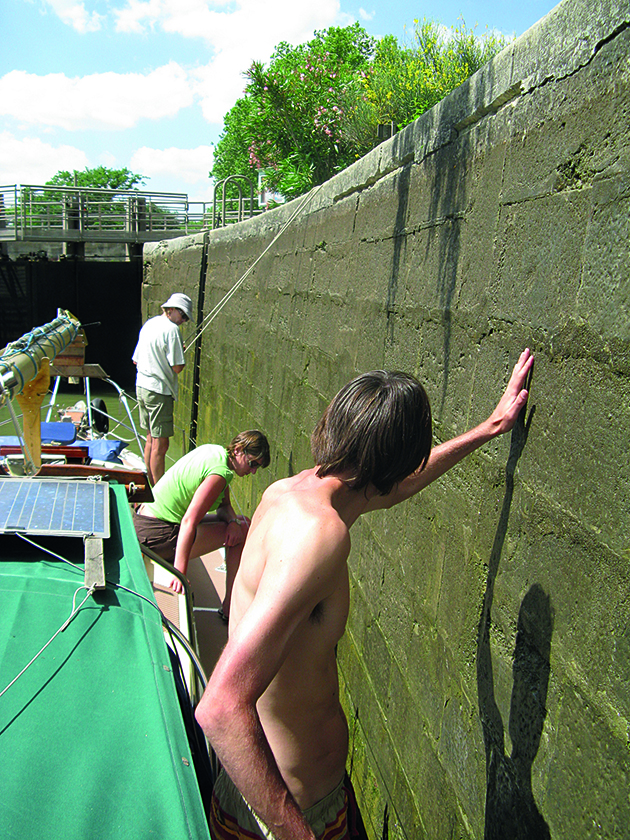
Credit: Richard Hare
4. As the water falls it’s a much more relaxed affair than going up, but keep the returned for’ard warp tight nonetheless.
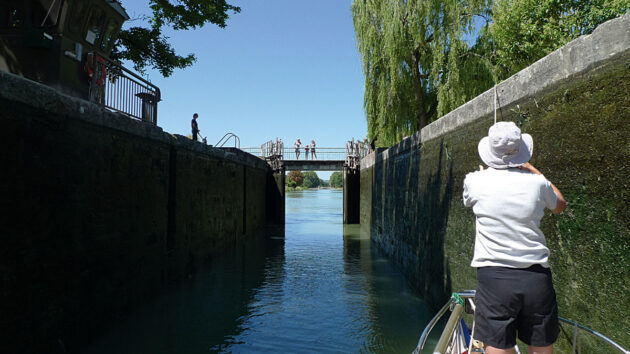
Credit: Richard Hare
5. With lock gates opening the boat slips the for’ard warp. You can now slip the stern warp, and you’re off again.
Keep warps tight!
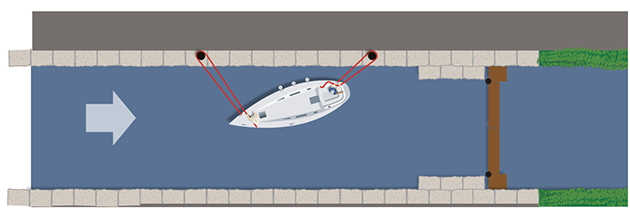
Albeit on the Garonne, not the Midi, our failure to keep the for’ard warp bar-taut was nearly catastrophic. We were then still doubling the for’ard warp back to the foredeck (we’ve never done it since).
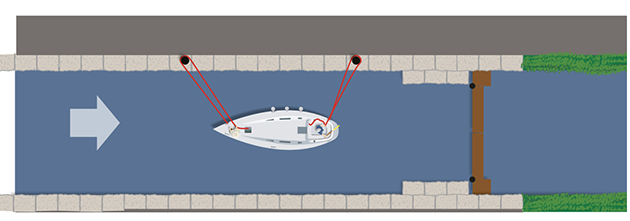
The surge caught the for’ard end of our yacht’s keel on the wrong side – forcing her bow out into the centre of the lock. It was impossible for Janie to bring her back alongside, given the weight of water. I tried to correct the situation, with potentially disastrous consequences, by helming her parallel to the lock wall while still only mid-way across the lock.
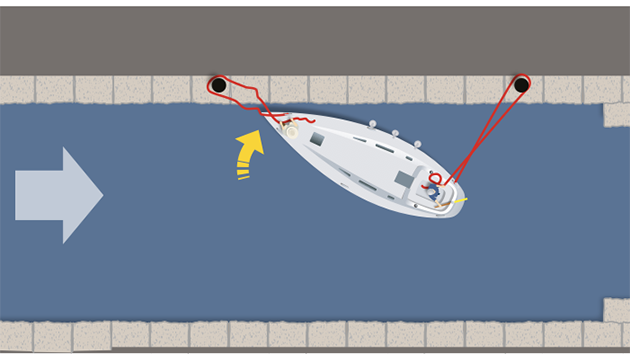
It worked to a limited extent, but the weight of the water then hit the other side of the keel and slammed the hull back against the lock wall with awesome force.
To this day our yacht carries the scars in her crushed iroko toerail. I was lucky – I got away with no more than a cracked rubbing strake and a bruised ego. I might easily have lost crew.
Chastened, we developed a system that has now worked well for three canal passages.
Janie takes up warp slack onto the quayside bollard the instant it’s offered. Meanwhile, the returned stern warp nips around a stern cleat and goes straight onto
the genoa winch that I wind steadily as the water rises. I also hold the helm over a tad to resist the bow from being thrown out.
So, the lesson is unambiguous – warps are as tight as possible.
What not to do!
1. With a slack for’ard warp the infl ow into the lock catches the keel and forces the bow away from the lock wall. The for’ard hand is unable to haul the bow in closer.
Copyrighted Practical Boat Owner
2. To counteract the situation, Richard ‘helmed’ the boat out into the lock in an attempt to reduce the strain on the for’ard warp.
Copyrighted Practical Boat Owner
3. The consequence was nearly disastrous. Lock inflow caught the keel on the other side and threw the hull against the lock wall.
Copyrighted Practical Boat Owner
French canal boating: the essential kit
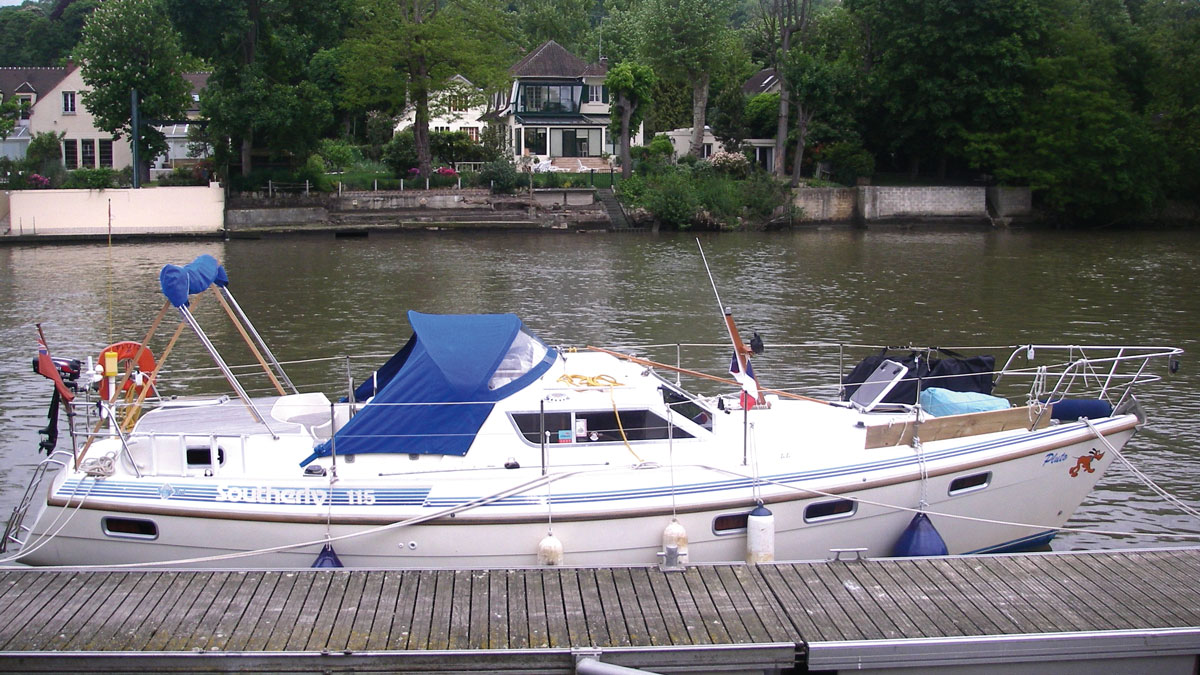
Julian and Vanessa Dussek took their Southerly 115 down through France to the Med, about 1,000 miles. Listed here are…

Best second-hand river yachts: sail and power
Duncan Kent highlights some of the most suitable sail and power boats under 35ft for exploring shallow coastal regions

Want to cruise the waterways of France? Here are the best sail and power boats for a memorable trip
The French inland waterways are an attractive route to the Med. Duncan Kent shares his pick of sub-40ft sail and…

Inland boating in the UK: a beginner’s guide
Rupert Holmes and Jonathan Mosse look at boats, seamanship skills, planning and destinations in their guide to inland boating in…
Want to read more seamanship articles like How to use canal locks?
A subscription to Practical Boat Owner magazine costs around 40% less than the cover price.
Print and digital editions are available through Magazines Direct – where you can also find the latest deals.
PBO is packed with information to help you get the most from boat ownership – whether sail or power.
-
-
-
- Take your DIY skills to the next level with trusted advice on boat maintenance and repairs
- Impartial, in-depth gear reviews
- Practical cruising tips for making the most of your time afloat
-
-
Follow us on Facebook, Instagram, TikTok and X