



Ali Wood meets skipper Will Collins to learn just how far a family will go to turn their bluewater cruiser, a vintage Oyster, into a home
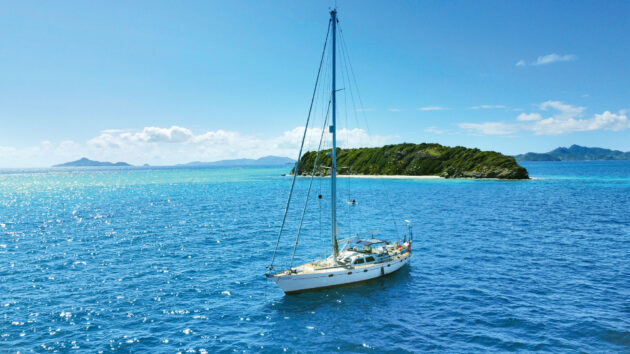
The minute you ring her doorbell it’s clear that Valent is a special boat.
Yes, doorbell.
Not your average ding-dong, but a catchy sea shanty that, like its owner Will Collins, exudes a sunny optimism that says, ‘welcome aboard!’
Just two days before the start of the ARC+ rally in Gran Canaria, Will is cooking lasagne for eight.
His wife, Suzy, is translating a Spanish grocery menu, and the girls Lucy (12) and Sophie (10) are making outfits for the costume party. Lucy explains the doorbell:
“We kept running on deck because we thought people were calling us, and then they weren’t. But then when they did want to come aboard we couldn’t hear them.”
The Collins’s are a family of problem solvers, and the doorbell, (its real use is to call Will during night watches if the captain is urgently required), is just a tiny example of the vast amount of work they’ve done to bring their 30-year-old Oyster up to spec.
Valent isn’t just a sailing boat but a family home, and though her refit has been fraught with obstacles, it has been beautifully documented in their family blog.
What started with some deck work and antifouling became an extensive four-year refit, and a testing voyage from the UK to the Canaries, hampered by breakages, strong winds and orcas.
Introducing vintage bluewater cruiser Valent
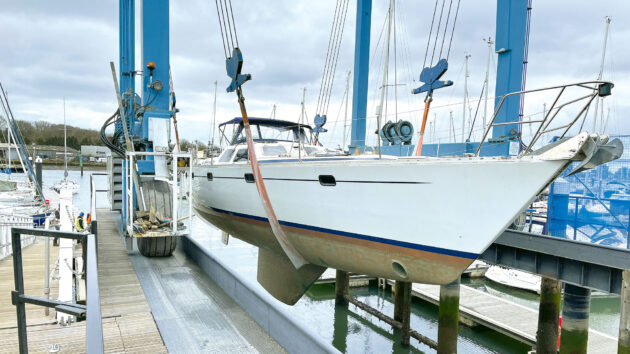
Valent goes back into the water after major deck repairs. Photo by Will Collins
Will has spent much of his life at sea, both in the Royal Navy and sailing and racing yachts. He left work in 2011 to look after the girls while Suzy worked for a London bank.
However, in 2019 the couple felt it was time to broaden their horizons.
They’d always dreamed of sailing the world with the girls, and so set about finding a bluewater boat.
Will found Valent in Empuriabrava, Costa Brava; one of the largest residential marinas in Europe.
The Oyster 55 was hull number 10 – one of the early Holman & Pye designs – dating back to 1988, and needed a significant amount of work.
The refit began in the autumn, and included replacing the worn deck with Flexiteek, the installation of a new bow-thruster and adding two holding tanks – a requirement for the Panama Canal and Galapagos islands.
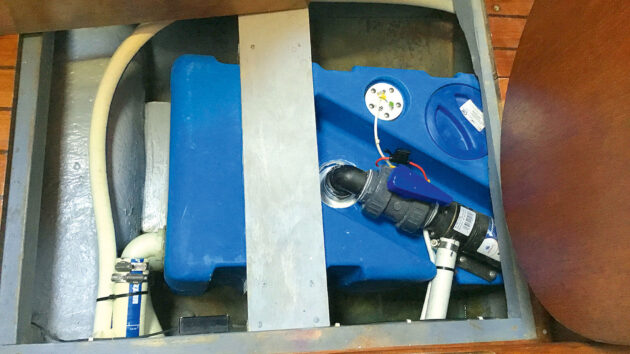
The black water tank. Photo by Will Collins
The aft tank was installed under the skipper’s bed, and the forward tank under the floorboards in the forward cabin.
“I was crossing my fingers they’d be airtight!” said Will.
Following a rewire, new electronics were installed with a smart new backboard to house the displays.
“We got the power on, inserted the new chip and hey presto, it worked!” said Will. “Not only that, but I successfully linked the chartplotter to the iPad and sat on deck viewing and controlling the plotter.
It was a wonderful sensation to get technology working correctly without too many wrong turns!”
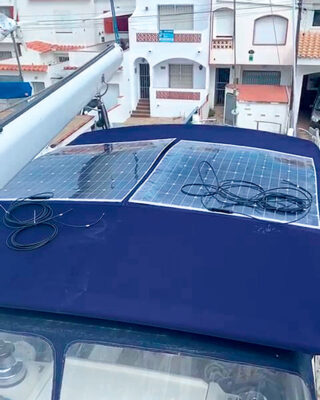
Solar panels were fitted to the new bimini. Photo by Will Collins
In the cockpit, Will fitted new displays to the pedestal as well as speakers.
On erecting the old bimini, it was clear the fittings were degraded and unlikely to last a decent breeze, so Will decided to replace the whole structure, with the bonus that it could accommodate flexible solar panels.
Once the Coppercoat antifoul was applied, along with the electric winches and kicker, it would be possible to launch and finish the refit on the water.
“We were making great progress, and started talking about dates to relaunch Valent. While there was lots to do, she was definitely looking more like the boat we envisaged,” Will said.
Pandemic hits
Will was due to fly out to Spain on 17 March 2020, with sea trials lined up for 21 March. The weather was glorious but then Covid-19 happened.
Spain shut down, shortly followed by the UK, and everything shuddered to a halt.
“We were so near and yet so far,” said Will. “There was no prospect of us being able to use Valent or indeed visit her in the foreseeable future.”
The family put their dream on hold. Even if they could return to the boat in six months, there was no way they could get her shipshape in time to cross the Atlantic.
They kept their fingers crossed for departing August 2021, and hopefully a more stable global situation.
Although a bad year for travel, the Pandemic triggered a significant boom in ‘staycations’, and the Collins family enjoyed their Beneteau First 310 Dogmatix in UK waters, before selling her to a sailor on the Hamble.
Still, they longed to be reunited with Valent.
Meanwhile in Spain, work on Valent continued, and she was launched in August. Unable to get there himself, Will commissioned the original marine surveyor to inspect the works.
There were a few snagging issues, but nothing major.
Homeward bound
In October 2020, Will was finally able to sail Valent back to the UK, and in order to meet the Covid travel restrictions he employed PYD professional yacht deliveries to bring Valent home and joined as crew.
The first stopover, in Gibraltar, was to collect the Hydrovane, Watt&Sea hydrogenerator and sat comms systems, which had been forwarded there.
They also topped up the main 585lt fuel tank, of which 564lt had been used on the long motor from Empuriabrava.
“We were pleased to find we’d used less than calculated: around 5lt/h, meaning we could do roughly 1,000 miles of motoring at 1,700rpm using both tanks.”
The last task was to collect hydraulic fluid for the autohelm.
As the spare oil had been inadvertently removed, the quantity of air left in the system – along with a loose connection – meant they’d had to hand-steer for the past three days. Will longed for more sleep!
After an efficient 90-minute layover, they set sail from Gibraltar with a following wind, making over 7 knots on the genoa alone.
Unfortunately the good weather wasn’t to last, necessitating a three-day stopover in Cascais – ‘a lovely town’ just outside of Lisbon in Portugal.
The crew used their time at anchor to fix some niggles.
They isolated a leak in the hot water system which was causing fresh water to discharge to the bilge, fixed some loose solar panel connections, replaced the headsail sheets and stripped down the outboard motor and cleaned it.
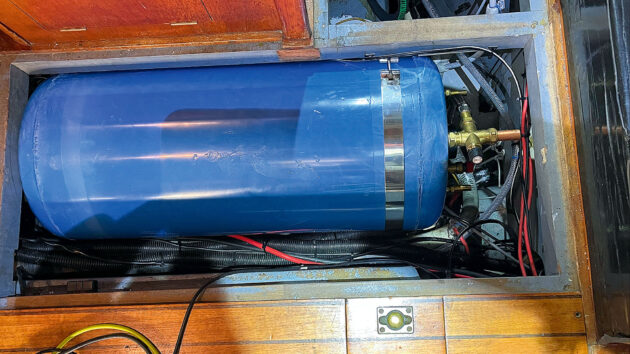
The new hot water system and 75lt calorifier
fit snugly in the old battery stowage. Photo by Will Collins
Will also took the opportunity to prepare some meals for the Biscay crossing, reasoning that it’s much easier to reheat a meal on a pitching boat than cook it from scratch.
With a galley stocked with chilli, cassoulet and braised lamb, they set sail at midnight on 15 October, ‘bouncing across Biscay’ and anchoring three days later in Camaret.
After breakfast and refuelling, they completed the 170 miles to the Needles and on to Haslar Marina in Portsmouth.
“It was a very quick trip back, in part because we held the northerly tide from Brest for around 10 hours. A lovely large engine and a favourable wind meant that we travelled fast enough to keep up with the tide and ahead of a front as it moved north-east across the Channel.”
Home at last, the next job was to learn how to run and operate the boat as a family.
Spring forward
After a winter in Haslar, Valent was moved to a yard in April 2021 to undergo the rest of her refit. Down came the mast, and in went a new hot water system, the Hydrovane, hydrogenerator and watermaker.
With Covid restrictions now eased, the family booked onto a one-day first aid course, learning skills such as CPR and using a defibrillator.
“The girls thoroughly enjoyed the day, asking lots of questions, and fully immersing themselves in the learning experience,” said Will.
The planned departure date was just round the corner, so Suzy handed in her notice and informed the school that the girls would be leaving in the summer.
However, by early May it was clear the trip was still in jeopardy due to Covid. World Cruising Club warned that it was thinking of cancelling the 2022 round-the-world rally, and so a few phone calls later Suzy got her job back and the girls were re-enrolled at school.
The World ARC was indeed cancelled in June, and the Collins’s dream postponed for another year.
Storm damage
Early in 2022, storms battered the UK, causing gelcoat damage to Valent, and then in February storms Dudley, Eunice and Franklin hit in short succession, with Eunice setting a new wind record for England at 122mph.
Valent fared reasonably well, or so Will thought, until he noticed a strange new addition to the rigging.
Leaning on the spreaders was the high-frequency radio aerial, which had snapped at the base. While not expensive enough to clear the insurance excess, there was at least an upside to the breakage, noted Will, ever the optimist.
“Since I needed a new HF aerial I could improve the setup and have the replacement use the backstay, getting rid of the whip aerial entirely.”
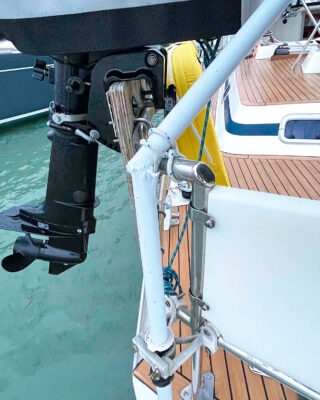
The snapped VHF aerial. Photo by Will Collins
Other jobs, not storm-related, including fitting the new, much quieter, Lewmar windlass, and the stowage of kit, spares and food. Lucy persuaded her dad that Valent needed colour-changing lightbulbs.
“With reluctance, I purchased them but was soon hooked! Each bulb can be switched off individually and set to a single colour, including red, which solves the challenge of night lights.”
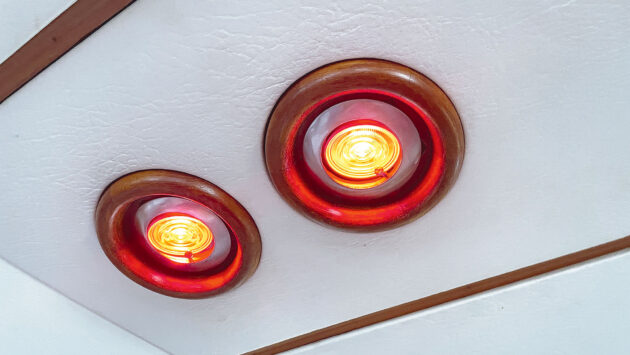
The colour-changing lighting was daughter Lucy’s idea. Photo by Ali Wood
By June, Covid restrictions had eased again so the Collins family took the opportunity to sail to France, slipping before 5am and arriving in Cherbourg late afternoon.
The French Border Police were friendly as they stamped the passports and the family spent a pleasant few days in Cherbourg buying wine and cheese, before heading to Alderney for a few hours’ exploration and dinner at Braye Beach Hotel.
Valent’s first family sailing trip could not have gone better, and they arrived back in time to celebrate Lucy’s birthday and the Queen’s Platinum Jubilee.
The to-do list was getting shorter, and Will’s final preparations included the installation of a new fuel pick-up system, enabling the smaller fuel tank (originally a water tank) to be the ‘day tank’ with the larger tank to be the reservoir that fills it.
In between the two tanks a scrubbing system was installed to clean and polish the fuel.
Star gazing
Will also fixed the galley plumbing, which seemed to come apart at the slightest knock, admitting, “I never knew that imperial pipes are measured on the bore diameter (inside) and that metric pipes are measured on the outside diameter. All I will say is thank goodness for these new flexible tubing joints.”
As well as all the new kit – including a replacement AIS – Will ordered a 1950s sextant from eBay.
He was delighted to find that his gamble was good, it was in superb condition and he even managed to get the light working again, and couldn’t wait to use the sun and stars to plot his way across the Atlantic and Pacific oceans.
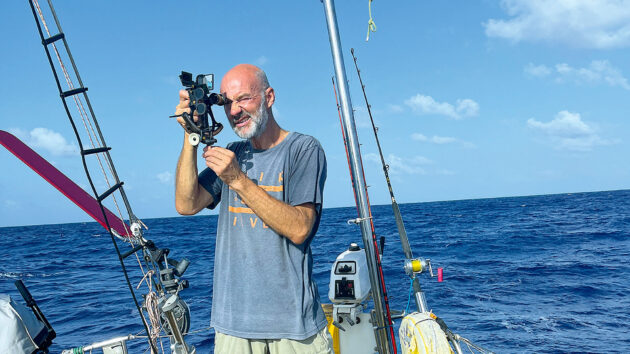
Will tries out the sextant. Photo by Will Collins
“Of course, the GPS should work, but where is the fun in that when you have time on your hands?”
An impressive 200lt of emergency bottled water was stowed in Valent’s nooks and crannies, on top of the 1,000lt tank and watermaker, which would produce around 60lt of desalinated water an hour.
The girls left school in July and over the summer the family spent some enjoyable weeks cruising the West Country and Isles of Scilly in between packing up the house in Woking.
They were on course to set sail for the Canaries for the ARC+ 2022 (to be followed by World ARC 2023) when two critical issues arose.
The first was a possible stress fracture on the bolts securing the foredeck plate (responsible for keeping the mast up) and the second, some delamination in the upper deck.
Dreadful news
Sadly, the delamination turned out to be more serious than first thought.
Water had built up in the wooden core, gradually separating it from the layers of ply, meaning the new deck was no longer bonded, nor the serious load-bearing fittings secure.
Were these to become subjected to stress at sea, the result could be catastrophic. Repairs would likely take three months, meaning they’d again miss the ARC+ rally.
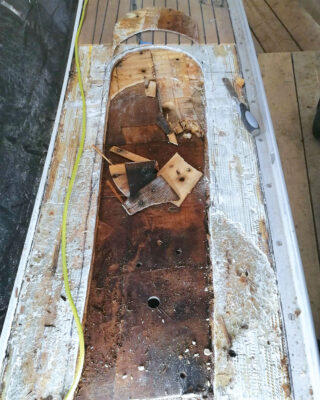
The delaminated deck was badly water damaged. Photo by Will Collins
“Valent’s deck was disintegrating. It was dreadful news,” said Will. “We were marooned in the UK with no boat and our house was already let out. We tried to stay positive, and focussed on getting Valent fixed and ready to go.”
They moved Valent to Ocean Quay Marina where Willett Built marine services would take charge of resolving the deck.
The girls continued being home-schooled and it was all manageable, and even enjoyable, reflected Will until the weather broke and storms came along.
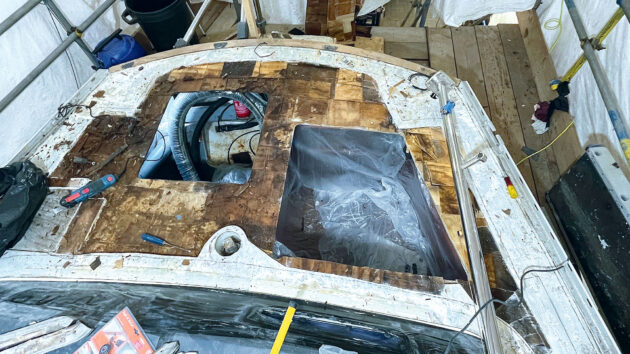
Stripping back the after deck. Photo by Will Collins
“With the hatches battened down (literally), an orange anchor buoy filling in where the mast should go and rags soaking up the drips, life became somewhat more challenging. The addition of an electric heater and a dehumidifier made a big difference.”
Valent was lifted out in November and transferred to a shed. Scaffolding was erected around the boat and every deck fitting labelled. The headlining came down and the cupboards were dismantled.
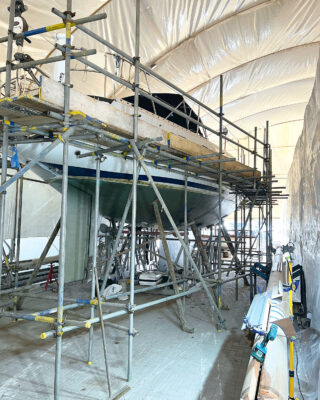
Scaffolding surrounds Valent for the deck delamination repairs. Photo by Will Collins
Once this was done the deck fittings were removed, including ‘an awful lot of nuts and bolts’ holding things down such as the genoa tracks.
Stripping the deck was a physically demanding and time-consuming task. Some areas were particularly wet, but further forward there was less water.
Moisture readings confirmed the only issues forward were due to leaky deck fittings, but that the aft third of the deck was in a bad way.
“We had a variety of different smells. The drier balsa had a pleasant marzipan smell. The rotten balsa had a smell that was rancid – reminiscent of the oil in an old deep fat fryer – and then we had the rotten ply. That smelled like leaf mould – just without as much structure!”
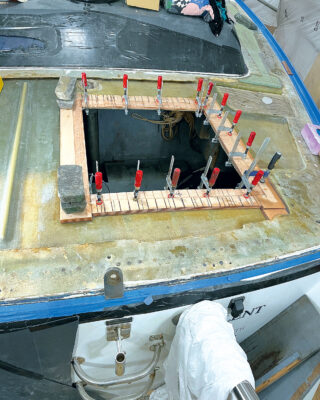
Work begins on the new aft deck hatch surround. Photo by Will Collins
Once the Flexiteek deck was up, the shipwrights cut out a top section of glassfibre skin to access the wooden core below, which was levered and chiselled out.
“The idea was to remove all of the old core and to dig back under the remaining fibreglass deck to create a cornice-like cave,” explained Will. “This allowed the new core to be retrofitted and provided a solid lip for it to be bonded to.”
As it was only the aft third, and not the whole deck that needed replacing, the Flexiteek could be patched in. During this process, Valent had hot air blown through to drive out as much moisture as possible.
No longer able to live on board, the Collins’s moved into a four-bedroom rental in Lymington. Will took the opportunity to get Valent rewired and upgrade the batteries to lithium.
Meanwhile Suzy and the girls settled into home-schooling in Lymington, enjoying the dry beds, walks to the seafront and the Saturday market.
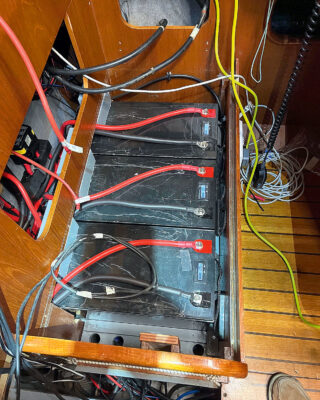
New batteries. Photo by Will Collins
Back on board their bluewater cruiser
The family made it back on board in March 2023, albeit to a boat that was, in Will’s words, “a tip”.
“Remembering which nooks and crannies everything went into proved difficult. Added to that our personal stuff had multiplied, with a UK winter having boosted our bulky clothing.”
Parts were needed as systems were tweaked, including the bow-thruster, VHF and anchor windlass relay, but there were no big jobs.
“All that was left to do now (other than tidy and sort) was to get to sunny and warm climes and win the lottery!”
Managing two of the three goals, they set sail in May and made it to France and the Channel Islands, where Will climbed the mast to fill some holes with silicone, while Lucy went up just for fun!
On the voyage over they trialled their new Blue Water Runner (BWR), a downwind sail best described as ‘two headsails sewn together’.
More challenges on Valent
After fixing the mast winches that control the spinnaker pole, they left Jersey in June, destination Spain. It was a breezy first 24-hours, causing yet more challenges.
The overworked hydrogenator caused a power surge, fusing some of the lights.
They discussed diverting to Brest, but as the forecast was much calmer around the corner of France, they continued across Biscay to northern Spain.
The following morning the headsail decided it had had enough of the crossing and the clew detached itself.
Not a problem as they had spare sails, but a job to be booked in with sailmakers in Cascais, Portugal.
With the wind getting lighter as forecast, they were now downwind in a pleasant Force 3, time for the BWR.
For the next 24 hours or so Valent glided along beautifully, all was good and the coast of Spain gradually came into view.
“This was the first big test for us as a family – 500 miles non-stop, spending three nights and four days at sea,” said Will.
“We all coped well, and the girls found their sea legs quickly, happily eating meals, watching the sun set, and going to sleep in their cabins. On five occasions we were visited by pods of dolphins who enjoyed swimming alongside the boat and occasionally performing a back flip!”
The family celebrated Lucy’s birthday on the last day of the crossing and, on arrival in Muxia on the north-west tip of Spain, went out for dinner.
Orca encounter
Delightful days followed as they sailed in and out of the Spanish rias of the Galician coast, swimming off the boat and exploring the old towns.
After Spain they were headed for Portugal. During the trip down the Portuguese coast, heading for Cascais to get the genoa repaired, the BWR was again deployed.
This time the BWR halyards deteriorated and the furling mechanism malfunctioned leading to a loss of the sail as the wind quickly picked up.
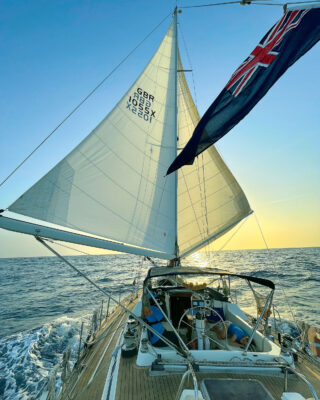
The evening sail plan of main and poled-out genoa. Photo by Will Collins
Due to the knock-on effect of various issues, Will ended up sailing into the anchorage at Cascais under main and staysail.
After a couple of days they moved down to Lisbon and spent an enjoyable week sorting out the sails.
Departing Lisbon the plan was to head to Gibraltar and visit a couple of other places along the way, especially Cadiz.
Valent departed Cadiz on 7 July. During the overnight leg in the Strait of Gibraltar, the boat lurched violently off-course.
“The autohelm was on, but suddenly the wheel spun uncontrollably and three orcas appeared alongside us,” recalled Will. “Every minute or so the rudder took a big knock.”
While the girls slept soundly, Will and Suzy motorsailed towards land but the orcas returned and gave the rudder several more whacks.
Fortunately there was no water ingress, but the steering was noticeably different.
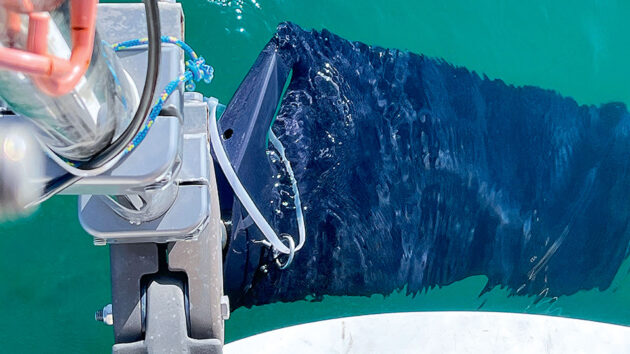
Orcas damaged the Hydrovane. Photo by Will Collins
At 0300 they reached the anchorage in Gibraltar and as they reduced speed, heard a nasty grating sound on turning the wheel.
It turned out the hydraulic steering ram was bent along with the Hydrovane shaft.
Valent required a lift out for a full check and the insurance company provided a surveyor. Incredibly, there were at least four other boats in the yard, all with rudder damage caused by orcas. Will considered himself lucky.
“The underneath of the boat was good. No issue with the bearings or brackets and – as the surveyor put it – no teeth marks or bites on the rudder!”
Valent was able to be relaunched and limped back around to Queensway Quay Marina. However, as parts needed to be sourced and shipped it would be another two months before the Collins family could leave their berth for the Canaries.
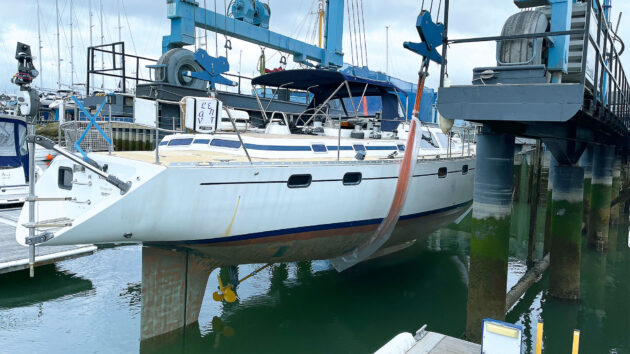
Valent is relaunched March 2023. Photo by Will Collins
Liveaboards in Gibraltar
Making the most of the unexpected stopover, they climbed the Rock of Gibraltar twice, visited the Great Siege tunnels and St Michael’s cave and embraced the liveaboard community at the marina.
In September, with Valent’s steering fixed, they set sail for Tangier, Morocco, which was quite a culture shock after the ‘very British Gibraltar’.
“There was the exotic scent of spices, with Arabic and French spoken everywhere,” said Will.
“Five times a day there was the call to prayer, but the girls took it all in, and enjoyed bartering for goods in the medina.”
The second night in Tangier they were surprised when all the nightlife around the marina suddenly went quiet.
After an amazing night’s sleep, not disturbed by background music, shouting, whistles and car horns, the reason became clear.
That night there’d been a significant earthquake in the Marrakech area, measuring 6.9 on the Richter scale. Tragically, nearly 3,000 people lost their lives.
After Tangier, they sailed up the Bouregreg river to Rabat and Sale and stocked up in the souk. This was possibly the highlight of the whole trip for Will.
They felt very welcome in the marina, once the entry formalities were over and the sniffer dog had done its stuff.
Valent then headed to Agadir in the south, a trip of 300 miles. However, the engine was labouring and kept cutting out.
Will identified the issue as air getting into the fuel line. He found a crack on the pre-filter and managed to change the base unit, which kept it going, but not smoothly.
It was ‘nerve-racking stuff’. In Agadir they had engineers check it over, and the family visited Marrakech and ventured to the edge of the Sahara desert.
On the 230-mile leg to Lanzarote, the Collins family experienced yet more wildlife, but fortunately of the more passive variety.
They were joined by several pods of dolphins and a flying fish, which landed on deck while trying to escape the tuna: a sure sign of being in the warmer waters of the Atlantic ocean.
On the second day, they saw a pilot whale: ‘a huge grey shape moving slowly at the surface of the water, which, after a flick of his tail, returned to the depths’.
The engine, despite being serviced, lost revs once more. Will changed the fuel filters and switched to the other tank, and they made it to Lanzarote before sunset.
After a few pleasant days at anchor (and some outboard engine repairs), they departed for the final 95-mile leg to Gran Canaria, which fortunately went without a hitch. Four years after they decided to take part in the ARC+ rally, they had finally arrived in Las Palmas!
Suzy and Sophie helped with preparations then left the boat. Meanwhile Will and Lucy took on some additional crewmembers for the transatlantic – one of whom came out with a big box containing a shiny new Starlink system.
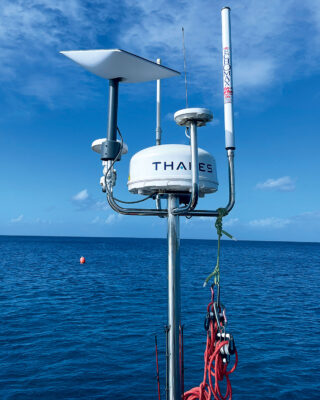
Starlink added for the Atlantic crossing. Photo by Will Collins
After resolving a few more issues, including the engine (it transpired the day tank was contaminated and needed scrubbing), taking delivery of a new Bora Parasail from Oxley Sails, working on the generator (which was now producing dirty exhaust water), refitting the new hydraulic steering system installed in Gibraltar and patching the headsail, they finally made it to the start line on 5 November 2023.
Postscript: Bidding Valent farewell
PBO waved off the Collins family, together with 94 other boats, and crossed our fingers that all would go to plan. After such a long journey, it was only fair they should have some good luck.
We covered their orca adventures in PBO August 2024, and shared some of Will’s excellent tips for keeping a shipshape galley.
The good news is, after all the heartache and hard graft of getting to the start, the transatlantic was, in Will’s words, ‘fairly uneventful’, with only minor breakages and plenty of fish.
The family were reunited in Grenada and spent six glorious months exploring the Caribbean, before Will and crew sailed home via the Azores.
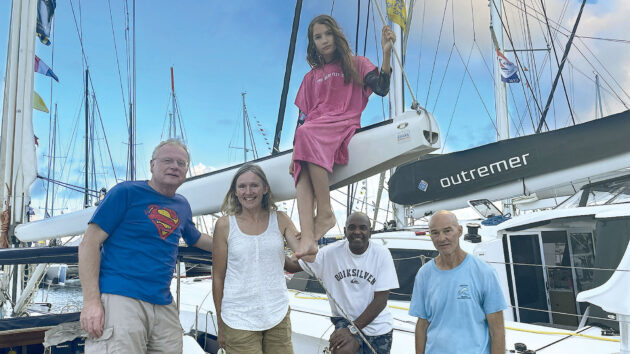
Family and crew at the ARC+ startline. Photo by Will Collins
They docked in Falmouth in June 2024, and returned to a lovely neighbourhood welcome in Woking.
Will’s sextant worked beautifully and he obtained his RYA Yachtmaster Ocean.
“We feel very lucky to have had such an amazing adventure, full of new experiences and discoveries, and to have spent precious time together as a family,” said Will.
Last December, with mixed emotions, they completed the sale of Valent, and Will signed off the family blog with the following note:
“Valent has looked after us well and showed her strength when required. A true blue water cruiser who eagerly awaits her next adventure. It’s farewell from her… and farewell from us.”
You can read the full story of the Collins family’s adventures at worldsuroyster.com
Glaciers, williwaw gusts & dodging drifting ice: Cruising the Beagle Channel with a French legend
Marina Guedes sails the Beagle Channel with Jérôme Poncet aboard Damien 2
6,000 miles solo in a £1 boat: lessons learned from an Atlantic Circuit
The wind was coming on like my brother Alex had warned me it would, as I approached the north side…
How we live the dream: sailors share their routes into bluewater sailing
There are many paths to bluewater cruising. Here boat owners share their stories with Ali Wood ahead of their transatlantic…

Equipping a boat for bluewater cruising
Factory boats are rarely ready for an ocean passage. Chet Chauhan explains the modifications he made to his Nautitech Open…
Want to read more articles like this?
A subscription to Practical Boat Owner magazine costs around 40% less than the cover price.
Print and digital editions are available through Magazines Direct – where you can also find the latest deals.
PBO is packed with information to help you get the most from boat ownership – whether sail or power.
-
-
-
- Take your DIY skills to the next level with trusted advice on boat maintenance and repairs
- Impartial, in-depth gear reviews
- Practical cruising tips for making the most of your time afloat
-
-
Follow us on Facebook, Instagram, TikTok and Twitter