



Clive Marsh explains what he looks for in a lightweight cruising dinghy
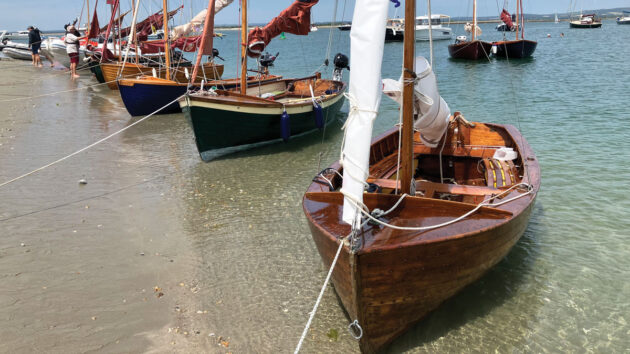
Between Dover and Portsmouth in the south-east of the UK, there are few places better for dinghy cruising than Chichester Harbour.
For those unfamiliar with this harbour, it is a large natural harbour in West Sussex and Hampshire and a protected area of outstanding natural beauty. It’s only a few hours’ drive from London and provides ideal saltwater launching sites. It has 17 miles of channels and direct access to the Solent and Isle of Wight. There are 10 villages within the harbour, anchorages, sandy beaches and some excellent hotels and restaurants that are all accessible by boat.
The harbour has 15 sailing clubs, six marinas, moorings galore and is home to more than 9,000 vessels. As you’d expect you’ll encounter every type of boat, but luckily we don’t all sail at once. I find there’s always plenty of room for dinghy sailing and it’s good to see such a wide variety of watercraft.
The harbour is an excellent location for gentle dinghy cruising with plenty of village stops, using the tides and wind to advantage to avoid the use of a motor. Breakfast at Bosham, lunch at Dell Quay, a swim at East Head and maybe dinner at Emsworth before returning to your hotel at Bosham or maybe Itchenor. To do this comfortably and to be able to pull up onto a beach or close to a pub, you can’t beat a good cruising dinghy. But what model is best?
Whenever I attend a Dinghy Cruising Association (DCA) event at Cobnor there are so many different types of dinghy, each ideally suited to their owner’s needs and budget. I have owned many types, all of which suited my needs at a point in time.
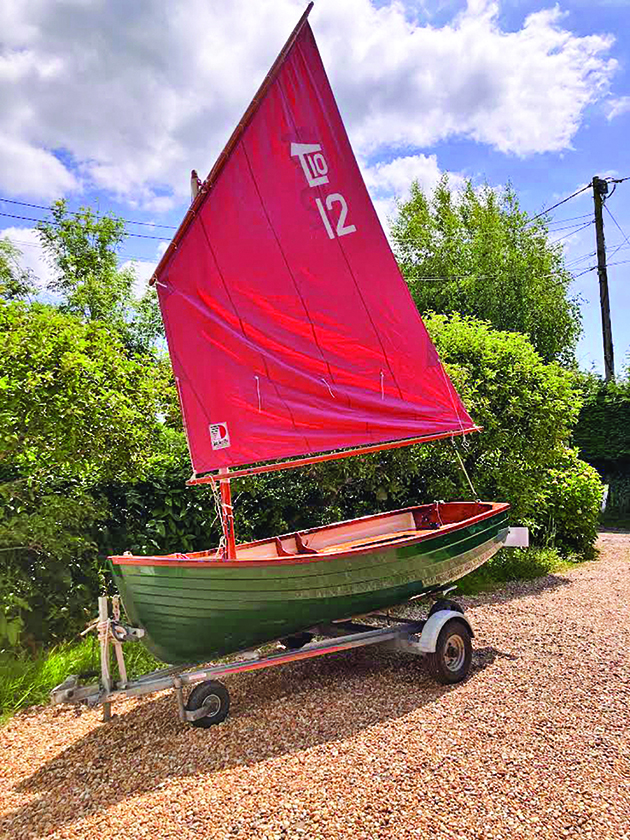
Clive’s Tideway 10 Lugger. Credit: Clive Marsh
These have included a Drascombe Lugger, Dabber, Lune Pilot, Sussex Beach Boat, Otter, Emsworth Lugger, Tideway, Tideway 10s, Foreland, Invicta, Yole, Smacks Boat, Cormorant and many others.
One of the deciding factors is whether the boat can be hand-launched or if a car is needed. I used to have bigger dinghies and launch by car, but now I prefer to launch from a trolley by hand – it’s a lot less hassle, especially when single-handed and gives me more launching options.
And if sailing with the DCA by arrangement from the Cobnor slipway you can only launch by hand. Moving from car-launched boats to hand-launched boats opens up many more launching sites. For hand launching a light boat you can use the trolley from a combination trolley/trailer. This will keep your road trailer bearings out of the water.
My definition of a light boat is one you can pull up a slipway unaided because there’ll be times when there is no-one else around. This all depends on the gradient of the slipway and your own strength and weight.
To help myself get a boat up a slipway there are a few things I can do:
- Have a long, thick rope that is easy to grip so you can pull the trolley and boat from the top of the slipway with your feet on flat land and out of the mud.
- Enlist any handy-looking passers-by. Most people like pulling a rope.
- Empty all heavy things from the boat, yard, boom, mast, rudder, dagger board, anchor, oars etc to make it a lot lighter.
- Don’t pull the boat directly up the slipway, pull it up at an angle if possible. This makes a huge difference.
Know your limits when choosing the perfect cruising dinghy
Your own weight will make a difference – a 350lb (158kg) boat has a huge advantage over a 140lb (64kg) sailor. If a heavy boat starts to pull you down the slipway just steer it back up the slope, this will stop it. Sounds obvious but I have seen people dragged down.
The 350lb (159kg) Cornish Cormorant was too heavy for me, so I moved on to a Tideway at 240-270lb (108-122kg). To this you must add the weight of the trolley and I needed to go even lighter. So, I went with a Tideway 10 weighing 165-198lb (75-90kg) depending on the rig. I find I can manage this weight alone in most conditions.
Of course, one of the lightest proper ‘sit in’ boats is the amazing Mirror dinghy which weighs in at only 98lb (46kg). There are more than 70,000 Mirrors built, and always a fair number to be seen at Chichester. One owner regularly sails his modified Mirror to the Isle of Wight. Some people change the rig to a lug sail and change the dagger board for a pivoting centreboard. Most people can pull one of these boats up a slipway.
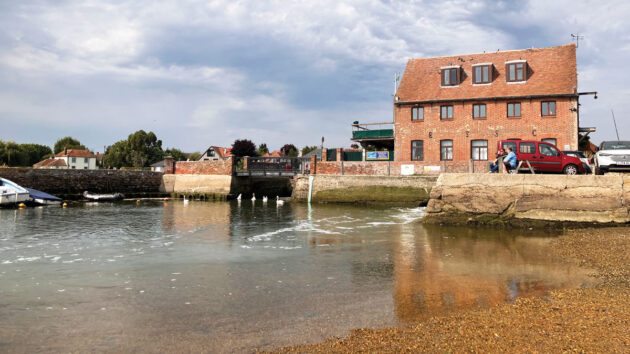
The little beach and hard at Emsworth. Credit: Clive Marsh
The 10ft 10in wooden Mirror is around half the weight of a 10ft 2in Tideway 10 and less than a third of the weight of a 12ft Cornish Cormorant, which is why so many people choose them. If you want to pull a sit-in cruising dinghy up a slipway single-handed, it’s worthwhile trying a few before buying.
I have included the Dabber in my comparisons because I did manage once to launch her by hand from Itchenor hard which is a gentle slope, but I needed the car to recover her.
For me, the maximum comfortable boat weight for single-handed launching from a trolley is now about 165lb (75kg). All of the cruising dinghies listed are ideal for Chichester Harbour, and I currently use Tideway 10s that I can move around on land on a trolley without developing another hernia.
Another favourite is the Emsworth Lugger. Like the Tideway 10 (lug), these have balanced lug sails that will point well enough as long as the luff is tight. They only take a moment to rig. However, I also sail a Tideway 10 with a gunter sail plus jib which points better and enables me to take a few liberties with the tides.
Another factor to consider is stepping the mast. The lightweight Tideway 10 (lug) and the Emsworth Lugger both have short masts that are easily stepped by hand. There’s no forestay or shrouds to fiddle with. They also have just one halyard, and both row nicely.
The Emsworth Lugger has the edge but the Tideway’s extra length and beam are better for carrying a passenger. So, for me, the best hand-launched cruising dinghy for pottering around the villages of Chichester Harbour is the Tideway 10 (lug sail). Be interesting to hear your preferences.
Length/hull weight comparisons
All weights and measurements are approximate for hull only
Mirror Dinghy: LOA – 10ft 10in (3.30m), Hull Weight – 98lb (45.5kg)
Emsworth Lugger: LOA – 9ft 3in (2.82m), Hull Weight – 125lb (57kg)
Gull: LOA – 11ft 0in (3.35m), Hull Weight – 160lb (73kg)
Tideway 10 (Lugsail): LOA – 10ft 2in (3.10m), Hull Weight – 165lb (75kg)
Tideway: LOA – 12ft 0in (3.66m), Hull Weight – 275lb (125kg)
Wanderer: LOA – 14ft 0in (4.27m), Hull Weight – 285lb (129kg)
Cornish Cormorant: LOA – 12ft 3in (3.73m), Hull Weight – 350lb (159kg)
Wayfarer: LOA – 15ft 10in (4.82m), Hull Weight – 372lb (167kg)
Drascombe Dabber: LOA – 15ft 6in (4.72m), Hull Weight – 550lb (250kg)

Drascombe & Devon Lugger vs the Dabber
Designed for safe family boating under sail, or or power, but taken long distance by intrepid sailors, Clive Marsh looks…
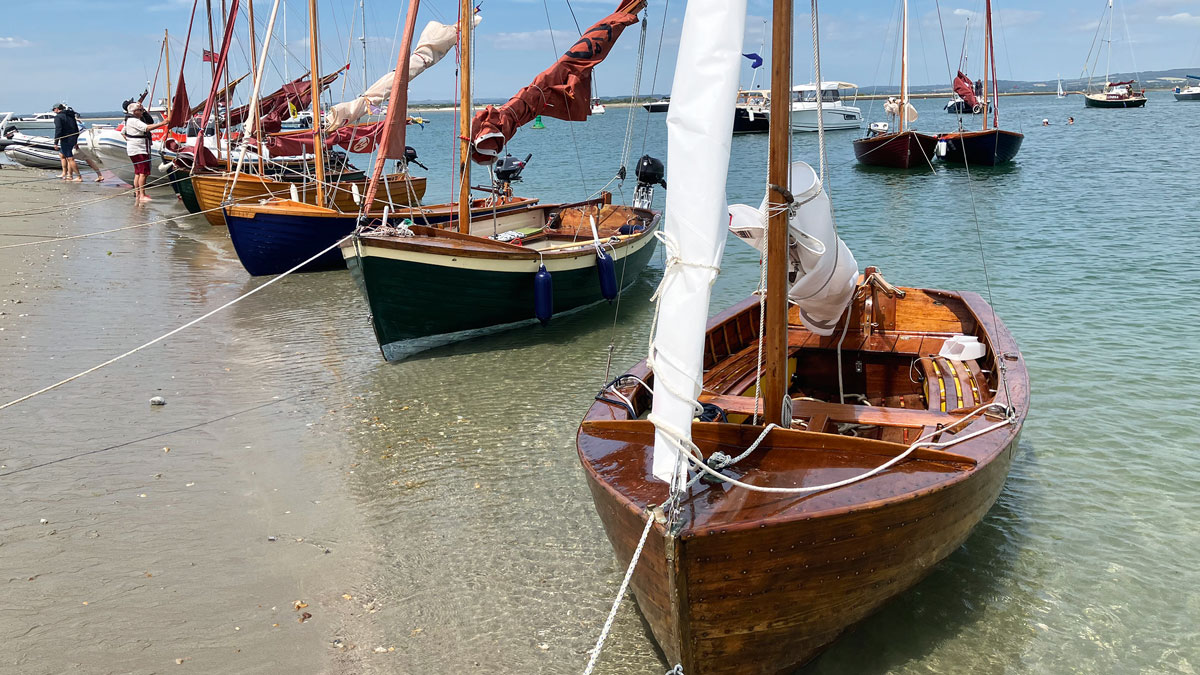
The Tideway dinghy: celebrating the classic trailer-sailer
While the 10ft option is easy to row and a delight to sail, Clive hails the 12ft trailer-sailer as one…
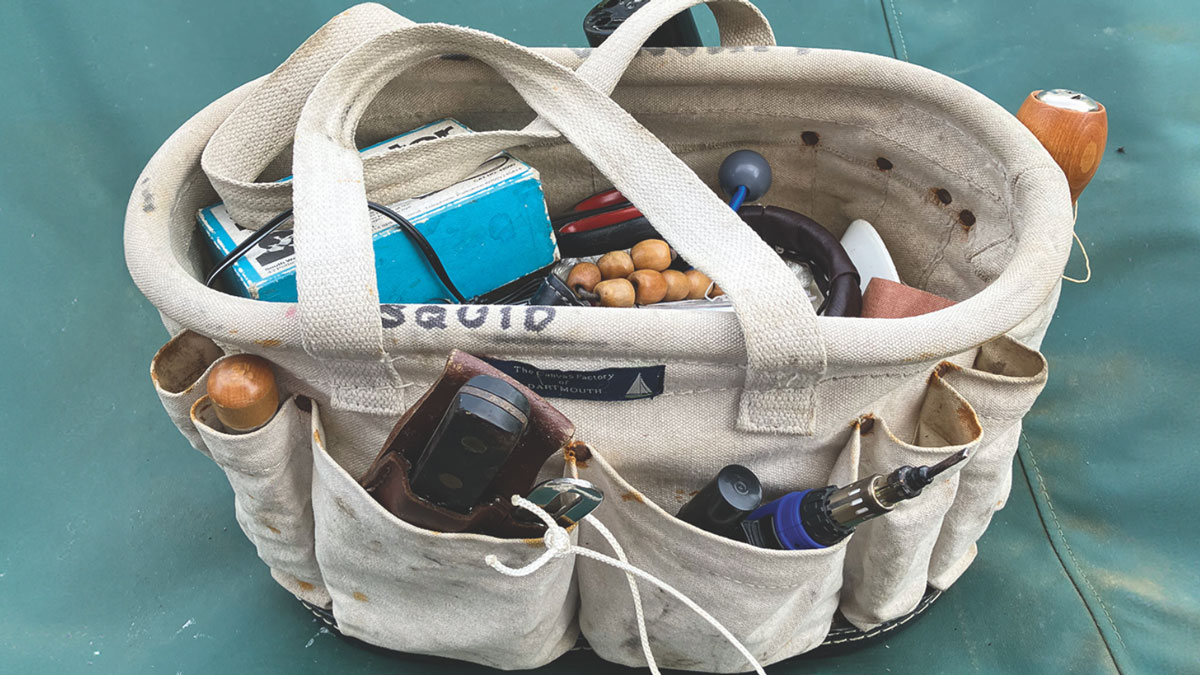
Why you should consider the weight of boat tools
Minimise the need for weighty tools on board by swapping metal parts with wood and rope, and muffling those you…
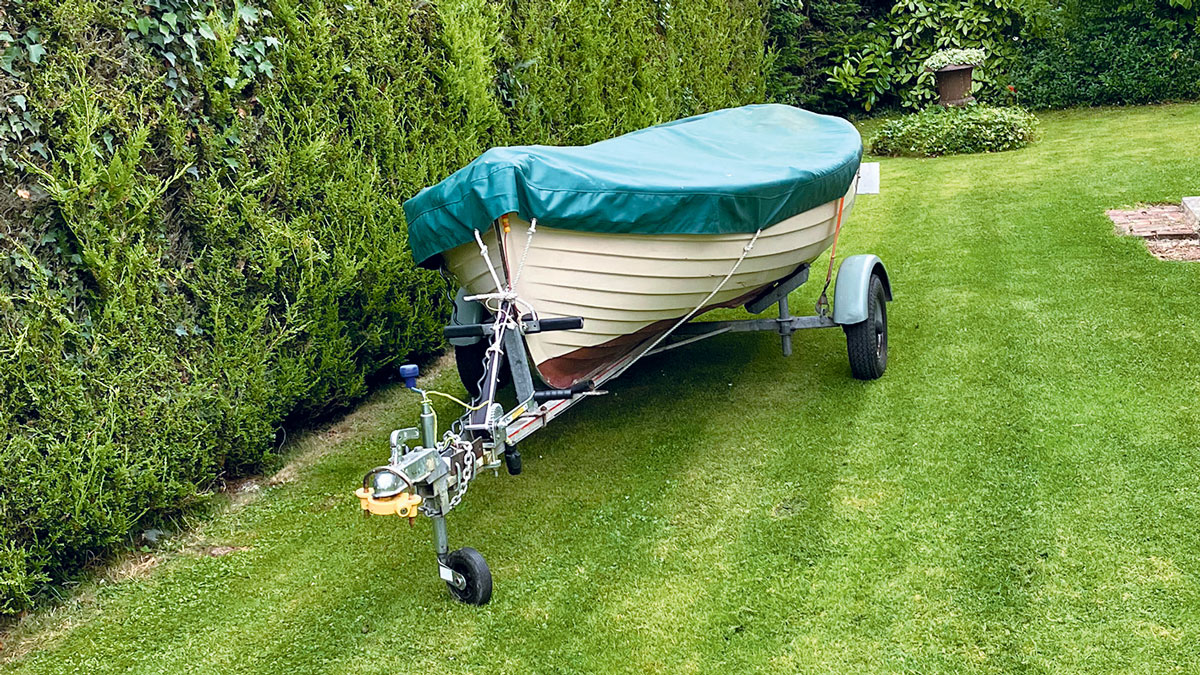
Why I have 5 boats in the garden
A variety of trailer-sailer options ensure maximum time on the water, says Clive Marsh
What to read more boat articles like Which is the best cruising dinghy?
A subscription to Practical Boat Owner magazine costs around 40% less than the cover price.
Print and digital editions are available through Magazines Direct – where you can also find the latest deals.
PBO is packed with information to help you get the most from boat ownership – whether sail or power.
-
-
-
- Take your DIY skills to the next level with trusted advice on boat maintenance and repairs
- Impartial, in-depth gear reviews
- Practical cruising tips for making the most of your time afloat
-
-
Follow us on Facebook, Instagram, TikTok and X