


A key snapping off in his Maxi 84’s ignition – in unfamiliar waters and tricky conditions, just when the engine is needed most – leads to some big decisions for Ian Craig
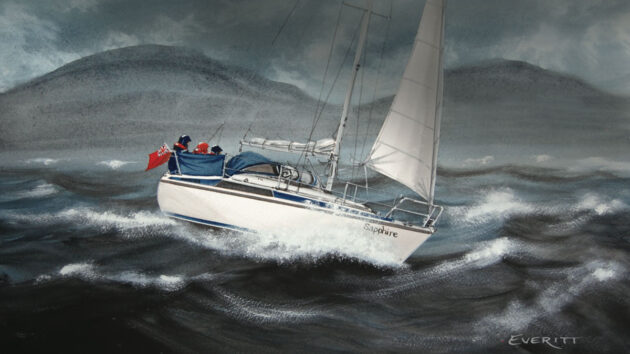
This wasn’t good. Here we were in a howling wind, driving rain and poor visibility, all sorts of dire warnings on the charts and in the pilot book about rocks and a tidal race, and now with no engine. It was hardly the relaxing, scenic first passage I’d planned for my new boat.
It had all started promisingly enough. A good number of years ago I’d bought Sapphire (formerly Jena), a Maxi 84, during the winter when she was lying at Cairnbaan on the banks of the Crinan Canal. I’d been offered temporary use of a mooring at Tayvallich, so that was to be my first destination after leaving the canal. I hadn’t sailed south from Crinan before.
In planning the passage, the critical point seemed to be negotiating the narrow gap with attendant rocks and hazards between Danna Island and the MacCormaig Isles before entering Loch Sween, so I was aiming to reach this point at slack water to avoid the tidal race. The rest of the trip looked fairly simple – heading south-southwest down the Sound of Jura from Crinan, just off the eastern shore, and a broadly reciprocal course back up Loch Sween to Tayvallich. I’d be sailing with my father and David, a colleague from work and a highly experienced sailor.
On the chosen Saturday morning the forecast was for easterly Force 5, but when we reached Crinan it seemed much windier than that, with trees and bushes bending over in the gusts. It looked like Force 6 or 7, but Sapphire wasn’t fitted with wind instruments at that time so I couldn’t check the wind speed.
In an onshore wind I’d never have contemplated going out, but since the wind was offshore I reasoned we could give it a try – the sea would be relatively flat. Over the years I’d seen another Maxi 84 out racing in all weathers with my local club at Troon, so I had no worries about the boat.
We headed out of the sea lock and, by the time we had filled up with fuel at Crinan Boatyard and cast off again, it was 12.50 – an hour or so later than I’d planned. Slack water was at 1515, and by then I had hoped to be 12 miles away, just off the MacCormaig Isles, for the tricky part of the passage. As we headed out of Loch Crinan with the wind behind us, no mainsail and only a fraction of the jib unfurled, we were still making nearly 6 knots through the water. This tended to confirm my impression of the wind strength.
There was a brief lull when we hoisted the main, but we very quickly dropped it again when the wind came back up and carried on under heavily-reefed jib alone. This was to remain our rig for the rest of the day.
Stuck in a tidal race
With heavy, driving rain and poor visibility it wasn’t the most enjoyable sail, but we were progressing quickly and soon made up the time from our late start. We reached the GPS waypoint I’d set up south-east of the islet Carraig an Daimh exactly at slack water, as intended. From there the plan was to motor into the headwind through the narrow passage between Danna Island and the MacCormaig Isles on a fixed heading to the next GPS waypoint. That would take us safely through the tidal race and other dangers and over to the entrance to Loch Sween.
I went to start the engine, but events then took an unexpected turn. Even though we were quite close inshore, the strength of the wind was enough to have built up short, steep waves, and the boat was bouncing about a little. As I tried to turn on the ignition, I was caught off balance and fell slightly on the key – which promptly broke in two. The break was so clean that we couldn’t get any purchase on the end of the key left in the ignition, so we couldn’t either remove or turn it.
The ignition was comprehensively jammed, and none of us had the technical expertise to tackle the mass of wiring behind the ignition panel. We couldn’t start the engine.
So, now we had rain pouring down, the intimidating screech of the wind in the rigging, limited visibility, a boat we hadn’t sailed before, waters we didn’t know, and no engine to navigate a tidal race – the trickiest part of the passage. What should we do?
Well, as I saw it, we had three options. The first was a risky attempt to tack up through the channel pretty much directly into the wind, but for me this really wasn’t a starter – the channel was too narrow and hidden rocks were waiting to catch us out if we strayed even marginally off course.
The next was to turn round and head back for Crinan, but I was worried that without the engine, if the wind dropped as forecast (however unlikely that seemed at the time), we could end up adrift and at the mercy of the tidal current in the Sound of Jura – who knows where we might end up? Even if we did reach Loch Crinan, there was then the question of where to moor or anchor, and the canal sea lock would certainly be untenable under sail in these conditions.
The final option was to head further south, tack beyond the MacCormaig Isles and then reach back up to Loch Sween. This had us with little or no sea room and closer to rocks, islands and potentially stronger currents. However, as long as the wind held for long enough to get us into the relative sanctuary of the loch and away from these hazards, I reckoned at worst we could then anchor somehow if necessary. So, option three it was.
Frayed nerves
Nerves were a bit frayed on board, and at that point I was wishing I was somewhere… anywhere… on dry land. If ever there was a time when I seriously wondered what the attraction of sailing was, this was it. We had a debate about whether we should contact the coastguard or even put out a pan-pan call. In the end we took the view that we were still sailing under control, so we ought to be self-reliant and shouldn’t really trouble the coastguard unless or until our plight deteriorated further.
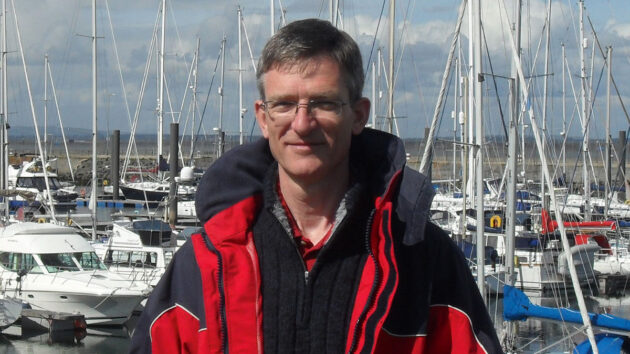
Ian Craig is a chartered surveyor. He sold Sapphire several years ago before buying Andiamo, a Sadler 29 –sticking to lighter winds
We headed on south and tacked once we were beyond the MacCormaig Isles, still under reefed genoa only. Headlands south of Loch Sween loomed out of the murk, but just merged disorientingly into each other. We had to use the instruments to make any sense of where we were, even though we were close to land and what should have been clearly identifiable features.
Despite making over 5 knots, the tacking seemed to drag on interminably, and there was a nagging concern that the tidal current would soon be building.
Eventually we cleared Eilean Gamhna, the most north-easterly of the MacCormaig Isles. By 1645 we were in the comparative safety of Loch Sween and at last away from the threat of strong tidal current. We charged up the loch at over 6 knots, Sapphire over-canvassed at times even with no mainsail and just the partly-furled jib. The wind came in fierce gusts through the gaps in the hills, but I was anxious to keep up the boat speed in case the wind fell away, so we didn’t reduce sail further.
After a very fast run we reached Tayvallich, the easterly wind fortunately behind us as we passed through the narrow entrance into the natural harbour. Finally we picked up our borrowed mooring, under sail, at exactly 1800 – just when the wind died completely. After the trials and tribulations of the day, the Tayvallich Inn and a welcome bite of supper was a great way to relax.
Lessons Learned
- Should we have gone out, even unknowingly, into what may well have been a Force 7? I still think the decision to go was a reasonable call, and if anything the strength of the wind actually helped us reach our destination quickly.
- While it was daunting, the wind in itself wasn’t the source of our problems – we couldn’t have predicted a broken key and jammed ignition.
- Knowing how to bypass the cockpit ignition system to start the engine without the key would have been a useful skill.
- The temptation was to panic but, looking at the situation objectively, we had a seaworthy boat and experienced crew, and were still sailing under control – but maybe it would have done no harm to at least make the coastguard aware of our circumstances.

Maxi 84: roomy, capable & rewarding to sail
Why has the Maxi 84 proved so popular since her launch 45 years ago? David Harding sailed Maximus, the ‘work…

Tidal races, overfalls, and headlands: how to prepare for challenging waters
Sailing around a headland in the British Isles will nearly always involve an encounter with tricky tidal races and overfalls,…

How to sail tidal estuaries safely
On tidal estuaries boat owners can become explorers. Ken Endean has advice for potential creek crawlers
Understanding tidal streams and heights
Understanding tidal streams and heights is essential for passage planning and safe navigation. The RYA's former chief examiner, James Stevens,…
Want to read more seamanship articles like Trapped in a tidal race: Lessons learned from a mid-passage breakdown during a gale?
A subscription to Practical Boat Owner magazine costs around 40% less than the cover price.
Print and digital editions are available through Magazines Direct – where you can also find the latest deals.
PBO is packed with information to help you get the most from boat ownership – whether sail or power.
-
-
-
- Take your DIY skills to the next level with trusted advice on boat maintenance and repairs
- Impartial, in-depth gear reviews
- Practical cruising tips for making the most of your time afloat
-
-
Follow us on Facebook, Instagram, TikTok and X