


An example of the new breed of river cruiser, the SunCamper 31 looks unlike anything most of us have seen before – but there’s a very good reason for that, as David Harding explains
SunCamper 31: “a highly practical river cruiser that can punch across a lake if needed”

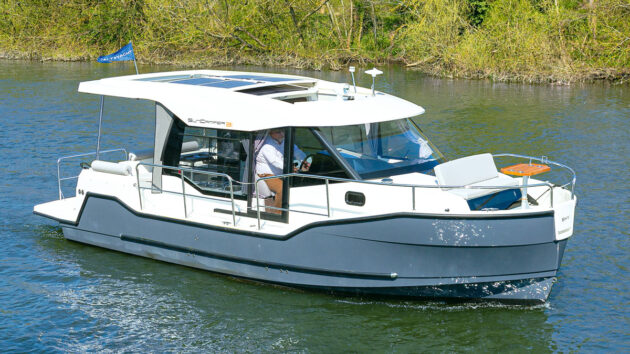
When a sailor describes a boat as looking like a floating caravan, it’s not usually meant as a compliment. So bear with me when, as a sailor, I describe the SunCamper 31 as looking like a floating caravan.
Actually it’s more like a floating motorhome, since it’s self-propelled, but that’s a detail.
When sailors speak in such terms about a sailing yacht, they mean that it’s boxy, bloated and perhaps not the most aesthetically pleasing they have ever seen. They’re also suggesting that it probably wouldn’t sail particularly well and is not a vessel in which they’d choose to venture far from land.
In the case of motorboats, especially those designed for inland waters, perspectives have to be rather different. For cruising up and down the non-tidal Thames, for example, isn’t a floating motorhome exactly what you want? It doesn’t have to cope with rough weather, it’s not allowed to go faster than 4 knots and, when you want to stop, you pop into a marina or moor alongside the riverbank.
Such a boat has to have a degree of manoeuvrability and to fit into locks and marina berths, and it’s better if it doesn’t kick up an enormous wash. Those constraints apart, it can be designed purely for maximum space and practicality below and above decks.
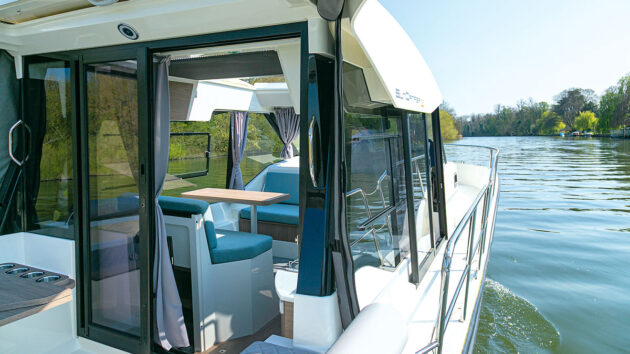
Big windows and wide-opening door to the saloon give a good view forward from the cockpit. Credit: David Harding
Ideally it would be like a motorhome with a pop-up conservatory tent, a patch of garden behind a windbreak, an outside decking area and somewhere to keep your bicycles. Everything except, please, the fairy lights.
When you think about all that, you can’t help but wonder why so many inland motorboats look not unlike their coastal brethren. They might have bigger windows and smaller engines – or they might not – but in other respects they’re often remarkably similar.
Coastal motorboats have a habit of gravitating towards the Thames in their old age, and some river cruisers make their way to the sea now and again. As often as not, however, a river cruiser will remain a river cruiser, so why not have one that’s designed specifically for that purpose?
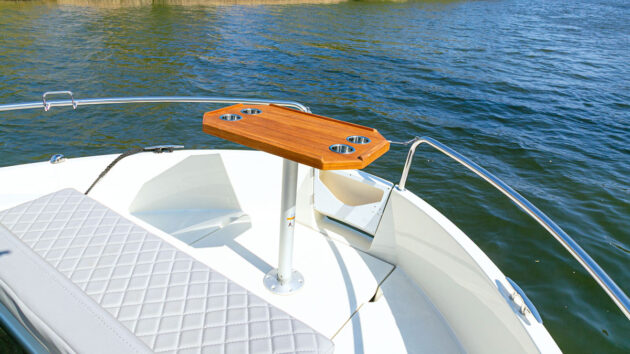
Seating and a table in the wide bow, with a gate for easier boarding if you’re moored bows-to. Credit: David Harding
The SunCamper 31 was designed specifically for that purpose, though with its Category C rating under the RCD (Recreational Craft Directive), it could theoretically be used in coastal waters too. The fact that it was designed and built in Poland makes it no less suited to the Thames or to rivers, lakes or canals anywhere else in the UK or Europe. Interestingly, like the Delphia 11, the SunCamper 31 comes from the drawing board of a designer known for his sailing boats.
In the Delphia’s case, that’s Tony Castro. The SunCamper’s designer, Jacek Centkowski, is perhaps less of a household name in the sailing world, but has been responsible for a fair few small cruisers, including Jeanneau’s extremely pretty little Sun Fast 20.
Establishing a brand
As for the builders – well, Balt Yacht is a name that few people in the UK will have heard of. Since 1990, however, it has been responsible for over 19,000 boats. Like many Polish builders, it built vessels under contract for well-known names including, in this case, Jeanneau, X-Yachts and Brunswick, before developing its own brands. So both the designer and builder have a pedigree, which is reassuring.
And the boat itself? One thing for sure is that it looks different, and that’s simply a consequence of form following function. Most definitely not like a de-tuned coastal cruiser, it’s more akin to the camper van with the conservatory, decking and bicycle rack.
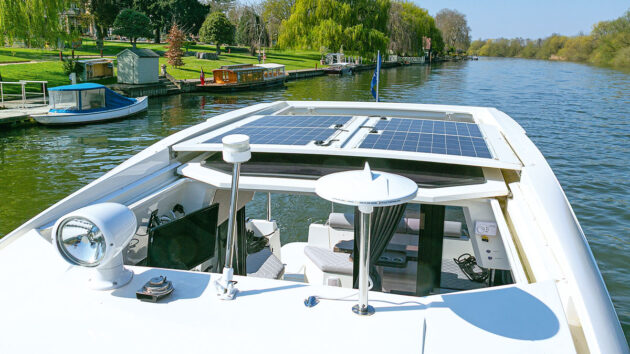
The space between the opening sunroofs over the saloon and cockpit can house solar panels. Credit: David Harding
For example, it has a large platform at the stern (with a removable section that allows the outboard to be tilted up fully so you can reach the propeller). The platform is 400mm (16in) above the water – the same height as many pontoons – for easy boarding. At its aft end is a stainless steel railing for security and somewhere to keep your bikes.
From the platform, you walk through the transom door into the cockpit. Here you find yourself under a hard-top that’s an extension of the cabin roof, and in which you can slide open the sun-roof to make the cockpit almost completely open. Should the weather invite you to enclose rather than open up the cockpit, you can drop down the canopy that rolls up to stow away under the hard-top.
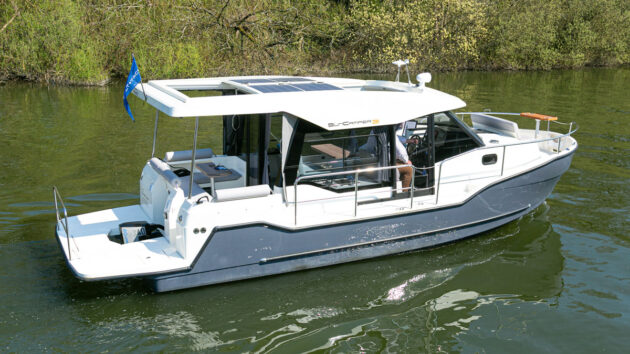
Twin sunroofs can be opened to let the sunshine in to the cockpit and saloon. Credit: David Harding
Moving forward again, into the cabin, you find enormous windows with opening centre sections for ventilation. In the middle of the boat, the windows come down as low as the galley worktop to starboard and the level of the seats in the dinette to port. Light is plentiful in here, especially with the large, opening sunroof over the saloon too.
Something else you’re unlikely to find on older or coastal-cruising designs is the opening door in the raised bulwarks at the bow for easy boarding if you’re berthed bow-to. Up here you also find a seat built into the forward end of the cabin top. A table right in the bow gives you somewhere to put your drinks. The base for the table’s leg is bolted to a section of the deck’s moulding that hinges up to reveal the anchor well.
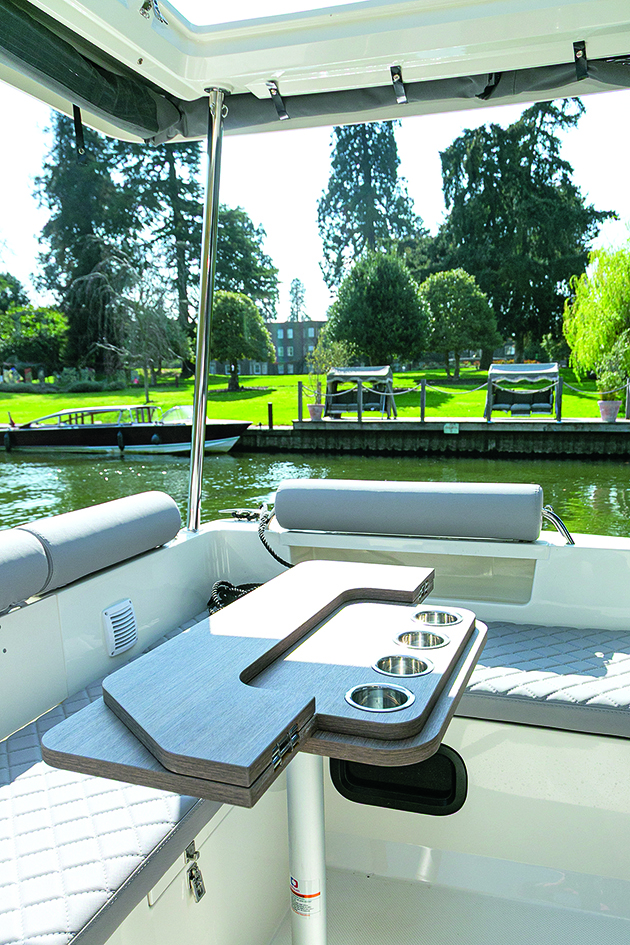
Good seating in the cockpit, and a handy table that folds every which way. Credit: David Harding
All these features make a lot of sense on a river-cruiser and account for the unconventional appearance. It still has to possess boat-like characteristics, however, and plenty of thought has gone into the hull.
The more easily-driven it is, the less power is needed to push it along and, as a rule, the less wash it will create. That’s important on inland waterways.
Green and quiet
When you’re going at only 4 knots or so, no conventional engine on a boat of this size is going to drink a vast amount of fuel, and you will be able to carry enough to take you a long way. If, by contrast, you’re using electric power, you need to be more energy-conscious because batteries will give you a shorter range.
Our test boat did use electric power and was the first electric SunCamper 31 to be built. Balt Yacht didn’t want to offer electric propulsion until happy that it would be every bit as good as a petrol outboard.
Perhaps the first thing to say is that you charge from a normal 16A marina socket. An overnight charge will fully top up the batteries. The motor with the electric option is ePropulsion’s x40, with a power output equivalent to a 50hp petrol outboard (Yamaha’s 50hp 4-stroke is supplied as standard). It uses a bank of four 96V 100Ah lithium iron phosphate batteries (as opposed to the commonly seen lithium-ion), which should keep you going at four knots for 16 hours.
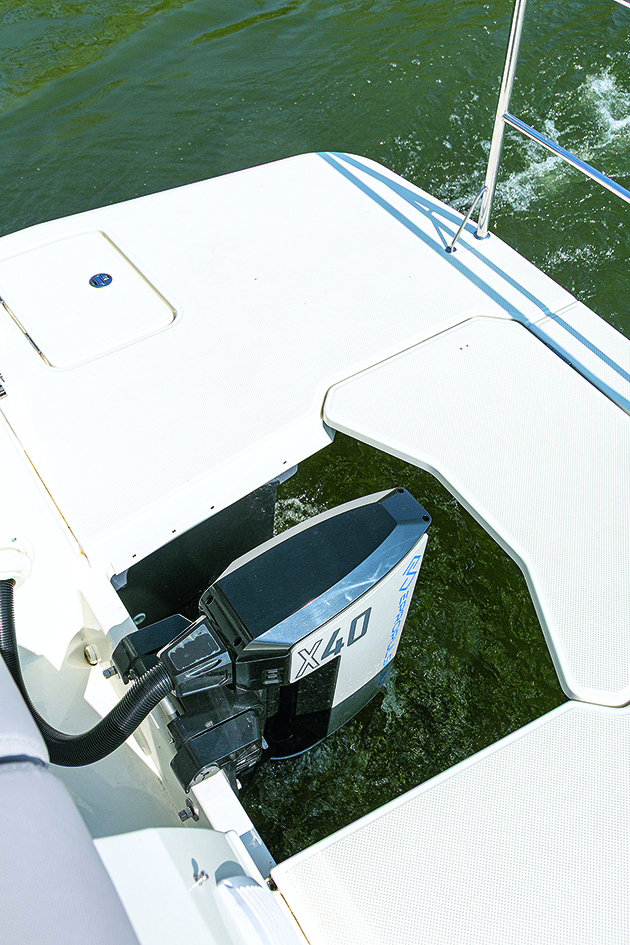
Electric propulsion is in the form of the 40kW ePropulsion X40 motor. The hinged panel in the platform allows the motor to be tilted so the prop is clear of the water. Credit: David Harding
On the Thames, that would take you from Bray (home to Bray Marine Sales, the UK SunCamper dealers) to Henley and back and still leave 20% in reserve.
A typical range with electric-powered motor cruisers is closer to 5-6 hours. The range of the SunCamper 31 is principally a function of the substantial battery capacity and an efficient hull form. If you open the throttle all the way to reach the top speed of around 8 knots (not legal on the Thames for starters), you will have about 1.5 hours’ running, so going gently will get you a lot further.
If you’re using the boat where you need more speed, a larger petrol outboard is the answer. Yamaha’s 115hp should give you around 11 knots. A 29hp shaft-driving diesel inboard is another option.
Apart from the question of range, a major consideration with electric propulsion is the initial cost. In its basic form with the Yamaha 50hp 4-stroke, the SunCamper 31 costs from just under £140,000. With electric propulsion, it’s a penny or two shy of £200,000.
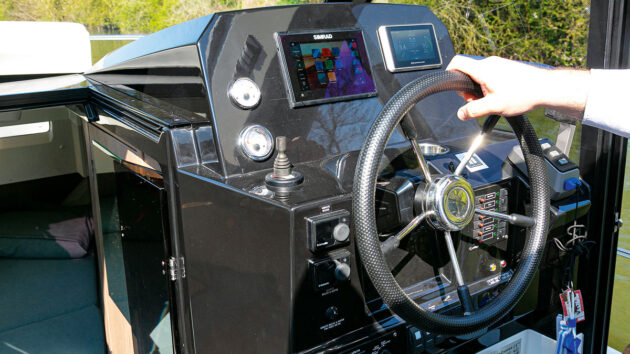
The helm console provides space for instrumentation and control systems. Its angled top creates headroom in the heads below. Credit: David Harding
That’s a big difference but, if you take a long-term view, the costs might work out lower, given that the batteries should last for 3,000 cycles. If a cycle gives you an average of 9 hours, that’s a total life of 27,000 hours. A typical servicing interval for a petrol outboard is 150 hours, and a service might cost £400, so it doesn’t take much calculation to work out the potential savings over time.
What you can say for sure with electric power is that it’s quiet. It improves manoeuvrability, too: being appreciably slimmer than a petrol outboard, the x40 can turn about 45° each way – as opposed to 30° with the 4-strokes – so the turning circle is impressively tight.
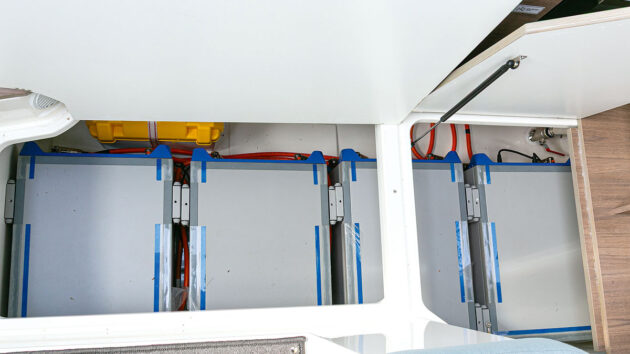
If you choose electric power, the four 96V 100Ah lithium iron phosphate batteries live beneath the sole in the saloon. Credit: David Harding
The SunCamper 31 also turns much more positively than you might expect. If you approach a turn slowly, then give a burst of throttle while applying full lock, you will spin in little more than a boat’s length.
Back and forth
Unusually, the SunCamper 31 has three full-length keels. They should help protect the bottom of the hull, though to what extent they contribute to the surprising manoeuvrability is hard to say. It’s even possible to steer in reverse, which you can’t do with many boats.
A bow-thruster is fitted as standard and a stern-thruster can be added. In open water, the SunCamper’s tendency to keep a straight course, combined with the quiet running and the light and responsive hydraulic steering, makes for easy cruising. The wash is modest, too, suggesting a low-drag hull.
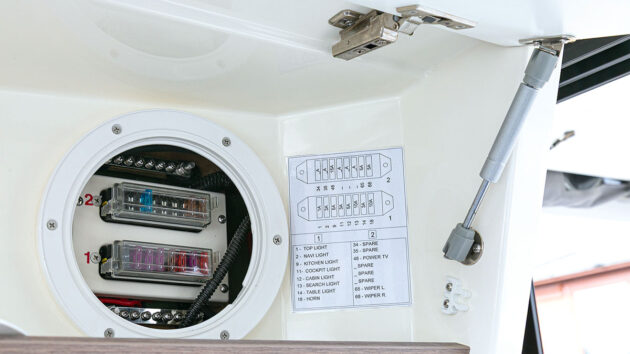
The headliner is moulded, but inspection hatches provide access to breakers and wiring. Credit: David Harding
It’s certainly more river-friendly to slide along quietly, creating modest ripples, than to announce your arrival with thudding engine noises and leave everyone bouncing around in your wake. The layout and ergonomics contribute to the relaxed feel on board.
For example, a sliding door next to the helm seat opens on to the starboard side deck, from where it’s an easy step down to the pontoon through a gate in the guard rails. You would use the starboard deck to move forward and aft, because that’s the wide side. The port deck is narrower and without guardrails: you can shuffle along, hanging on to the handrails on the side of the roof moulding, but would only do that when the occasion demanded.
Easy access on the SunCamper 31
Working out the levels is important in a boat like this, where ease of stepping on and off a pontoon makes a big difference. You step down from the cockpit into the cabin, the step meaning that you don’t bang your head in the process. The lower cabin sole creates 6ft 9in (2.06m) of headroom and allows those enormous windows.
Then the decks are an easy height in relation to a pontoon, before they rise towards the bow. Beneath the sole of the saloon in the electric version are the propulsion batteries, charged only from a mains supply.
Forward of them, the domestic batteries can be charged from the mains or from solar panels between the sunroofs that generate up to 300W.
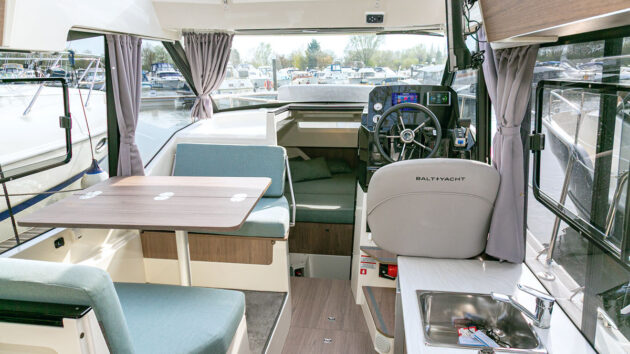
Lots of light inside, thanks to the sunroof and big windows. The dinette to port converts to a double berth. Credit: David Harding
Balt Yacht has chosen to use other fuels for cooking and heating, preserving the batteries for propulsion so as to maximise range. The cooker (hob, grill and oven in the UK spec) runs on gas, while diesel is used for air and water heaters. You can also have a mains-powered immersion heater if you choose.
Unlike coastal cruising yachts, inland boats rarely carry generators. And bear in mind that, when you plug into shore power at an inland marina, the supply will typically handle no more than about 3.5kW. Running a 7kW induction hob, for example, wouldn’t be possible. If you want to have a good range and be able to go ‘off grid’ with electric propulsion rather than having to stop in a marina every night, it makes sense to keep battery power for the motor.
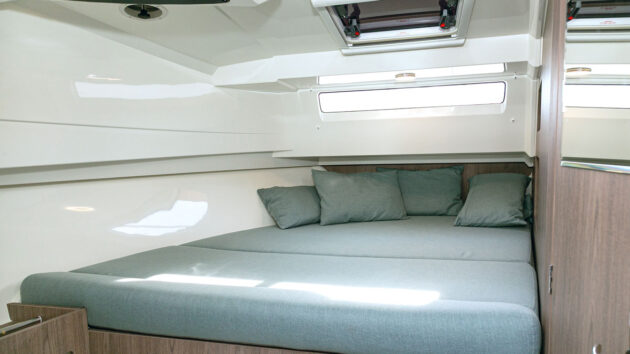
In the forward cabin is a double berth offset to port, a heads to starboard and a single berth running aft under the saloon. Credit: David Harding
When you step into the cabin from the cockpit, you find the galley to starboard. Forward of the galley is the helm station, with the wheel, throttle, ePropulsion display (showing range, battery usage and so on), the switch panel, level indicator for the domestic batteries, and the other domestic and system controls.
The helm seat can easily be partially folded to allow easy access through the sliding door to the deck. Opposite the helm station and galley is a dinette. The table can be lowered to create a double berth, and the forward seat has a centrally hinged backrest so you can sit at the table or hinge it the other way to face forward. You and someone else, if you like: the seat is big enough for two.
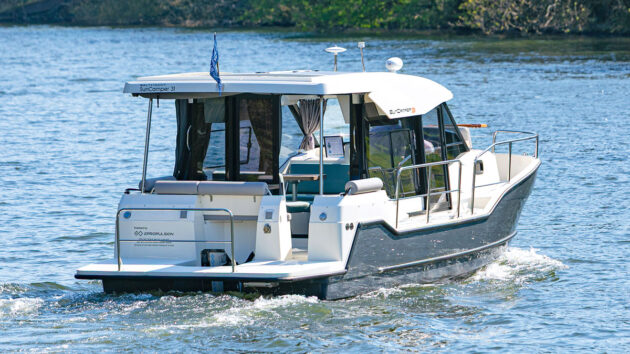
The SunCamper’s easily-driven hull creates minimal wash at river speeds. Credit: David Harding
At the aft end of the saloon, right by the cockpit door, you can drop down a couple of steps into an aft cabin. Here you find a double berth partly under the cockpit, and a fair amount of stowage. At the forward end of the saloon are steps down into another cabin. This one has a double berth offset to port, plus a single berth running aft under the sole of the saloon.
To starboard is a roomy heads with a shower, all moulded for easy cleaning. The raised moulding of the helm console gives standing headroom in here, and you can reach the inside of the console through a hinged panel above the sink.
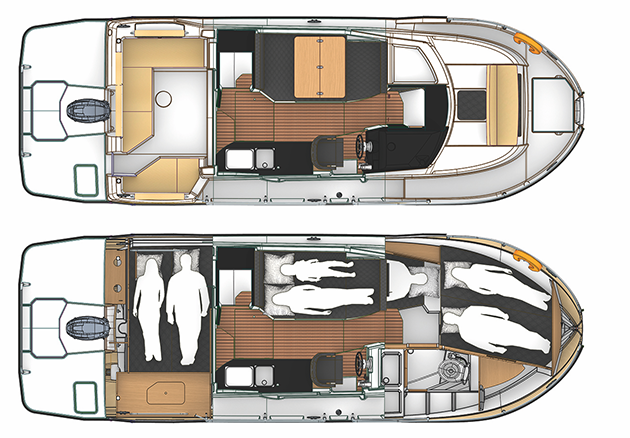
Accommodation plan on the SunCamper 31
Since access to the heads is from the forward cabin, it’s not particularly private, but there’s only so much you can expect in a boat with a hull length of just under 27ft (8.22m). The 31 designation relates to the length including the stern platform.
If you like the boat but need less length, you could have the SunCamper 29. It’s the same hull, only with a shorter platform that stops level with the aft end of the outboard.
Verdict on the SunCamper 31
The SunCamper 31 is very different from a traditional river cruiser. Clever design has created a highly practical boat that promises to be easy and comfortable to live aboard. It should also be capable of punching its way across a bay or a lake into a fresh breeze and a few waves to get you where you want to go.
Balt Yacht builds the whole boat in-house. The finish is neat throughout and the mouldings seem substantial.
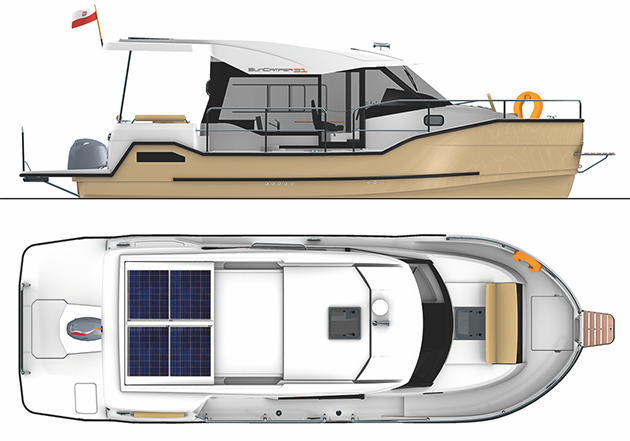
Boat plan on the SunCamper 31
Below decks, the feel is slightly ‘productionised’ rather than hand-crafted, but it’s light, bright and airy. Inspection panels in the extensive internal mouldings allow access to wiring circuits and suchlike.
When it comes to practicality, comfort, functionality and choice in a boat of this size, combined with a starting price that’s pretty competitive, the SunCamper 31 has a lot to offer.
Details
Price:from £139,995
LOA: 9.52m (31ft 2in)
Hull Length:8.22m (27ft 0in)
Beam:3.00m (10ft 1in)
Draught:0.56m (1ft 10in)
Weight (without engine):3,440kg (7,584lb)
Engine - diesel inboard:29hp
Engine - outboard petrol:25-115hp
Engine - outboard electric: 40kW
Water:215lt (47gal)
RCD Category:C
Designer:Jacek Centkowski
UK Distributor:Bray Marine Sales
Contact:www.braymarinesales.com