



Not only is Holman & Pye’s Hustler 25.5 one of the prettiest boats on the water, but she also provided the inspiration for the Oyster range of yachts, as David Harding reports
Hustler 25.5: why this Holman & Pye classic still beats modern cruisers

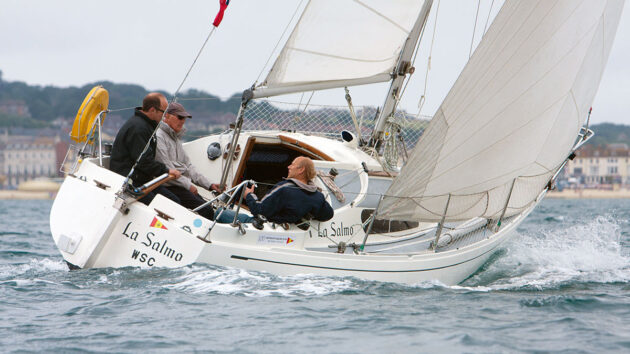
Surely we go to sea in a sailing boat to sail; not just to stagger along to windward, which all too often seems the norm for so-called ‘family cruisers’. The words of a yachting journalist? They could be (split infinitive aside), but they’re not. They’re from an early brochure for the Hustler 25.5.
Back then, even the best copywriter might have found it a challenge to sell the pretty little Hustler based on her accommodation, since plenty of 25-footers offered more space below deck. Where this boat scored – and still scores today – is in the way she sails. As a boat whose manners and performance really do match her appearance, she takes some beating.
To those familiar with Holman & Pye’s designs, that’s almost to be expected. After all, this is the design office that drew the Twister, the Rustler 31 and the Super Sovereign – all lovely-looking boats that sail beautifully. Also preceding the Hustler 25.5 were her two Holman & Pye-designed big sisters, the 30 and the 35, which quickly made their presence felt on the racing scene before becoming popular as fast cruisers too.
The success of the two larger Hustlers inspired John Harrison to introduce a third, smaller model in 1972. Harrison, who ran Island Boat Sales in West Mersea, was a successful racing skipper and the man behind the Hustler range, commissioning the designs that later included the lighter and racier second-generation models from Stephen Jones. It was no surprise when the Hustler 25.5 – moulded by Aquafibre and fitted out by nearby Landamores in Wroxham – hit the water fully up to speed.
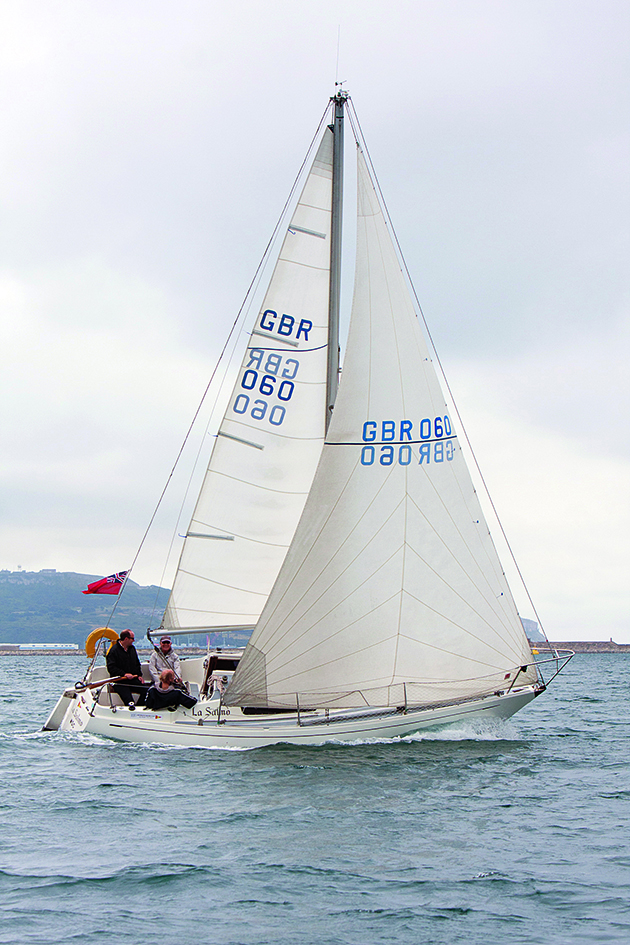
Upwind, the Hustler 25.5 would see off many modern performance cruisers. Credit: David Harding
Harrison lent the first boat, named UFO, to one Richard Matthews. ‘He thought we might win a race or two’, said Matthews – and his team did just that, topping their class in the East Anglian Offshore Racing Association (EAORA) championship in 1972. Matthews bought UFO the following year and went one better by becoming overall EAORA champion. Other notable wins included the Ramsgate Gold Cup (relegating Morning Cloud to a minor placing), while results also came from across the North Sea in the Dutch-organised Flevo races. It was a dream start for the new baby Hustler, and one that encouraged the designer himself, Don Pye, to order his own Hustler 25.5.
From the little Hustler 25.5
Richard Matthews founded Oyster Marine later in 1973, commissioning Holman & Pye to design a 33-footer that later became the UFO 34, moulded by Colvic. Smaller UFOs – a 31 and 27 – came later, followed by the first boat sold under the Oyster name, the Oyster 37 one-tonner. Oyster went on to become the builder we know today, moving progressively up the size range, but another early model was the Holman & Pye-designed Oyster 26 – an alternative to the Hustler for anyone in search of a small, tough, fast and well-mannered cruiser.
According to some of those who sail her, the Hustler 25.5 is capable of seeing off a lot of newer and larger boats including, on occasions, the UFO 27 that Holman & Pye designed in 1978, seven years after the Hustler. This might be because of the way the IOR (International Offshore Rule) developed. In 1971 it was still in its infancy, having evolved from the old RORC rating system, and favoured boats of moderate displacement with relatively Veed sections such as the Hustler and the Contessa 32. It had changed by 1978, in some ways not for the better, encouraging traits not widely associated with fast, safe and well-mannered yachts.
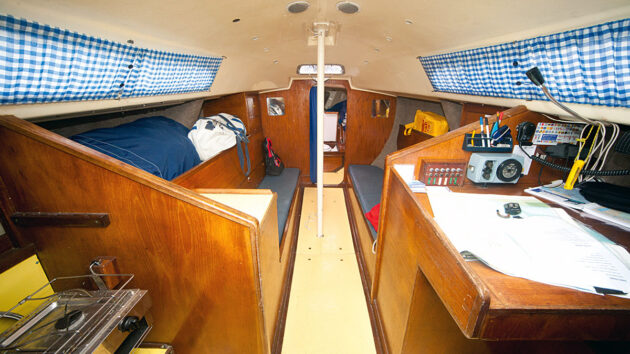
This is the original layout of the Hustler 25.5, with settee berths each side in the saloon and a pilot berth to port. Credit: David Harding
Thankfully the UFO, in keeping with Holman & Pye’s philosophy, is a moderate design that steered well clear of many IOR-inspired excesses and still has a strong following today. Nonetheless, it’s hard not to wonder whether the Hustler’s allegedly better performance on some points – particularly downwind in a breeze – isn’t partly due to changes in the rating rule.
With a beam of 8ft 8½ in (2.65m), the smallest Hustler was moderately but not excessively beamy for her day and, despite a stem that’s well raked by today’s standards, her waterline length of 21ft 3in (6.48m) was long too. Combined with a 40% ballast ratio, these measurements make her a powerful performer. Without any IOR-induced distortions in her hull she proved to be slippery and well-mannered, while her accommodation layout reflected her primary purpose as a boat on which her crew could eat, sleep and navigate at sea.
She has an enormous chart table by today’s standards, a functional galley and four good sea berths including a pilot berth to port. As we will discuss later, a more family-oriented alternative layout was subsequently offered.
Putting down roots
It’s no surprise that many smaller British-built boats are most popular in the region where they were built. You’re likely to find more Leisures, Seamasters and Pegasus 700s and 800s on the Deben than on the Dart. Similarly, the concentration of E Boats on the Forth is no coincidence. The smaller the boat, the shorter the distance people will generally travel to buy one.
Sometimes, however, fleets become established for other reasons. Just look at the Pandoras in Abersoch, the Sonatas in the Lake District, the Trapper 300s in Plymouth or, in this case, the Hustler 25.5s in Weymouth – specifically at Weymouth Sailing Club, which celebrated its centenary in 2013. One of the early owners in Weymouth was Michael Hall. His boat was moulded in 1977, towards the end of the production run, and fitted out by her first owner who sold her five years later to move up to a larger Hustler. Michael too was moving up, from a Jaguar 22, and he liked the look of the Hustler.
He soon came to like sailing her, appreciating her seakeeping qualities and her ability to be raced two-handed with reasonable efficiency as he often sailed with his son, Gavin. Another reassuring point was the fact that many owners were in professions that demanded a high degree of technical proficiency and analytical ability: he reckoned that their choice of boat meant something.
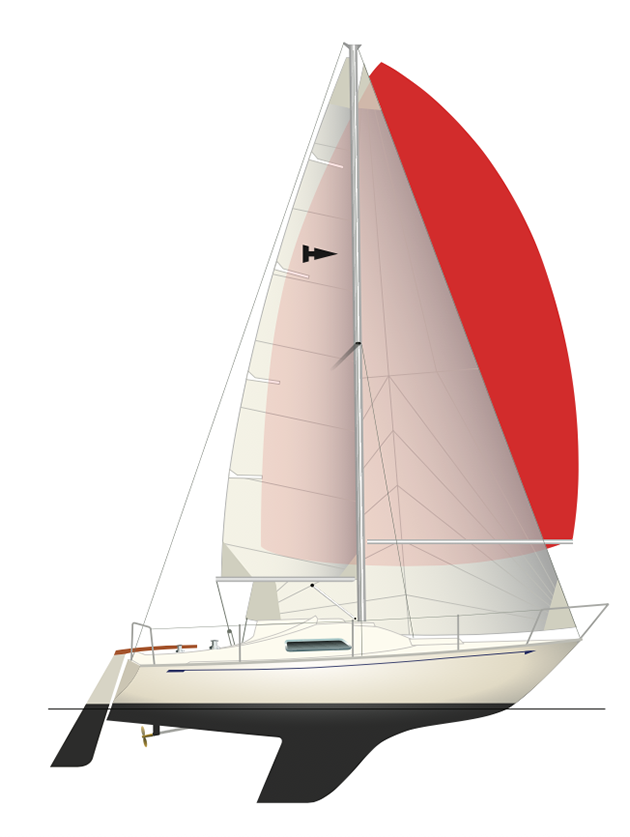
Sail plan of the Hutler 25.5
The largest boat Weymouth Sailing Club could accommodate then was 27ft (8.2m), so the Hustler was a little way from the upper limit but still appealed more than the most likely alternative, the Varne 27. During his 10 years with La Salmo, Michael did a lot of racing in Weymouth and the Hustler 25.5s became one of the biggest fleets.
When boats were sold they tended to remain in the club, or at least in the area, and that has been the case ever since. Now, 30 years on, Weymouth remains home to one of the largest concentrations with about eight 25.5s in residence.
Michael sold La Salmo to a fellow WSC member in 1995 and Gavin later bought a GK 24. When the old family boat came back on the market a few years ago, however, Gavin and his brother Nev couldn’t resist: La Salmo was back where she started.
Enthusiastic Hustler 25.5 owners
As well as Gavin and Michael, the crew on the day of our outing included David Taylor, who sails his Hustler 25.5 from the Blackwater, having moved up from a Hunter Medina. Between them the assembled company had logged an impressive number of hours aboard Hustler 25.5s and combined their hands-on experience with good knowledge of the history.
Our first job was to go for a sail, and while the forecast wasn’t promising in terms of sun (in fact, it started to rain heavily) at least we had a decent 15-18 knots of breeze over the relatively flat water of Weymouth Bay. Gavin has stayed with hank-on headsails rather than compromise with a roller-reefing system, so we had to choose which to start with and opted for the No1. It proved to be the right choice, keeping the boat powered up in the lulls without making her uncomfortably hard-pressed in the breezier patches.
Having long admired the appearance of the Hustler and heard about her performance, I expected to find her thoroughly agreeable to sail. Thankfully she didn’t disappoint. She was quick – the speed nudging into the low 5s upwind – and close-winded too, our tacking angle consistently staying within 80°. She was stiff, light on the helm, beautifully responsive and so well balanced she could be sailed upwind with the helm unattended and the traveller eased a few inches down the track. With the traveller in its normal position she carried just enough weather helm to give a positive bite.
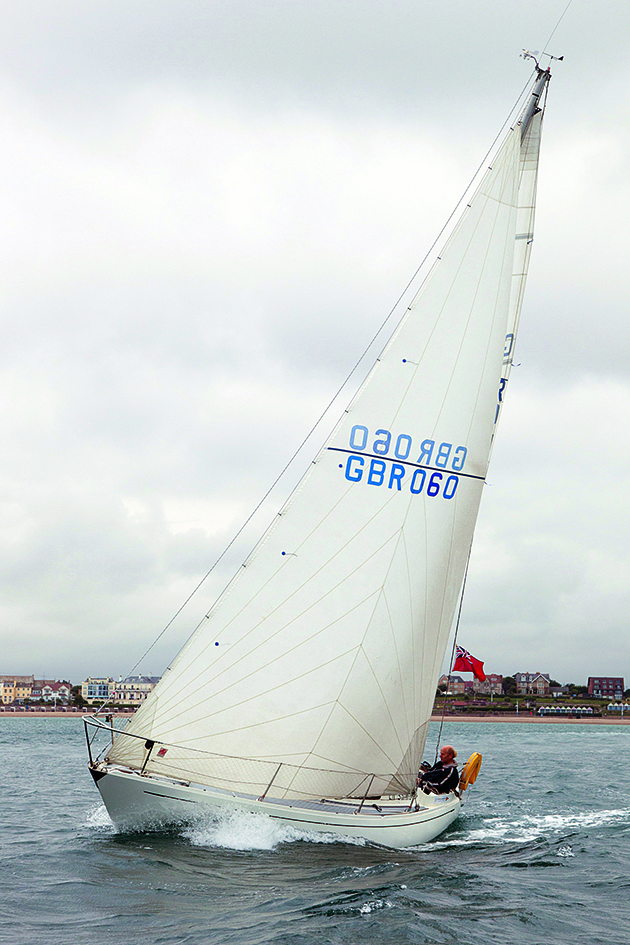
Enormous headsails were fashionable in the 1970s. Credit: David Harding
Her directional stability might in part be due to the displacement skeg that develops between the keel and the propshaft and runs aft to the transom. Like many non-extreme sporty cruisers from this era she has a smooth, purposeful feel, making life easy for the crew and never becoming remotely twitchy. That large rudder blade on the raked transom looks as though it might get heavy as there’s precious little balance, but it never did. It clung on tenaciously when I provoked the boat by bearing away with the sheets pinned in during a gust of 24 knots over the deck, only losing grip after a good fight and allowing the gentlest of rounding-ups.
Up and down
How the Hustler 25.5 would fare downwind in a breeze against modern designs it’s hard to say. While her narrower stern, deeper hull and masthead rig with such a skinny mainsail suggest she might be at a disadvantage, by all accounts she handles such conditions pretty well. The combination of moderate breezes, flat water and white sails gave us no chance to explore the limits, though we maintained speeds in the high 5s when goose-winged and experienced no corkscrewing when the occasional powerboat wash rolled in from the quarter.
Upwind is where I would expect the Hustler 25.5 to shine. A rig like this, with its IOR-induced trim-tab main and enormous (in relative terms) headsails lacks some of the versatility and convenience of a modern fractional alternative, but can generate a good deal of power providing the headsails have held their shape. I suspect many modern performance cruisers of similar size would struggle to keep up with a well-sailed Hustler 25.5 to windward. Unable to find anything comparable to pace ourselves against, we had to be content with starting on the weather quarter of a respectably slippery 32-footer of the same vintage and quickly pulling both ahead and to windward.
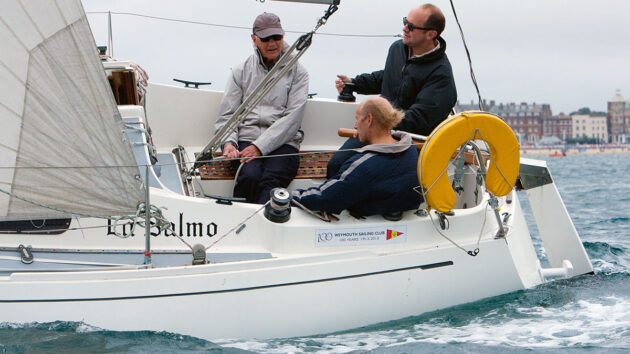
The yacht was fitted with Lewmar 40 winches, giving a good winch-size-to-sail ratio. It is a good idea to wear a lifejacket on board. Credit: David Harding
For dedicated cruising folk who don’t fancy changing headsails and using the forecabin as a sail locker (which was its intended use in the original layout), a roller-reefing system could be fitted at the expense of a good deal of performance. The trouble is that the largest headsail would have to be appreciably smaller for a start – shorter in the luff and with less overlap – and it would inevitably lose much of its shape when reefed. When the headsail is so much bigger than the mainsail it’s often reefed first, so the sail plan is immediately compromised. It also needs to be reefed a long way as the breeze picks up, progressively losing shape. If you can with a boat like this, do what Gavin does and stick to dedicated headsails – a medium-weight No1, a heavier No2 and a working jib should see you through most of the wind range. At 282sq ft (26sq m) the original light No1 was nearly three times the area of the mainsail.
Whatever your approach to the sail wardrobe, short-tacking can be hard work with headsails this size, especially when there’s a babystay in the way too. At least La Salmo’s Lewmar 40 primaries make short work of sheeting home after the tacks: the winch-size-to-sail-area ratio is healthy, and that makes all the difference. Pump-action winches on the coachroof are the originals from 30 years ago. The round boom and roller reefing for the mainsail are further reminders of the past; ones that Gavin is quite happy to live with for now.
Back in the cockpit, a good leg-bracing width between the seats helps make it secure in heavy weather. On the other hand, the coamings are close to the guardwires and not a particularly comfortable perch when the boat heels. One answer is to poke your head between the guardwires so you can lean back with your torso outside the upper guardwire.
Lockers are both sides. To starboard is the smaller one, abaft the quarter berth and containing the fuel tank. To port it’s full-depth, providing a vast amount of space.
Moving forward is easy enough. Chainplates in the deck allow passage inboard or outboard, while long grabrails are handily placed on the slightly domed coachroof. Deck paint provides the non-slip finish underfoot. In the bow is a navel pipe, the chain living in the forecabin.
Accommodation on the Hustler 25.5
As on La Salmo, the Hustler’s original layout was designed for use at sea: a big chart table opposite the galley, a quarter berth, 6ft 6in (1.98m) settee berths each side in the saloon, a pilot berth to port and, forward of the bulkhead, sail stowage and the heads. It’s a highly practical arrangement but, following demand from more family-oriented prospective owners, an alternative was introduced with the bulkhead moved aft a couple of feet, the galley along the starboard side and a separate heads compartment between the saloon and two-berth forecabin. Whichever version you have, headroom is 5ft 6in (1.68m).
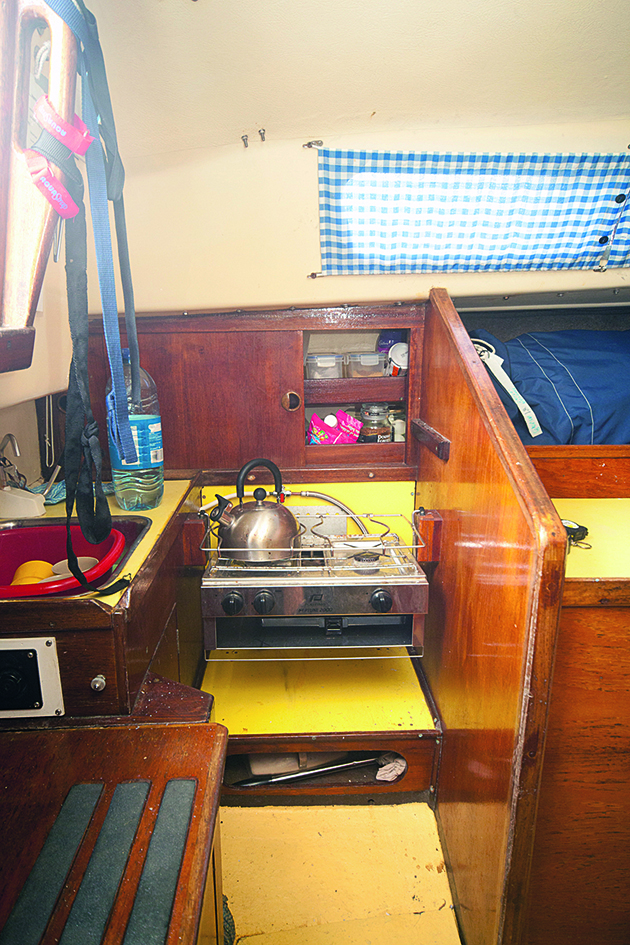
A small but functional galley. Additional work surface is forward to the partial bulkhead. Credit: David Harding
Stowage is remarkably good, especially the array of small lockers so rarely found on modern yachts. The headliner is the only internal moulding, all the bulkheads and joinery being bonded directly to the hull to create what should be an extremely stiff structure. Hulls are a solid laminate of chopped strand mat and woven rovings, while a balsa core is used in the deck and coachroof.
Early literature makes reference to a Lloyd’s certificate being issued with each boat. Although some reports during the Hustler’s production run criticised aspects of the construction – mostly cosmetic – nothing about La Salmo inspired anything other than confidence. The mouldings were fair and remarkably free from signs of stress or distortion.
Reaching the front of the engine from the companionway is easy. Access to the sides is from the cockpit lockers. Engines were originally a Vire 7hp (petrol) or Petter 5hp (diesel). A 9hp Volvo was a later alternative, though some budget-conscious owners fitted outboards on a transom bracket. Like La Salmo, with her Yanmar 1GM driving a two-bladed folding prop, most boats will have been re-engined at least once by now.
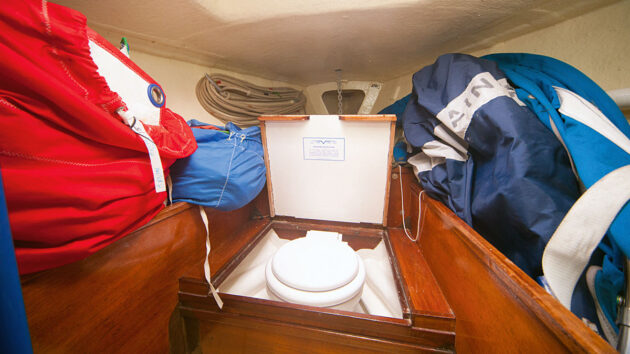
A traditional forecabin: heads, sail stowage and anchor chain. Credit: David Harding
In terms of interior finish, boats vary. Landamores were known for finishing to a high standard but boats were also supplied as mouldings for home completion. Beneath the sole is a shallow sump and access to the bolts securing the cast-iron keel.
Verdict on the Hustler 25.5
The Hustler 25.5 is a proper little seaboat – fast, stiff, tough, well-balanced and a joy to sail as well as to look at. As an economical and thoroughly capable cruiser or competitive club-racer, this Holman & Pye classic has to be one of the best buys around.
Want to read more second-hand boat tests?

A subscription to Practical Boat Owner magazine costs around 40% less than the cover price.
Print and digital editions are available through Magazines Direct – where you can also find the latest deals.
PBO is packed with information to help you get the most from boat ownership – whether sail or power.
-
-
-
- Take your DIY skills to the next level with trusted advice on boat maintenance and repairs
- Impartial, in-depth gear reviews
- Practical cruising tips for making the most of your time afloat
-
-
Follow us on Facebook, Instagram, TikTok and Twitter