


Sailor and author Graham Cox talks to Mini Globe Race skipper, Eric Marsh about his man overboard incident and how he managed to get back on board his 19ft yacht
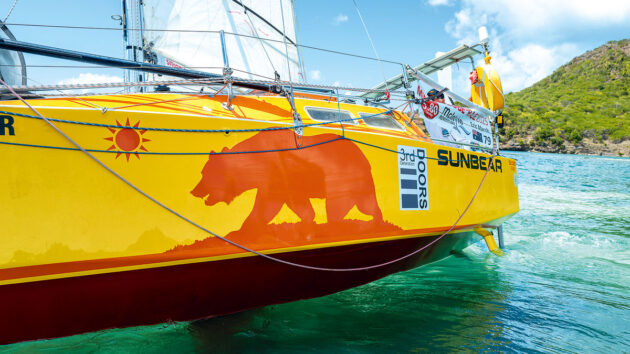
External safety lines, rigged from the bow to the stern on both sides of the Mini Globe Race boat, Sunbear, have been credited with saving the life of entrant, Eric Marsh.
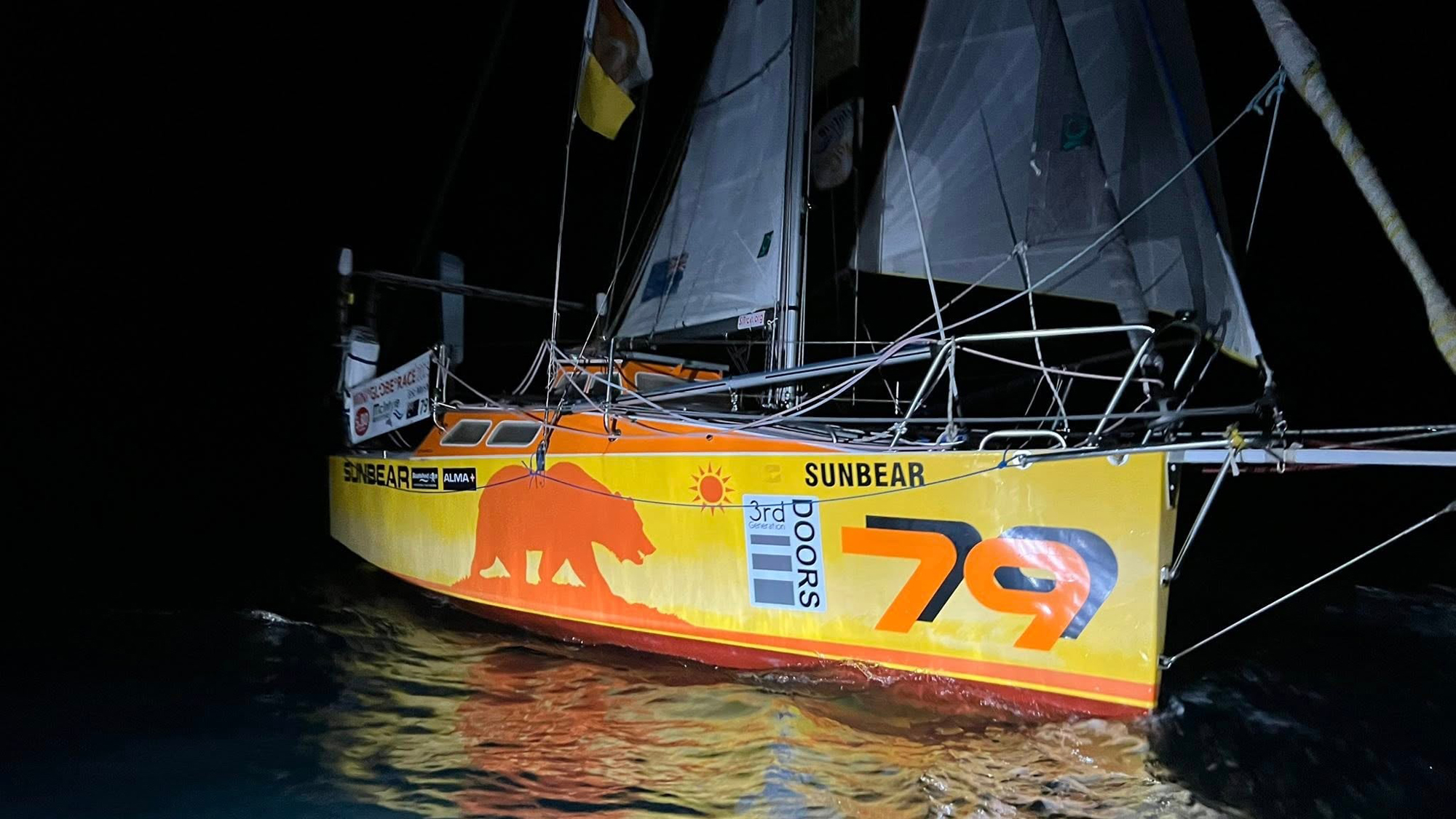
The 72-year-old skipper was 70 miles from Port Louis in Mauritius during the race’s second leg when he went overboard, at night, from his 19ft Class Globe 5.80.
At the time, he was clipping the boat’s spinnaker pole to the lifelines on the foredeck before the boat was hit by a big wave.
He had two tethers, long and short, but only the long one was clipped on at the time of the accident, something he admits was an oversight – he usually does clip it on.
Once in the water, he was able to clip this short tether onto the external safety line, unclip the long one from his harness (the inboard end was still attached to the deck), and slide aft to the stern quarter, where he climbed aboard after some difficulty with his lifejacket, which had auto-inflated.
Sunbear was roaring along with the A7 flying, self-steering under Hydrovane. Without the short tether and the external safety line, he would have been dragged alongside until he drowned.
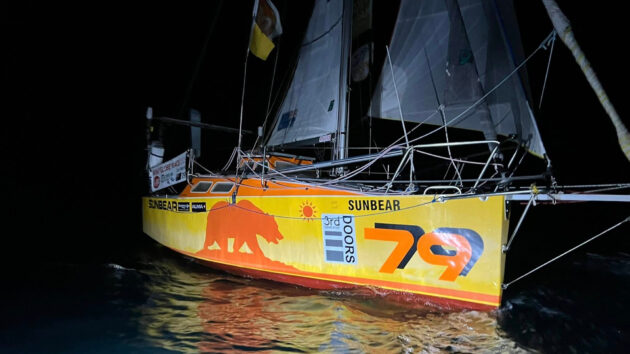
The man overboard incident on Sunbear happened at night, just 70 miles from Mauritius. Photo: Mini Globe Race 2025.
The forecast at the time of the man overboard was showing 20-25kt easterly winds, with frequent rain squalls and 2-3m seas.
Since setting out from America aboard Sunbear, to make the start of the Mini Globe Race off the National Sailing Academy in Falmouth Harbour, Antigua, Eric has sailed approximately 16,000 miles without a mishap.
Eric Marsh is also a veteran offshore racing sailor, with numerous credits to his name, which shows that these things can happen to anyone.
Looking back on the experience, he says, “I was pretty stressed out about it for a while, but I’m ok now. I’m in an apartment for a few days, just near the Grand Baie Yacht Club, to have a bit of a chill.
“When I went over the bow, I had the long tether clipped on. In some ways, it actually helped me to get back on board, because if it had been tight, it would have been difficult to disconnect it and then reconnect onto the shorter one. The long one helped me to slide along and get back to the stern of the boat.
“You don’t quite make it, you still have to disconnect, but you’re a hell of a lot closer than you would be with a short one. I also think, if you had a short one, the shock on your body would be quite considerable. But in saying all that, having a short tether, you maybe wouldn’t go overboard in the first place, but that’s debatable, sort of.
“I’ve got external safety lines running from bow to stern, outside the shrouds and lifelines, and I’ve got a small climbing-harness tether – about 500 mm long -so I clipped that into the external line, and then slid right to the stern of the boat. Being dragged along next to the boat is a big problem, though. You get dragged under the water, and you sort of got to roll over on your back. That’s the scary part. That’s what really frightened me the most. You burn up all your energy.
“Coming aboard over the leeward stern quarter was good, because it’s a bit lower there. I managed to get my legs up first, between the bottom lifeline and the rail. The problem was the inflatable life jacket went off, and it made it impossible to get through the lines. I couldn’t find the little tube where you press to deflate it, so I ended up letting go of the crutch strap, which was a bit scary, because I thought, ‘If I go back overboard now, I’m bloody history.’ But I had no choice, so I let go of my crutch strap and slid out the jacket. I’m pretty lucky to be as fit as I am for my age (72). It’s probably due to all the surfing I do, etc.”
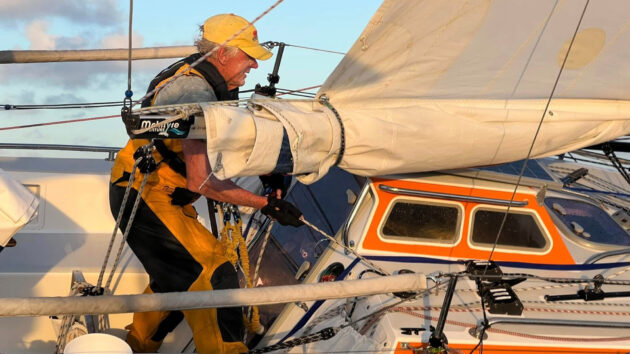
Eric Marsh generally sails with a long and short tether, but admits that, like other skippers, he sometimes doesn’t clip on. Credit: Mini Globe Race 2025.
Once back aboard, he retrieved the spinnaker pole, which was trailing alongside, attached to the jib sheet.
Describing what caused the accident, he said, “I was putting the pole on the side (the lifelines). Normally, I hang onto something, but when securing the pole, I have to hold the pole in one hand and then push the clip into the beak with the other. But just as I let go of my grip on the boat to do this, a wave hit from the other side, and it catapulted me straight off the boat, along with the pole. I’ve done this procedure hundreds of times, because I don’t like leaving the pole on the mast, with the other end rattling around on the deck, or punching the bloody spinnaker or something.
“I’d been running with the A7 up, and the poled-out jib, but the seas were starting to get quite heavy. I thought, ‘I really need to get rid of this pole, (after furling the jib), because if the breeze picks up any more, I don’t want to be dancing around with the thing up there.’ So that was the whole object of going forward. I avoid it if I can, but I just needed to get it done. Normally, if I’m in a spot where I think I need to, I double-clip on – I put the short tether on a solid part of the boat where I know it’s going to hold me – especially if I’m right on the bow or doing something really tricky.”
Thinking about lessons learned, he said, “I will tighten the jack lines a bit more, and I will definitely put the shorter tether on when I can.” But then he admitted, “It’s not just me, we all run around on the decks untethered sometimes. I’ve done it at night too, and sometimes with no lifejacket. You come flying up from down below sometimes; you might have an A5 up or an A7 up, and you got to get them furled really quickly. You know you’re meant to come out with a lifejacket on, and wet weather gear, the whole lot, but you haven’t got time.”

Eric Marsh has experience sailing dinghies, multihulls, trailer-sailers and offshore boats. Credit: Eric Marsh
Robin Lee Graham used to sleep with his harness on aboard, Dove – he never took it off at sea, and the first thing he did when he reached the companionway was to clip it onto the inboard end of his tether.
The other end of the tether was always attached to the boat. After we had discussed this, Eric Marsh said, “I’ve got a Wichard climbing harness, and if I can sleep in the bloody thing, I think I’ll probably be looking at doing that.”
Despite the experience of having his self-inflating lifejacket hinder climbing back aboard, Eric still thinks it is wise to wear a lifejacket of some sort. “Some people don’t wear lifejackets; they just wear harnesses, which I don’t think is a good idea. We’ve had some big waves sweep the decks at times. The Indian Ocean produced some pretty testing conditions at times. I’ve even been putting my lifejacket on during the day, and I think it’s necessary. If you don’t, and you get hit by a wave, you can be thrown off very quickly.”
- Mini Globe Race organisers now intend to examine the use of automatic versus manual lifejackets. Race regulations give skippers the choice between the two.

Eric Marsh: Mini Globe Race skipper 2025
Eric Marsh has always wanted to sail around the world. He is now preparing to finally achieve that dream, by…
‘I thought it was all over’: man overboard drama hits Mini Globe Race 2025
Overnight (17 October), Eric Marsh of Sunbear took a chilling tumble. It was the first man overboard in the Mini…

Mini Globe Race 2025 underway: racing 19ft boats around the world
14 skippers have crossed the start line of the Mini Globe Race 2025, with the first leg taking entrants from…

Globe 5.80: the home-built ocean racer
What’s it like to build your own plywood 19-footer to race solo across the Atlantic? David Harding sailed with Keith…
Want to read more articles like Saved by the Safety Line: How Solo Sailor Eric Marsh Got Back Onboard his Boat After Falling Overboard in the Mini Globe Race?
A subscription to Practical Boat Owner magazine costs around 40% less than the cover price.
Print and digital editions are available through Magazines Direct – where you can also find the latest deals.
PBO is packed with information to help you get the most from boat ownership – whether sail or power.
-
-
-
- Take your DIY skills to the next level with trusted advice on boat maintenance and repairs
- Impartial, in-depth gear reviews
- Practical cruising tips for making the most of your time afloat
-
-
Follow us on Facebook, Instagram, TikTok and Twitter