



Infestations of insects and other unwanted visitors like rats are an ever present risk, especially in warmer climates. Rupert Holmes shares how to keep them at bay
When faced with an infestation of insects on board your yacht, it’s usually best to address the problem as soon as possible to avoid a large-scale infestation. As always, the imperative is to make sure everyone on board remains safe, so extreme caution is required if an infestation involves stinging insects such as wasps, bees and hornets that may swarm and collectively deliver a potentially lethal dose of venom if the group feels threatened or is defending a nest.
My first encounter, however, was more prosaic. It followed a big provisioning trip ashore that included a lot of fresh fruit. It was October in Greece and not particularly warm, so we figured there was a lower risk of an insect infestation at that time of year than in high summer. I was therefore complacent about washing the fruit in a vinegar solution to remove any bugs or their eggs, and was more keen to get sailing instead.
Everything seemed fine until I got up to make a coffee early the following morning and saw half a dozen fruit flies hovering above the fruit bowl. Complacency still ruled, and I went back to bed to read for a couple of hours.

Fruit flies can quickly become an infestation. Credit: Alamy
But when I returned to the saloon, the air was thick with dozens, if not hundreds, of fruit flies. Clearly, rapid action was needed. We were now in a remote anchorage, but fortunately had a couple of cans of fly spray on board.
The first line of attack was to remove the pineapple that was the likely source of infestation. Insects often lay eggs in the crevices within the crown, so that was duly bagged up so no more newly hatched flies could escape.
Next, the rest of the fruit was washed in a bucket of sea water and kept outside in the cockpit. But what of the fruit flies that were still swarming around the saloon and galley? Did we have enough fly spray to kill them all off?
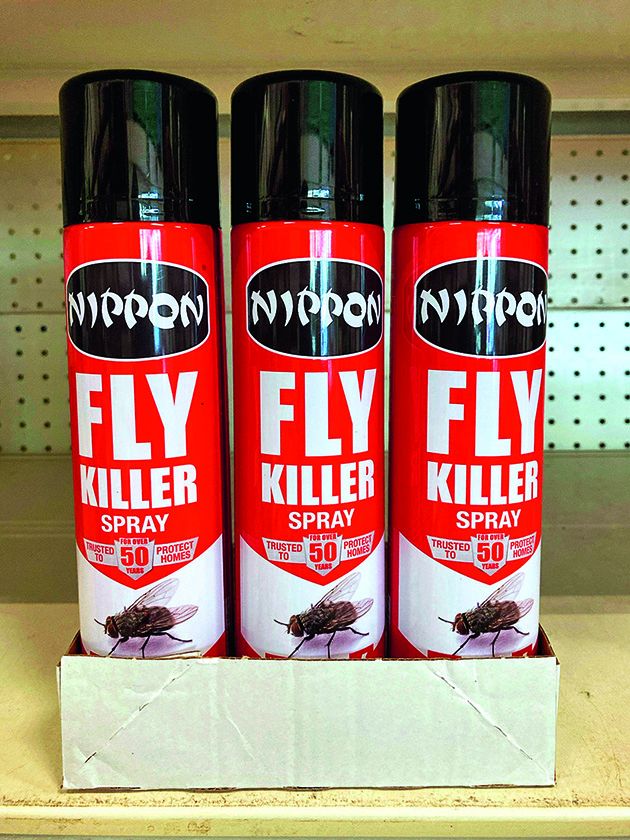
Make sure you stock up on fly spray before heading to remote anchorages. Credit: Craig Brown Stock/Alamy
It was clear the best course of action was to do what we could with supplies on board – even if it wasn’t 100% successful, at least the problem would be minimised while we sailed off to the nearest port with a shop. Complacency had now firmly given way to anxiety, and we decided not to take any chances. Snacks, drinks, books, phones, and laptops were all decanted into the cockpit.
Then we closed the hatches and I discharged as much of the first tin of fly spray as possible while holding my breath, before escaping through the companionway and putting the washboards in place, then discharging the rest of the can – and most of the second – into the saloon through an overhead hatch.
Keeping insects at bay
More than four hours passed before we dared look back inside. Luckily, it was a complete success and there were no drosophila left flying around, so we opened all the hatches and allowed the afternoon Meltemi wind, which had by now sprung up, to rid the boat of the insecticide-laden air.
The next incident, fortunately a short-lived one-off, concerned cockroaches. With hindsight, these had almost certainly been imported in my own bag after delivering a boat that had just been shipped from the Caribbean from the Ionian to the northern Adriatic. The first ominous sign came as we rigged the boat; the mainsail had been in the saloon, but several cockroaches fell out of it as we bent the sail onto the boom.
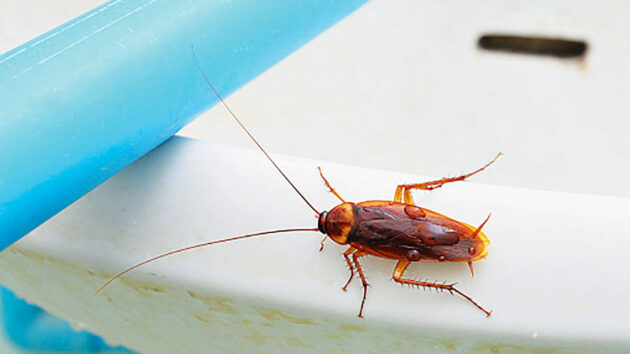
Cockroaches can hide in crevices and nooks on board. Credit: Getty
We were on a tight timescale, so it was agreed that the owners would deal with the issue at the end of the delivery, but I was slow to figure out the wider risk. Halfway through dinner on the ferry back to Greece, another roach started crawling round the perimeter of the table.
I was just about to complain to the waiting staff when it dawned on me that this might have been one we’d imported. Fortunately, we were able to quickly dispatch it without drawing attention to the situation, but it was a harbinger of more to come. A few days later, once back on board Ammos in the Aegean, it quickly became clear I had definitely brought a problem on board.
Fast action was therefore required before they started breeding and laying eggs, or just hiding in the many nooks and crevices a cruising yacht offers. After a discussion with friends who ran a large Mediterranean yacht charter base at the time, insecticidal smoke bombs seemed like the best approach, with all lockers opened and floorboards lifted, and the boat then sealed up for 24 hours.

Cockroaches are attracted to cardboard boxes – they can use the glue for food and lay eggs in the corrugations, so don’t bring boxes aboard
It worked perfectly, though this approach has potential drawbacks because the critters can retreat into gaps behind headlinings, into wiring conduits and so on, where the poison won’t reach them. Current advice is therefore to immediately follow the use of a smoke device with gel bait placed in cracks and lockers, along with IGR (Insect Growth Regulator) discs that contain a chemical that prevents roaches from maturing and reproducing.
Cardboard boxes are a very common source of cockroach infestation on a boat, as the roaches use the glue as a food source and lay eggs in the corrugations. The next incident on Ammos was what I assumed to be a few hornets that crept into a small gap below the bulkhead-mounted compass, which they were presumably using to access a nest in the void between inner and outer coachroof mouldings.
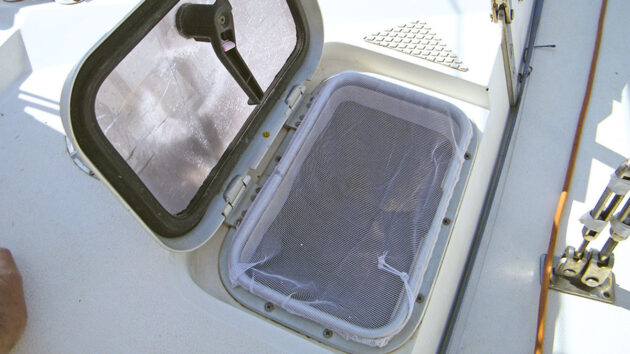
Net hatch covers can help keep mosquitoes and other insects at bay
They were successfully dispatched using a spray can of insecticide, but later learnt I ought to have been more cautious as they can swarm and give multiple stings if they fear the nest is under threat.
I was lucky on that occasion, but vowed to be more careful in the future. Fortunately, as sailors we already carry a lot of protective gear – full foul weather gear, hats, gloves, books and so on – making it easy to gain protection against a swarm of potentially stinging insects.
Fast forward to July this year, and that same small gap under the compass was being used by another large wasp-like creature, close to an inch in length and with long dangling legs. Today, there are many apps, often powered by AI, that promise to identify any insect or plant, but they are not 100% reliable.
Still, they can still be a great help provided you check the answer independently, for instance via Google or Wikipedia. Accurate identification is important, as the level of danger presented by different species can vary greatly.
Initially, we thought these new creatures were European paper wasps, a species that forms colonies of up to several hundred wasps that will aggressively defend the nest. Being attacked by a swarm could therefore pose a grave danger, especially in a remote location.
Dealing with insects: wasps & mosquitoes
However, one element didn’t add up: we only saw one wasp at a time. Further research revealed them to be mud daubers, a well-known type of wasp locally and a mostly solitary creature that builds only small nests in multiple locations.
The mud daubers always seemed curious, but never appeared threatening. If we were in the cockpit they would check us out, hovering safely just out of arm’s reach, before carrying on with their day, presumably once they didn’t consider us to be an immediate danger.
Fortunately, they turned out to be a problem that literally went away, at least in the short term, and we successfully blocked up the gaps from which their offspring may emerge later in the summer. Mosquitoes are another threat that’s important to protect against, especially in warm climes where they can be vectors of some serious diseases.
If you have a quality boat from the past 20 years or so, there are probably mosquito nets built into the overhead hatches. For those of us with older boats, it is often possible to improvise an effective low-cost arrangement that is easily implemented.
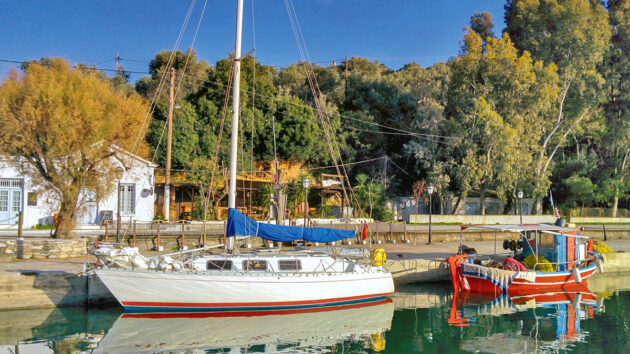
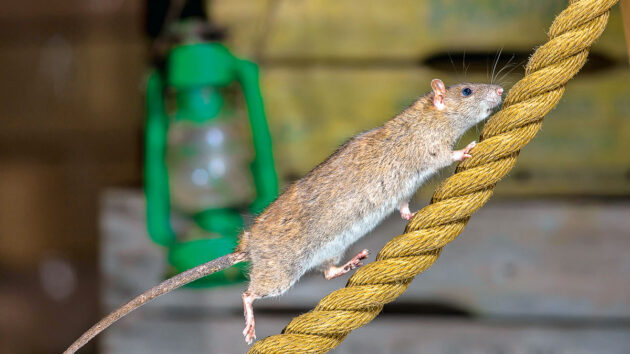
Lifting the boarding plank or passarelle at every opportunity will help reduce the opportunities for rats and other rodents to get on board. Credit: Rupert Holmes
The Lewmar hatches on Ammos, for instance, have a lip on the base of a shape that makes it easy to secure netting in place using shock cord. To date, I’ve luckily had no experience of rodents on board, but I have met people who have had significant problems, including one friend who had a family of rats move on board and produce more than one generation of offspring while the boat was laid up in a Greek boatyard for six months. Luckily, they escaped damage to wiring, plumbing and sails, but the upholstery didn’t fare so well.
A key to prevention is to block access by ensuring there are no easily accessible gaps that rodents can squeeze through. That can be a challenge on some boats, as both mice and rats have an impressive ability to contort their bodies to squeeze through the tightest of gaps – just 6mm for a mouse and 12mm for an adult rat. Equally, don’t be tempted to leave rubbish bags in the cockpit.
Eradicating rodents
In the Med or Baltic, risks can be reduced by mooring stern-to, or bows-to, whenever possible, rather than alongside, and by lifting the boarding plank or passarelle at every opportunity. Rats especially, can be adept at running across a taught mooring line, but an old CD, or the neck of a drink bottle, can be slid over the rope to create an effective barrier.
If you do encounter a rodent on board, avoid the temptation to use poisoned bait, as they tend to retreat to a confined and quiet corner to die. And the corpse will stink for a long time as it decomposes.
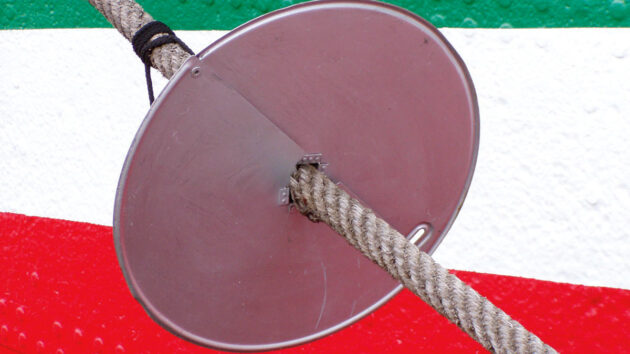
It may be worth putting rodent-proof protection on mooring warps. Old CDs can also be used. Credit: Panther Media Global/Alamy
So-called humane traps that keep the rodent alive inside a box sound like a good option, but are not kind to a small animal that depends on intimate knowledge of its surroundings to hide from predators. From an anecdotal perspective, I find this very believable.
When I had a stone house near Bath, I initially dealt with visiting mice using these traps, driving those I caught to a field a mile outside of town. But they made unbelievably loud, piercing screams of distress when transported in the trap, then were clearly utterly confused and stunned on release into unfamiliar territory, where they had no clue of where to run to for safety.

Greek harbours used to be home to a lot of stray cats who doubtless kept the rodent population under control, but today there are many fewer than in the past. Credit: Agencja Fotograficzna Caro/Alamy
Old-fashioned snap traps are therefore often the best option – quick and efficient. Both rats and mice use the edges of walls – or bulkheads, bunk fronts and so on on a boat – to navigate and will rarely cross an open space. Traps placed perpendicular to a bulkhead or bunk front, with the baited end against the wall, therefore work particularly well.
How to deal with rubbish at sea
It’s irresponsible to simply chuck rubbish overboard when at sea. So what do you do with it? Tom and Vicky…

DIY boat mosquito net to keep the insects at bay
Dave and Karen Proctor make a boat mosquito net for their companionway

How to make a wind scoop for under £10
With a previous home-made wind scoop now showing its age, Ann Berry fashions an efficient replacement for less than £10
Want to read more articles like Insects to rats: Practical tips and ingenious tricks to bug-proof your boat?
A subscription to Practical Boat Owner magazine costs around 40% less than the cover price.
Print and digital editions are available through Magazines Direct – where you can also find the latest deals.
PBO is packed with information to help you get the most from boat ownership – whether sail or power.
-
-
-
- Take your DIY skills to the next level with trusted advice on boat maintenance and repairs
- Impartial, in-depth gear reviews
- Practical cruising tips for making the most of your time afloat
-
-
Follow us on Facebook, Instagram, TikTok and Twitter