



Discover how the incredible story of the Uru, a 20m reed sailboat, challenges modern ideas of boat design and offers lessons for future shipbuilders.
There was a single sailboat in this year’s Venice Architecture Biennale, but it’s probably not the kind you’re picturing. Forget GRP and aluminium: the Uru’s hull was made entirely of reeds.
For the world’s largest architecture festival, Peru presented the ‘Living Scaffolding’ exhibition, commissioned by José Orrego and curated by Alex Hudtwalcker, Sebastián Cillóniz, José Ignacio Beteta, and Gianfranco Morales.
‘Living Scaffolding’ focused on the collective building processes used by the Uros and Aymara peoples of Lake Titicaca to construct their reed-island homes.
It also included the story of the sailing vessel Uru, its improbable ocean crossing, and its many makers.
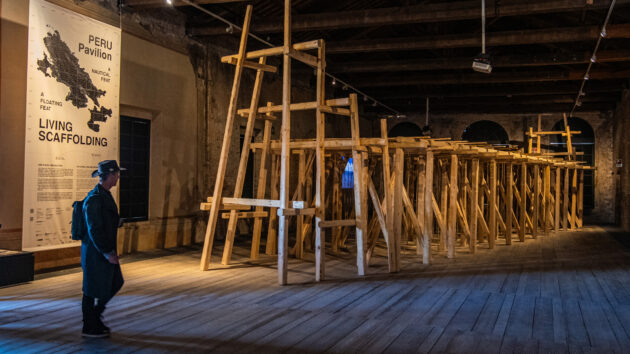
The Peruvian Pavilion, titled ‘Living Scaffolding’ at the 2025 Venice Architecture Biennale, curated by Carlo Ratti. Credit: Simone Padovani / Getty Images.
Inspired by controversial Norwegian explorer and ethnographer Thor Heyerdhal, in 1988 Spaniard Kitìn Muñoz turned to ancestral Uros and Aymara building techniques to help him prove that ancient South Americans could have embarked on trans-oceanic journeys with the technologies they had available.
For today’s sailors and boatbuilders, the Uru’s legacy can expand what it means to be seaworthy, offering valuable lessons for approaches to sustainable shipbuilding.
Back to the beginning: does the history of seafaring start with reed rafts?
Reed rafts are some of the oldest seafaring technology recorded.
Neanderthals might have been mariners, as this article from our sister publication Live Science explains. Even further back, Earth’s first cellular life even rode on ‘rafts’ made of igneous rock.
There is evidence of reed raft use in almost every part of the world where similar plants have been available, including Lake Titicaca.
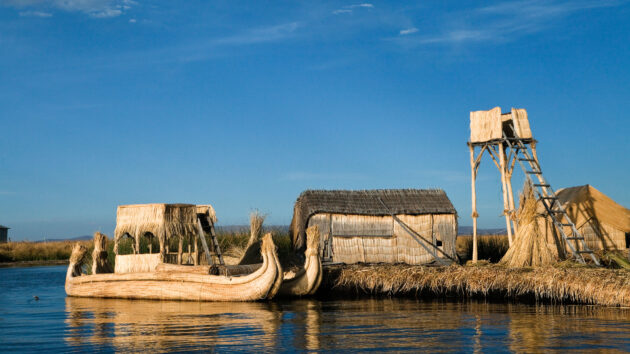
Lake Titicaca is in the Andes Mountains, bordering both Peru and Bolivia. At just over 3,800m above sea level, it’s the world’s highest navigable body of water. Credit: Rolf Schulten / Alamy.
500 years ago, to escape frequent Inca invasions, the indigenous Uros people of Lake Titicaca began developing floating islands made of totora reeds and submerged scaffolding.
This technology was progressively refined through time and remains an essential part of the homes, trade, and culture of Lake Titicaca’s Uros Islands.
The primary material: totora reeds
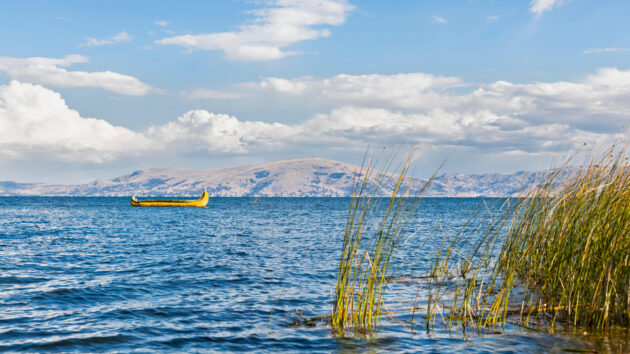
As the lake level drops and its waters grow increasingly polluted, diminishing totora reed populations further threaten the Uros way of life. Gathering sufficient reeds to meet their construction needs is an increasing problem. Photo: Westend61 GmbH / Alamy.
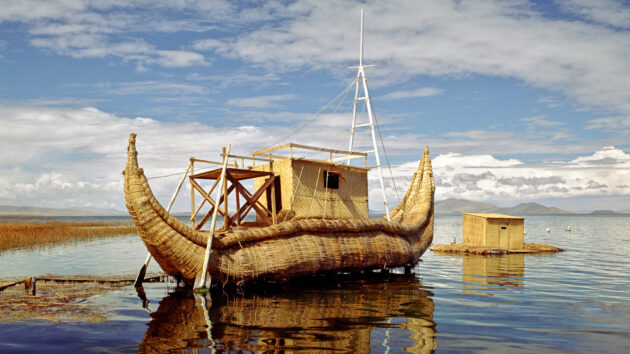
Totora, a reed-like papyrus, grows in shallow, marshy areas. Once harvested, the scythe-cut reeds are dried in the sun and tied into curved bundles before being integrated into construction.
Originally, the joining ropes were made of dried prairie grass, though many contemporary raft-builders now use nylon. Many Uros have also shifted to building their boats in wood instead of the more traditional material.
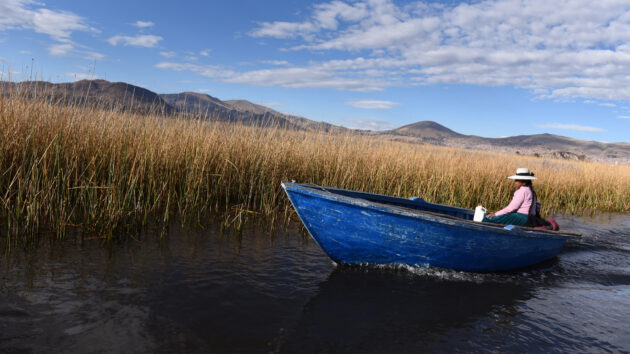
An Uro woman on board a motor boat is seen sailing among the totora reed in Titicaca lake. Photo: John Milner / SOPA Images / LightRocket via Getty Images.
Despite the influx of modernisation and the persistent threat of traditional building knowledge dying out in younger generations, totora remains a symbol of Uru identity and retains a diverse range of functions.
Totora can be used to build roofing and walls, as practiced by both the Uros and the Aymara people. It is fed to cattle; its flowers are boiled for tea. In times of famine, it has even served as sustenance.
Other applications include stuffing mattresses, fuel for cooking, medicinal use, tourist trinkets like replica boats and small figurines and, of course, raft and boatbuilding.
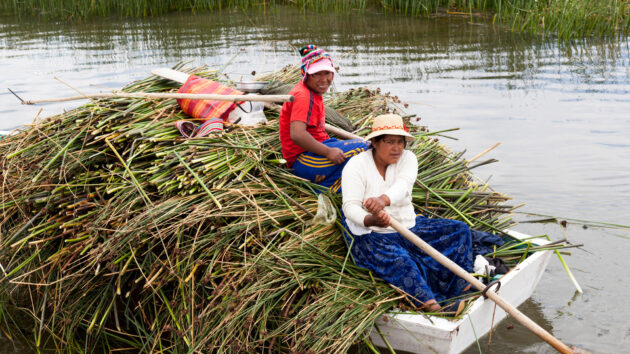
Harvested totora reeds being transported on a rowing boat on Lake Titicaca. Formal news outlets reported worrying contamination of the lake, its fish, and the all-important totora reeds already in 2016. Credit: Vibrant Pictures / Alamy.
Building a reed sailboat: the Uru
For most of their recorded history, boats made of totora, known as balsas, were used by the Uros people for fishing and transport. Like the islands, they are publicised as tourist attractions in modern times.
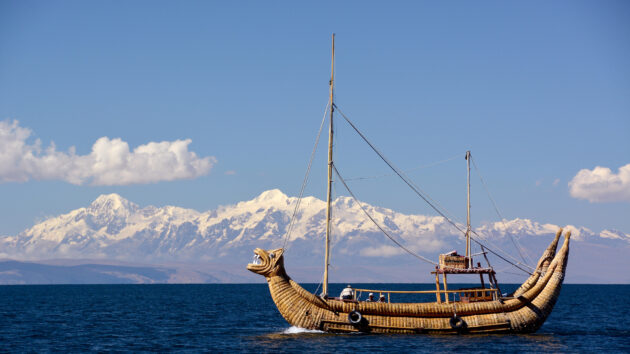
Typical reed balsa boat on Lake Titicaca. Credit: Harald von Radebrecht / Alamy.
Winding back to 1988, the explorer Kitìn Muñoz went to Paulino Esteban, a respected Aymara raft builder from Suriqui Island on the Bolivian side of Lake Titicaca, to build a balsa that could cross an ocean.
He hoped this unconventional deepwater reed sailing vessel would help him prove that ancient South Americans could have been oceanic navigators.
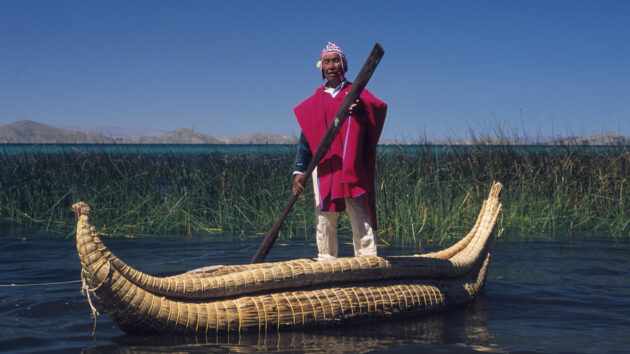
Paulino Esteban standing on a totora reed boat in traditional dress, Lake Titicaca, Bolivia. Photo: James Brunkner / Alamy.
Esteban had previously built the Ra II with Thor Heyerdhal. As head builder of the Uru, he brought a lifetime of experience (he had started building rafts with his grandfather, age 12), as well as a keen awareness of reed-craft’s social and cultural value.
He developed a project for the largest totora balsa ever seen, with a length of 20m by 4m, a beam just slimmer than a modern yacht of comparable length.
With the help of eight Aymara craftsmen, he set up a temporary shipyard South of Lima, with construction planned through the summer months.
Sharing the shipyard
In sourcing the raw materials, preparing, and later assembling them, the Uru’s construction was a collective effort.
According to exhibition materials, just two days into the build, spontaneous collaborators even began joining construction efforts, reaching a group of up to 30 people.
On eucalyptus scaffolding mounted by carpenters from the Peruvian Navy’s Industrial Services department, the craftsmen and rotating volunteers assembled the raft’s basic structure and built out its body with 3500 totora bundles made from reeds that had been collected by Esteban’s friends and family.
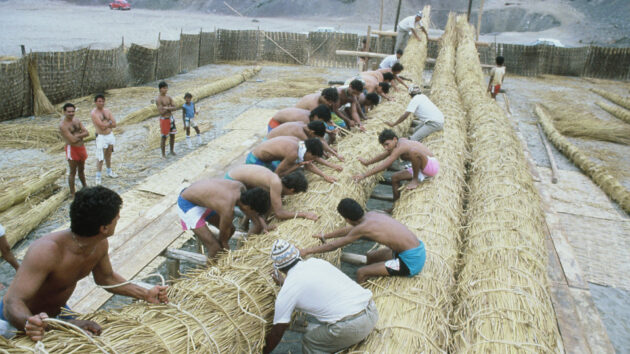
Eric Frattini, The Uru Expedition led by Kitin Muñoz, 1988. Volunteers and expeditioners working alongside the artisans above the scaffolding of the totora reed sailboat. Photo by Eric Frattini. Private Collection. Courtesy of Eric Frattini.
Building the Uru’s hull took a total of 43 days, after which it was transported to a hangar in Callao, Peru to be fitted with a wooden tiller and a bipod mast made of pinewood.
The vessel had upturned points designed specifically for deepwater sailing. Its structure was made up of two lateral sections gradually tightened around a narrower central bundle called the chuyma, which figuratively means heart, or a sentimental core, in the Aymara language.
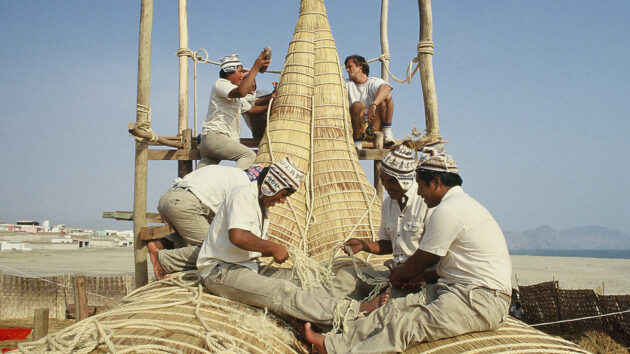
Eric Frattini, The Uru Expedition led by Kitin Muñoz, 1988. Aimara artisans working over the scaffolding of the totora reed sailboat in Punta Negra beach, Lima, under Kitin Muñoz’s supervision. Photo by Eric Frattini. Private Collection. Courtesy of Eric Frattini.
This reed structure was covered with antakos, totora reed mat sleeves, or skins, and hemp rope known as chala.
As they are joined, the reeds are gradually compacted by stomping; the binding ropes are pulled taut to contain the new volume. The chala is wet and dried again to harden and seal the knot.
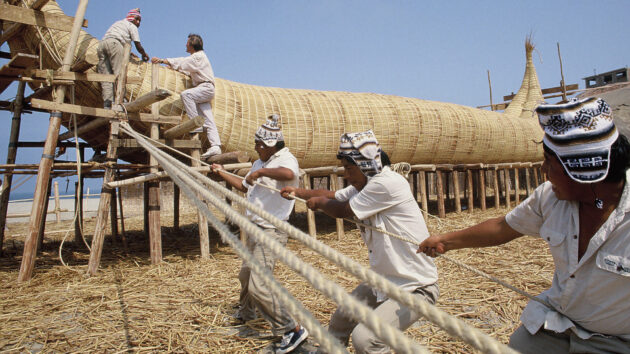
Eric Frattini, The Uru Expedition led by Kitin Muñoz, 1988. Aimara artisans pulling with ropes to adjust the body of the totora reed sailboat. Photo by Eric Frattini. Private Collection. Courtesy of Eric Frattini.
The Uru’s interiors and platforms were instead built with bamboo logs from the Peruvian rainforest, and fastened with more hemp rope.
Additionally, Peruvian artist Jose Salazar contributed a figurehead made of totora, modelled after the pumas used on the lake-boats, and painted Uru’s white cotton sails with natural pigment.
The voyage
The Uru set sail from the port of Callao, Peru and arrived in the Marquesas Islands in French Polynesia on August 22, 1988, after 54 days at sea and 5491 nautical miles.
Reportedly, it was received by the people of Nuku-Hiva, the largest island in the Marquesas, with astonishment.
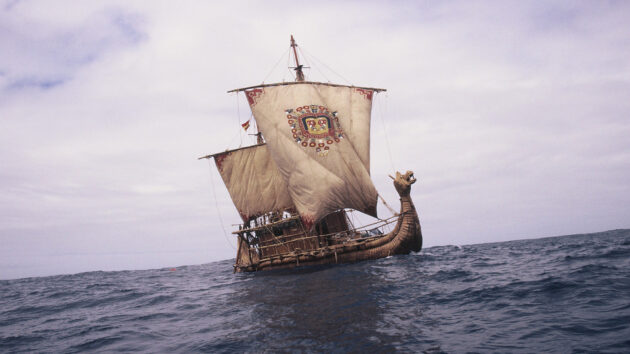
Eric Frattini, The Uru Expedition led by Kitin Muñoz, 1988. The totora reed sailboat in the Pacific Ocean towards French Polynesia. Photo by Eric Frattini. Private Collection. Courtesy of Eric Frattini.
After the Uru’s ocean crossing, both Thor Heyerdal and Kitin Muños continued their explorations, helping to build several more reed vessels each and embarking on further deepwater sailing expeditions.
Their exploits inspired countless other reed-boat explorers, research expeditions, and unlikely-craft imitators, including Phil Buck.
Speaking about his Viracocha expedition to Yachting World in 2019, Buck described the unusual challenge of sailing a vessel that starts sinking from the moment you set out.
Sarah Pearson, who visited Lake Titicaca in 2023, reported in a first-hand account that the totora reeds used on the Uros Islands need replacing approximately every three months.
While they may decay at a different (likely slower) rate in seawater than in freshwater, this does mean that even if a reed vessel starts out seaworthy, it doesn’t stay that way for long.
As the reeds absorb water, the vessel grows heavier, gradually increasing its draught, though on Heyerdal’s and other reed-vessel deepwater voyages, it was observed that the reeds only saturated to a certain point before stabilising.
Lessons from the building of the reed sailboat Uru
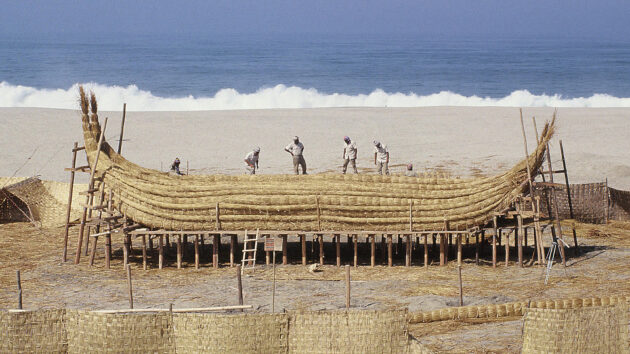
Eric Frattini, The Uru Expedition led by Kitin Muñoz, 1988. Construction of the 20-metre-long, 10-ton totora reed sailboat in the shipyard set up at a beach in Lima. Photo by Eric Frattini. Private Collection. Courtesy of Eric Frattini.
More than a seafaring tale, the story of the Uru and its builders is a story of making.
Like the reed islands of Lake Titicaca, the materials used on the Uru— totora, hemp, bamboo, wood– were biodegradable, and therefore destined to decay.
Even the shipyard used in the vessel’s construction left no traces. Its 30 poles, made from eucalyptus trunks, were removed from the sand soon after the build’s completion and returned to their owners.
Totora reed boat showing signs of saturation. Credit: FB-Fischer / Alamy.
While the Uru was built to answer a question about seafarers past, its story still holds valuable lessons for the wider marine industry and its future.
With questions around glass-reinforced plastic (GRP)’s possible toxic impact on aquatic life and GRP disposal solutions still sparse, the pressure is on to find less indelible materials for shipbuilding, and to deal with existing waste responsibly.
Stories like the Uru’s point towards boatbuilding approaches that centre sustainability.
Between its material choices and the process of its assembly, the Uru modelled a no-trace approach to shipbuilding that is cyclical, self-renewing, and adaptable. It used local materials, collective knowledge, and maintained a low impact throughout.
Want to read more articles about the reed sailboat Uru?

A subscription to Practical Boat Owner magazine costs around 40% less than the cover price.
Print and digital editions are available through Magazines Direct – where you can also find the latest deals.
PBO is packed with information to help you get the most from boat ownership – whether sail or power.
-
-
-
- Take your DIY skills to the next level with trusted advice on boat maintenance and repairs
- Impartial, in-depth gear reviews
- Practical cruising tips for making the most of your time afloat
-
-
Follow us on Facebook, Instagram, TikTok and Twitter