


Richard Ayrest made his first-ever Mayday call when his Southerly 420 dismasted close to the Manacle rocks, and learned vital lessons on emergency VHF, cutting tools, and the risks of a faulty chainplate.
I learned firsthand the risks of a faulty chainplate.
Enjoying a perfect start to our Isles of Scilly adventure, my two friends and I set off aboard my 42ft yacht Blue Dolphin after a good night on a mooring in Helford Passage. The sun was up, and we had a decent 15 knots of wind with a moderate sea.
On 29th April this year, we left early to catch the fair tide and plotted a course to clear the Manacles Cardinal buoy, which was now just abaft the beam. We were thinking about engaging the autopilot and settling down for the first brew.
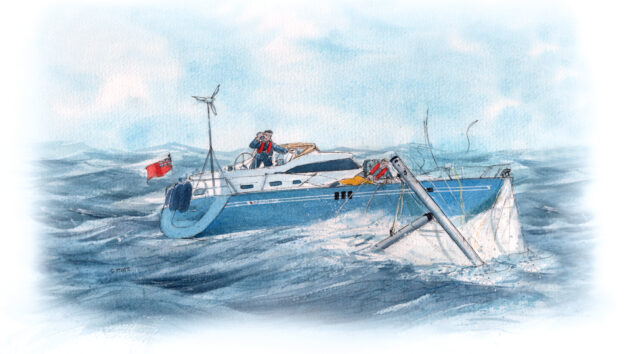
We were under full main and genoa, and enjoying that feeling of a boat sailing well, when there was an almighty bang and my 2013 Southerly 420 shuddered as though struck by an enormous force.
As I looked about to see if we had hit something, a large object passed my head at speed, taking off the starboard winch from the coaming.
Seconds later, the entire rig was in the water to leeward, with the Cardinal about 100m behind. The 54ft mast was still held by the starboard side shrouds, its foot on the deck and smashing the toe rail and stanchions with every wave.
The boom, responsible for taking off the winch, was floating alongside the mast, with full main attached.
We all transitioned immediately into emergency mode, and my first thought was to use the very high frequency (VHF) radio to put out a digital selective calling (DSC) distress alert, then a Mayday call.
Despite a long sailing career, I’d never needed to do this before, but like most sailors I had rehearsed it, and the words were neatly printed on a card by the radio: “Mayday, Mayday, Mayday! This is yacht Blue Dolphin…”
Mayday… silence
There was silence. I repeated the Mayday again, still nothing. Then it dawned on me that the VHF antenna was on top of the mast and now well under the water.
One of my experienced crew was quicker than I was on the uptake and was already on his mobile dialling 999, fortunately with immediate success.
Freeing the rig
With the swell transforming the mast into an effective battering ram, my priority was clearly to free the rig. I rushed to look below for the battery angle grinder that I expected to be there but, agonisingly, it was missing.
Instead, I grabbed bolt-cutters and a hacksaw, shouted to my other crew member to take the knife that we keep by the helm and cut all the running rigging, and I attended to the shrouds and backstay.
All are 19mm steel cable and the bolt-cutters made no impression at all.
Fortunately, I had a new hacksaw blade, though only one, so I started cutting the backstay as fast as I could, all the while more than aware of how easy it is to break a hacksaw blade!

RNLI crew boarded Blue Dolphin and held on to Richard while he freed the rig. Photo: Richard Ayres.
That transpired to be the easy part.
Cutting the three shrouds required leaning out over the starboard side, where the stanchion posts, guard wires and toe rail were by this time all smashed to bits.
The mast foot was swinging wildly against the boat.
It never occurred to me to clip on, as I went at it while sliding around the narrow side deck.
My hacksaw blade and our luck held as, one-by-one, I managed to cut through the shrouds – and I heard my friend talking to the Coastguard – a Royal National Lifeboat Institution (RNLI) crew was on their way.
Holing risk
The last cable parted, the mast foot crashing off the deck, and the whole rig swung forward, still attached by the two forestays.
We were drifting against a lee shore, and the current was sweeping us pretty fast south – not directly toward the Manacles, but onto the mast as it continued to rear up and down out of the water.
I was seriously worried about holing the hull, or catching the whole rig on the keel, so I took the risk of starting the engine and reversing away from both rig and shore.
This worked and things became a bit less terrifying, especially as we spotted the wonderful Falmouth RNLI in their new Shannon class lifeboat heading toward us: the most welcome sight anyone in trouble at sea could ever experience!

The Falmouth lifeboat stands by, while Blue Dolphin’s rig is released. Photo: Falmouth RNLI.
Help from the RNLI
As the lifeboat crew manoeuvred expertly around us, negotiating the increasing wind and swell, I started leaning off the boat again.
This time, I was at the bow, where the two forestays were swinging around with huge force, still attached to the rig ahead of us. Each forestay was joined to the bow by a large toggle, held by a split pin, carefully bent back on itself.
Releasing these involved hanging over the plunging bow roller, avoiding the swinging stays, and using a pair of long-nose pliers to try to bend back the split pins.
Fortunately, by now we had two RNLI crew aboard, one of whom held onto me while I worked, and he handed me a hammer when I managed to get first one and then the other split pin out.
A few blows at the toggles knocked them out and, with a crash, the whole rig fell off the boat and sank into the depths.
The presence of two cheerful and tough-looking RNLI crew lifted my mood considerably, and I returned to the cockpit to see if we could perhaps get the boat to safety ourselves under engine.
However, it was immediately clear that something was very wrong. A loud vibration suggested the engine was struggling.
I shut it off and we gratefully accepted a tow back to Falmouth, minus the rig and with a pretty smashed up starboard side.
I had been chatting just a few days before with someone who had been rescued and towed by rescuers in France, and the tale was cautionary. They had, he said, been towed at up to 15 knots with several breakages of the tow rope.
Getting towed by the lifeboat
Knowing that our bow cleats were not very strong, I asked the RNLI crew to wait while I rigged lines around both sides, from the rear to the front cleats, and joined them to form a tow bridle.
This worked well, although in fact our rescuers towed us expertly and carefully at a reasonable speed.
We made it to Falmouth safely and, yachting being a small and chatty community, by the time we were safely on the pontoon at the very helpful Port Pendennis Marina, it seemed that a great many knew our story and had turned up helpfully to have a look!
The chainplate was the culprit
Along with the assembled visitors, we now had time to look closely at what happened. On our boat, all three shrouds attach to a single chainplate on the deck.
The port side chainplate had sheared off completely, releasing the whole rig.
Being a deck-stepped mast, there was nothing to stop it all simply falling to leeward.
I’d checked the standing rigging before we left, as I always do, but there was nothing amiss. It later transpired that the weld holding the vertical part of the chainplate to the strong horizontal plate bolted right through the deck, simply failed.
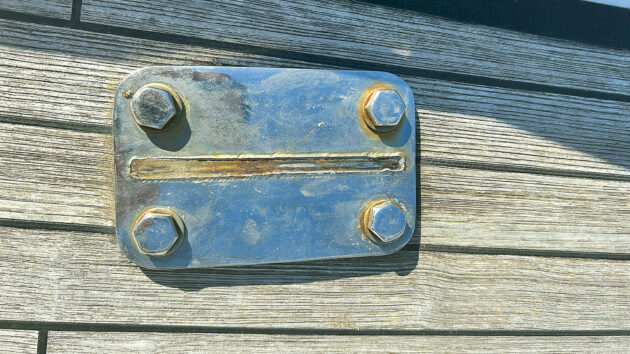
The broken chainplate showing the failed weld. Photo: Richard Ayres.
Conditions at the time of the chainplate failure were relatively benign. I had two wonderful, experienced crew who remained calm, and we had a good mobile phone signal.
There is no doubt that things could have been much worse. I have sailed Blue Dolphin in far worse conditions, and in remote locations.
We might otherwise not have been in the fortunate position of having no casualties, other than quite impressive bruises in various places, in my case.
Blue Dolphin remained intact, if rather battered and minus her rig.
She was towed the following day, in the expert hands of Falmouth Boat Co. where repairs are underway.
As I expected, a rope was wrapped tightly around the propeller, but the keel was free and undamaged, and damage to the deck and topsides was less than I’d feared.
Lessons learned: check that chainplate!
I have taken several lessons from the event. I am now learning to deal with claiming against boat insurance – which turns out to be a lot more complex and confusing than other kinds of insurance.
The Southerly 420 is one of the last yachts made at Northshore, which experienced financial collapse and finally closed in 2013, the year that Blue Dolphin was built.
To my knowledge, seven of these boats were built to the high standard for which Southerly yachts are renowned. However, the fabrication weld of the chainplate on Blue Dolphin was faulty.
To inform other owners, I have posted my experience on the Southerly Owners’ Association website, emailed the company still based at the Northshore site, and corresponded with Concept Yachts, which is the new owner of the Southerly brand. I’m assured that the current chainplate design is quite different.
I’m delighted to report that Falmouth Boat Co. has come up with a redesigned and much stronger chainplate, which will be fitted to both sides. We will miss most of this sailing season, but Blue Dolphin will be back as good as (or rather better than) new before too long and ready for new adventures.
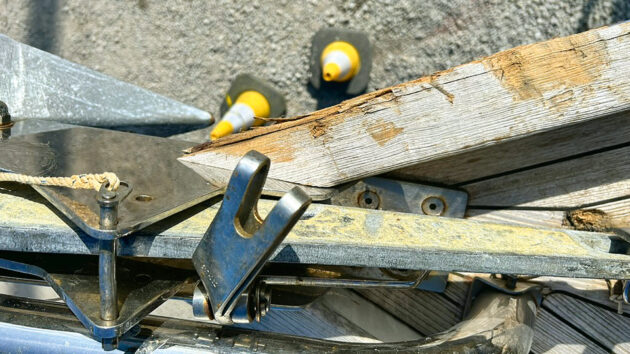
The broken chainplate showing the failed weld. Photo: Richard Ayres.
The take away after dismasting due to a faulty chainplate
- Additional aerial: It took me precious minutes to realise that the VHF aerial was under the water and not working. In the future, I’ll always have an additional aerial somewhere else on the boat, and probably an independent handheld VHF as well. If we hadn’t had a mobile phone signal, we would have been in trouble.
- Cutting tools: Slicing through steel cable is difficult, and in my experience, bolt cutters that many of us carry are not up to the job. I managed with a good hacksaw and a new blade, but a battery-powered angle grinder with a metal cutting disc would have been quicker and saved me bruises.
- Clip on: I was in a great rush to get the rig away from the boat and took risks sliding about on the damaged deck with nothing left to restrain me. Although I was wearing a lifejacket, if I’d gone overboard, a bad situation would have become much worse. I should certainly have clipped on before attacking the shrouds.
- Sometimes it’s necessary to break rules: I knew there was a possibility of getting a rope around the prop by using the engine, but doing so kept us away from the plunging mast and may have saved damage to the hull or keel.
- Prepare for the worst: Think about what you’d need to do if you are dismasted. I had a huge struggle to get the split pins out to release the forestays. I’ll find some other way of securing them in future.
- Still a Southerly fan: A boat that can cross the Atlantic and then sit on the beach is a wonderful thing, and I am very glad to see that the Southerly brand has been resurrected and is back in production.
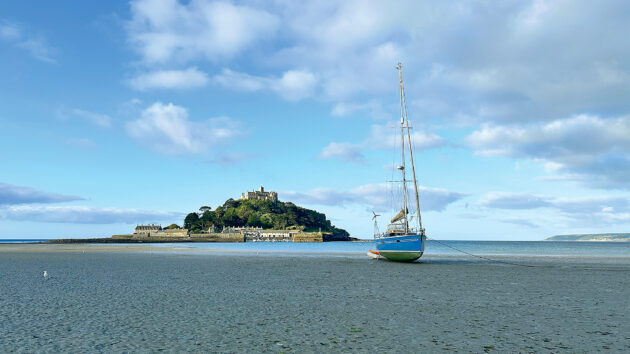
Blue Dolphin doing what she does best at St Michael’s Mount. Photo: Richard Ayres.
Expert response
Guy Addington, Water Safety Lead for the Royal National Lifeboat Institution (RNLI), comments:
Richard’s account of Blue Dolphin’s dismasting is a sobering reminder of how quickly things can unravel at sea, even in fair conditions and on a well-found yacht.
His calm handling of events undoubtedly prevented a bad situation from becoming worse, and the lessons he shares are invaluable for us all.
In this case, the cause appears to have been a chainplate failure rather than poor upkeep.
That said, regular checks and maintenance of rigging and equipment remain critical: many failures at sea do have their roots in wear, corrosion or neglect.
From the RNLI perspective, what struck me most was the value of preparation.
Mental rehearsal of ‘what if’ scenarios; a dismasting, fire, man overboard (MOB) or steering failure, means that your first actions come more readily under pressure. Ropework, too, remains fundamental when controlling rigging, rigging a tow bridle or recovering gear.
Communications should never be left to chance. An emergency aerial for your fixed set provides far greater range than a handheld, and it’s a sound investment.
Mobile phones, while useful close to shore, should never be relied upon offshore.
There is no specific RNLI training scenario labelled ‘dismasting’, but the breadth of training prepares crews to deal with such emergencies.
We practise complex towing, casualty care, search patterns, winching, and risk-based decision making. Each exercise builds the confidence to assess unfamiliar situations and respond safely.
Preparation, seamanship and calm action at sea are every bit as important as the strength of the rig.
Richard’s story underlines that truth powerfully.
Send us your boating experience story. If it’s published, you’ll receive the original Claudia Myatt-signed watercolour which is printed with the article.
Dr Richard Ayres learned to sail Mirror dinghies on the River Orwell. After working abroad and finally coming back to Devon, he bought his first boat, a Colvic 26 bilge keeler which took him on adventures along the South Devon coast, the Channel Islands, Isles of Scilly and up many rivers. Eventually he decided to go bigger and entered into co-ownership of the 42ft Blue Dolphin in 2023.

Snap, shackle and drop: coping with a dismasted sailing yacht
Steve Hodges and his fiancée Sam McClements’ second attempt at the RYA Yachtmaster Ocean passage is scuppered by a dismasted…

Coping with a dismasting & rig checks
Faced with a sudden dismasting in 40-knot gusts, Rupert Holmes explains how he and his crew saved his boat, and…
Want to read more articles like this?

A subscription to Practical Boat Owner magazine costs around 40% less than the cover price.
Print and digital editions are available through Magazines Direct – where you can also find the latest deals.
PBO is packed with information to help you get the most from boat ownership – whether sail or power.
-
-
-
- Take your DIY skills to the next level with trusted advice on boat maintenance and repairs
- Impartial, in-depth gear reviews
- Practical cruising tips for making the most of your time afloat
-
-
Follow us on Facebook, Instagram, TikTok and Twitter