


Jake Kavanagh speaks to Jester Challenge 2025 skippers to find out how they get ready for stormy weather while solo sailing.

The Jester Challenge 2025 once again proved a fertile ground for examples of how a short-handed crew can prepare for heavy weather scenarios.
The challenge began in 2006 and was designed for ordinary cruising boats of under 30ft to be sailed long distance, and single-handed.
Intrigued by the highly practical and self-reliant approach involved, PBO has both supported and reported on the event ever since.
The Jester Challenge 2025
In 2025, the fleet was departing from Plymouth in Devon with a simultaneous start from Phwelli in North Wales. The destination was the charming harbour of Baltimore in Ireland, roughly 250 miles away.
The voyage can take anywhere from three days to a week and is seen as a shake-down for the far more exacting challenges to the Azores (1,500 miles) and Rhode Island (2,500 miles).

The cutter rig gives versatility, with a slightly smaller inner foresail for bad weather. This layout was used by Chris Ayres in his Vancouver 28, Sea Bear. Photo: Jake Kavanagh.
The Jester Challenge 2025 (Baltimore Challenge) was well attended, with 15 boats from Plymouth and another 10 from Phwelli, the latter equidistant to Baltimore and giving simpler access to owners who are based further north.
There was the usual mix of personalities and yachts, with just one or two boats slightly over the 30ft limit, which is allowed if sailed in the ‘Jester spirit.’
Preparing for heavy weather with the Jester Challenge 2025
Most amateur sailors enjoy coastal sailing in a stiff breeze with the boat running at its best, but on a long, offshore passage, the crew can find themselves overtaken by bad weather.
While good forecasting and weather routing can help avoid the worst of a blow, there will be a time when the boat and crew must simply ride it out.
The start of the Jester Challenge 2025 was scheduled for June 12, a month of usually settled weather, but this isn’t guaranteed.
The 1979 Fastnet yacht race disaster, for example, proved that summer sailing can be unpredictable, and this challenge follows roughly the same route.
But as we toured the pontoons, we were impressed with the attention to detail and extra precautions the participants had taken – just in case.
Good seamanship is the mantra of the challenge so, with the main focus on bad weather preparation, we took a close look at the diverse production boats assembled.
The skippers are a friendly bunch, and several gave us an impromptu tour.
Here are some of their top tips for sailing alone, many already proven in heavy weather encountered on similar voyages.
Sail control: Lead everything back to the cockpit
A key part of staying safe in bad weather is to avoid going on deck.
If that becomes a necessity, then you need attachment points for harnesses, and there were plenty of examples among the Jester Challenge 2025 fleet.
However, there is still a risk that if you fall overboard, it’ll be hard to get back aboard again, especially when sailing alone.
The best way to stay safe in bad weather is not to leave the cockpit.
As a result, many of the skippers had decided to bring all the essential control lines back to the helm.

Christian Gallot’s home-built aluminium yacht has all the control lines neatly fed through chafe-resistant plastic guides set into the doghouse. Photo: Jake Kavanagh.
This was usually done by having blocks at the base of the mast, or reefing lines reachable from the end of the boom, so the skipper can stay hunkered down behind the spray hood.
On longer passages, some can operate the boat from the safety of the cabin.
Fortunately, many modern yachts now bring the lines aft by default, especially those with roller reefing or in-mast furling.
If you have a system that uses hanks, involving manual sail changes at the forestay, now is maybe the time to consider a furling system.
Consider a Solent rig
Some of the yachts we saw had the so-called Solent rig, which uses a slightly smaller second jib (the Solent) to compensate for the loss of efficiency of a furled genoa.
As such, there are two forestays, the inner one joining the mast a little further down.
This allows the skipper to fly two foresails simultaneously, or just use the Solent with a heavily reefed mainsail in high winds.
Another advantage is the extra security of having a second forestay, ensuring the mast stays up if one of them fails.
The disadvantage is that the inner stay is something else for the foresail to have to pass by when tacking.
Fit an emergency forestay
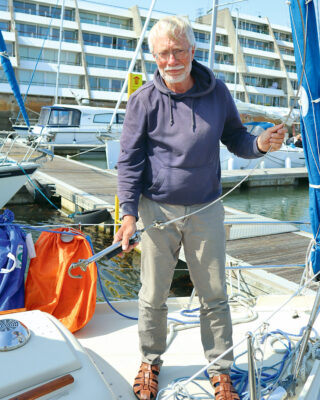
The emergency forestay on Eberhard Harms’ Allegro 27. It is kept stowed at the mast base and pulled forward for deployment. Photo: Jake Kavanagh.
Similar in concept to a Solent rig, but of a temporary nature, is an emergency forestay.
This can be deployed for running two foresails if required, or stowed if the skipper would prefer a large genoa instead.
Should the main forestay let go, then it can be used to keep the mast up and fly a small foresail. Many of the skippers had fitted this extra forestay for security as well as versatility.
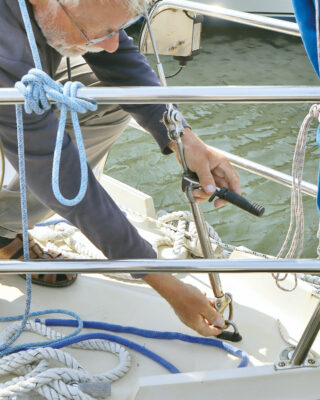
The stay is attached to a U-bolt in the deck using the snap hook, and the lever is pulled out and rotated to tighten the stay up. Photo: Jake Kavanagh.
Eberhard Harms, for example, added one to his Allegro 27 after his bow plate sheared off in rough weather.
Only the lower shrouds kept the mast up as he used the jib halyard as a temporary fix.
Have a self-launching storm jib
Although the golden rule is to avoid going out on deck in bad weather, this may become necessary when conditions deteriorate and a storm jib needs to be raised.
The old advice of ‘reef when you first think about it, not when it needs doing’ prevails.
However, several yachts had devised a system whereby the emergency forestay, storm jib, sheets and halyard are all combined in a bag tied to the cabin top and deployable from the cockpit.

The storm jib is packed away in a bag. The red ropes are keeping it secure and will be removed ahead of use. Note how the orange-topped jib is already hanked on with sheets and halyard attached. Photo: Jake Kavanagh.
The small jib is hanked on and ready to fly, and a downhaul keeps everything pinned down until needed.
When the time comes, the forestay is pulled taut from the cockpit, and the halyard is used to pull the sail out of the bag and up the forestay.
The sheets are already in place on a second set of pulleys on the genoa track, so they are simply bent onto the relevant winch and tightened up.

The storm jib’s temporary inner forestay is attached to a multi-purchase rope leading back to the cockpit. Photo: Jake Kavanagh.
Once the conditions have settled down enough for a safe deck walk, the whole thing can be put back into its bag, ready for the next gale.
See and be seen
It’s very difficult to spot a white boat with white sails in a grey sea with lots of breaking waves, so making the rig more visible is popular amongst the Jester Challenge 2025 fleet.
Modern electronics, such as radar enhancers, were also prevalent, but these depend on power, whereas the orange strips will always be seen during daylight.
There is some debate among sailors about which colours are the most visible from a distance.
The scuba sector feels that fluorescent yellow is best, but others – such as SOLAS (Safety Of Life At Sea) – routinely use orange for lifeboats and superstructure flashes.
The IALA (International Organization for Marine Aids to Navigation) buoyage system also considers black as a standout colour, especially against a grey sky, and combines it with yellow for the cardinal marks.
Several yachts we have seen have opted for a combination of black and orange at the masthead.
Mounting the radar scanner as high as possible, along with the VHF antenna for the best line of sight range, is also highly advisable.
A high antenna will greatly assist with AIS (Automatic Identification System) and DSC (Digital Selective Calling), both systems making your yacht visible when hull down, and alerting you to other vessels nearby.
Protecting ropes
Chafe is a regular point of failure for a yacht’s running rigging, and we saw several ways to allow the halyards and sheets to run as freely as possible.
Perhaps the worst offender is the base of stays, where there are sometimes exposed split pins or shackle keys.
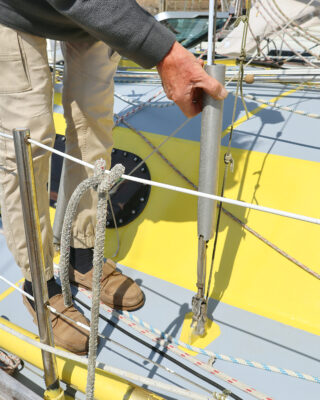
Christian Gallot uses an aluminium pipe to keep sheets from snagging on his shroud screws… Photo: Jake Kavanagh.
Solutions range from a simple piece of pipe (which can only be fitted when the shroud is detached from the chainplate) to a commercially available fabric boot.
Soft plastic versions are also available. Self-adhesive plastic or thin stainless-steel strips can be fitted to protect the ropes where they run across part of the deck.
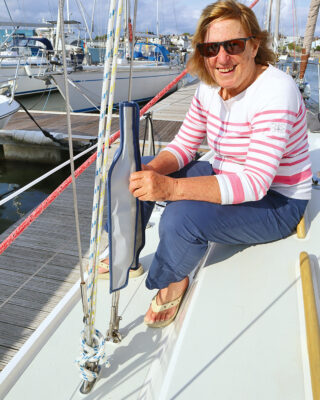
… whereas Sue Denham uses a chandlery-bought fabric boot to do the same job. Photo: Jake Kavanagh.
Know how to heave-to
When sailing short-handed or solo, being able to heave-to will prove a great way to buy some time to sort things out.

Heaving-to is a good way to take a rest. Experienced sailor Will Robinson demonstrates with his Achilles 24 Zeus. Photo: Jake Kavanagh.
The basic idea is that the foresail and main sail are made to work against each other, so the boat comes to a virtual standstill.
Unlike just letting go of the sheets, where the sails will flap frantically in the wind, and the sheets will whip up and down with possible entanglement, heaving-to is relatively quiet and undramatic.
Consider ‘soft’ shackles
While securing the sheets to a foresail with eyes and shackles creates a very secure connection, it also adds a solid mass which could do some damage if allowed to whip around in a storm.
A simple answer is to go for a soft connection instead.
Each sheet is secured to the clew, the attachment point, with a bowline.
This reduces the wear and tear on the clew and prevents a nasty knock to the body, or the mast, if the sail is flogging while the foredeck crew are trying to tame it.

Sue Denham used self-taught skills to splice these multi-braid sheets. This splicing of the inner core avoids a large bowline knot in each sheet. Photo: Jake Kavanagh.
Cockpit protection – in the doghouse
A speciality of Jester skippers is their ingenuity, and nowhere is this more obvious than in some of the doghouse structures they have made to cover the main hatch.
In a following sea, especially one that is breaking over the stern, boats can be pooped; access to the cabin is the most vulnerable area.

Jes Bates filled in the companionway of his Corribee 21 and fitted a full-size opening deck hatch. Photo: Jake Kavanagh.
Many boats had been modified to reduce the size of this opening, either by raising the coaming at the base or having fewer washboards.
Some of the smaller yachts have been fitted with a standard opening deck hatch to ensure full watertight integrity.

Tim Collins built this attractive doghouse for his Tripp 30 from ply. Photo: Jake Kavanagh.
To defend against waves breaking over the bow, some skippers had ditched the conventional fabric sprayhood for a more robust structure made from either wood or glassfibre.
Not only does this afford a pleasant place to sit and keep a lookout, but it also offers extra handholds at a useful height.
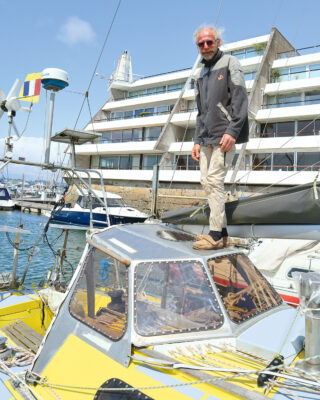
Christian Gallot built his curved aluminium doghouse for his Brisse de Mer to be exceptionally strong and with large windows. Photo: Jake Kavanagh.
Self-steering in the Jester Challenge 2025
Jesters always say that if you only buy one piece of equipment for solo sailing, then fit a wind vane steering system.
Hand steering is extremely tiring and almost impossible for long periods in a gale.

It’s easier to leave the drogue attached than to try to shackle it on in a seaway. The drogue can also be deployed over the bow. Photo: Jake Kavanagh.
While electronic tiller pilots are affordable and steer an accurate course, they were never intended to cope with the large stresses imposed by a rudder in a storm.
Instead, several Jesters keep them in reserve for motoring back from an event in still air, or sailing in light, following winds, which is the type of breeze that is most difficult for vane gear to steer to.
Larger yachts can make use of integrated electric wheel steering systems, which harness hydraulics and can be very dependable, but for sub-30ft boats making long passages, the mechanical vane gear is a must.

Self-steering gear on a small boat is a good clue that they are passage makers. Will Robinson’s Achilles 24 was fitted with a later version of the Hasler servo-pendulum wind vane. Photo: Jake Kavanagh.
The most powerful types are the servo-pendulum variety, where a slight change in wind direction twists a trailing paddle. This moves in an upward direction, pulling on steering lines until the boat is back on course.
Less powerful are the wind-powered systems, which use the force of the wind itself to maintain a course. The main advantage is that these are usually much cheaper to source or build.
Whether wind or water actuated, this type of steering system requires no electrical power and is usually easy to repair en route.
Unlike an electronic system, however, they only steer relative to the wind direction, so if the wind backs or veers, the yacht will follow it round.
Tim Collins has rigged a long, detachable MOB line that runs from stem to stern via a block on the pulpit. It can be reached by someone in the water. Photo: Jake Kavanagh.
We saw several versions on the Jester Challenge 2025 (Baltimore Challenge), many rigged so compensation for a change of wind direction can be made from the cabin via thin adjuster lines.
Among the most popular, and especially for those on a budget, were the Sea Feather and the Hebridean. The Sea Feather is hand-built in Devon, while the Hebridean is designed for DIY construction.
The working mechanism is supplied as a kit, and the boat owner builds the supporting frame from hardwood. Other DIY versions were also being used, such as one of the earlier Hasler systems, designed by the originator of the Jester movement, Blondie Hasler.
Some obsolete production wind vanes were also seen, such as the French-made Navik, a dependable piece of kit, but with spares becoming tricky to source. Other types, such as the Pacific and Aries, were also in evidence.
The common denominator – and a badge of office – was that every Jester Challenger had some type of self-steering system bolted to the stern.

The Sea Feather wind vane was well represented. Simple mechanical equipment is usually repairable en-route if necessary, flotsam being the biggest menace, so Jesters usually carry spare blades, vanes and fixings. Photo: Jake Kavanagh.
MOB self-recovery
To date, there has only been one fatality in the history of the Jester Challenge, and it occurred during the last Baltimore event.
Experienced and award-winning skipper Duncan Lougee went missing from his well-equipped Folkboat when sailing in benign conditions off the Lizard.
His body was never recovered, and the boat was later found drifting in light winds with no clue as to what had happened.
Speculation continues to this day, but the incident served to sharpen the challenger’s focus on self-recovery from a man-overboard situation.
The main issue is that lifting a deadweight out of the water is very difficult.
PBO has tried this many times over the years when testing man overboard (MOB) devices, but even a small, waterlogged body is slippery to get hold of, and unusually heavy.
For the unassisted swimmer, adrenaline helps to provide extra strength for self-help, but this may not be enough.
With the deck two feet overhead, no immediate handholds, and with clothing and footwear full of cold, energy-sapping water, the chances of self-recovery reduce with every minute of immersion.
A crew on board can help with rigging a halyard and sling or pulling a casualty up onto a swim platform or into an inflatable dinghy, but even then, they can struggle.
There is the story of a motorboater who fell off the back of his powerboat while cruising along the UK’s South Coast. His wife was unable to get him back on board, so she gave up, threw him a line, and towed him into shallow water instead.
As he staggered ashore, she shouted that she’d meet him at the nearest marina. Solo sailors a long way offshore have limited options, hence the emphasis on staying safely aboard.
We saw several ideas in the fleet, including a rigged long, detachable line that runs from stem to stern via a block on the pulpit on Tim Collins’s Tripp 30.
It can be adjusted by reaching over the gunwale. The idea is that the MOB gets their foot onto it and uses it as a spring to launch themselves upwards.
Others had ladders that could be pulled down via a short trailing line over the side, with perhaps the most effective being a rigid ladder attached to the transom. The MOB can reach up and swing down so their feet can engage the lower rung.
Having gone overboard myself in a tidal marina and being unable to get out of the water unassisted, I know only too well how frightening it must be offshore.
Carry a sea anchor
If the boat is literally overtaken by stormy weather, the use of a sea anchor can prevent it from being capsized or pitch-poled (rolled end-over-end).
The components are a long line, a parachute-style drogue, a bridle, and strong attachment points on each quarter of the boat.
Some sea anchors use a ‘series’ drogue, comprising smaller cones sewn at regular intervals along a sinking line.
This makes the sea anchor more adjustable, with more being deployed as conditions worsen.
Some yachts always keep the sea anchor in the cockpit, ready to be used, whereas others keep it out of the way and only get it ready when the conditions start to deteriorate.
The same rule as reefing applies to the sea anchor. Get it ready when you start thinking about it, and long before you need it.
Small panels for big power in the Jester Challenge 2025

A directional solar panel can prove more efficient than a larger, fixed type. Christian Gallot seeks out the rays. Photo: Jake Kavanagh.
With so much extra electrical equipment on board a modern yacht, the demand for renewable power has grown.
The fleet of the Jester Challenge 2025 are no exception, relying mainly on the latest electronics for position fixes, weather updates, and constant AIS with a guard zone to protect themselves from shipping when grabbing power naps.
We noticed that even the smallest yachts were carrying solar panels, some of them fixed onto gantries where the frame also doubled as handholds and places for other gear.
Other panels were small and directional, compensating for their reduced area by being able to directly face the sun.
Here comes the bridle
Apart from rope bridles put in readiness for a series drogue, allowing it to be streamed along the centreline astern, we saw two other examples of bridles being used to absorb a great deal of weight.
Sue Denhan, sailing the Westerly 33 Ragdoll has used a rope bridle to allow her to sheet the jib nearer to the mast, giving her the ability to sail closer to the wind.

Sue Denham has made this attachment point for the sheeting of the jib. It pulls the sheet much nearer to the mast than the deck-mounted track, so she can sail closer to the wind. Photo: Jake Kavanagh.
Jes Bates has ditched the track in favour of a bridle aboard his Corribee 21 Mwera to keep it clear of the tiller and bring the purchase onto the deck and not the pushpit, which is more vulnerable.
This has been made possible by modern ropes such as Dyneema, designed for sports like paragliding and kite surfing, but also able to replace metals in some high-load applications.

Jes Bates uses a bridle instead of a track for the sheet block for his junk rig. This keeps it clear of the tiller and brings the purchase onto the deck rather than its original location on the pushpit. Photo: Jake Kavanagh.
The Jester Challenge 2026 – the big one from the UK to Rhode Island
The Jester Challenge is open to any amateur sailor, providing their boat is 30ft or under (with a bit of flexibility if in the right spirit) and the skipper is over 18. That’s it.
There are no other requirements apart from signing a document to accept all responsibility for your actions.(No one has forced you to sail a small boat, single-handed across a very wide ocean).
You must let the organisers know when you arrive or retire, too, so everyone is accounted for. There are no entry fees, either, and the host marinas look after the fleets well.

Jester event skippers are never under any pressure to proceed or turn back – it’s an event rather than a race. This is the Jester Challenge 2025 (Baltimore Challenge) start at Plymouth. Photo: Jake Kavanagh.
Such has been the high level of seamanship shown, including praise for retiring if things aren’t going to plan, the Jester Challenge has had an almost unblemished record.
Apart from the mysterious loss of Duncan Lougee, there has so far only been one MOB self-recovered and a few bumps and bruises.
There has also been some memorable seamanship.
For example, one Jester helped another when a rudder was lost and the boat became unmanoeuvrable.
The subsequent tow over several hundred miles to the Azores under sail alone earned the two skippers, George Arnison and Duncan Lougee, the Ocean Cruising Club Seamanship Award for 2021.
Next summer is the big one, which, like the Olympics, only happens every four years.
Jesters will once again assemble in Plymouth and Phwelli to challenge the North Atlantic with a 2,500-mile crossing to Rhode Island.
Interested in joining the Jester Challenge?
More information on this event and the Baltimore and Azores Jester Challenges can be found at jesterchallenge.org.
The Jester Helm, the name for the three-strong team that arranges everything, has advised any participants in the Atlantic Jester Challenge to apply for their US visas early.
It lasts for 10 years, so no pressure if you – like about 70% of Atlantic challengers – turn back mid-Atlantic.
For those who do make it across, Norman Bailey and the team at the Rhode Island Yacht Club will be greeting the arrivals.
Jake Kavanagh is a former editor of Motor Boats Monthly and has spent 35 years as a full-time marine journalist. He is the technical editor for International Boat Industry (IBI) magazine and is an author and illustrator, specialising in marine themes.

How to prepare a small boat for a big offshore sailing adventure: Top tips from Jester Challenge sailors
The art of sailing a small boat single-handed for long periods has been perfected by Jester Challenge sailors. Jake Kavanagh…

How to service Monitor wind vane self-steering gear
Dena Hankins and James Lane show their Monitor wind vane self-steering gear some love and learn that patience is a…
Want to read more articles about the Jester Challenge 2025?
A subscription to Practical Boat Owner magazine costs around 40% less than the cover price.
Print and digital editions are available through Magazines Direct – where you can also find the latest deals.
PBO is packed with information to help you get the most from boat ownership – whether sail or power.
-
-
-
- Take your DIY skills to the next level with trusted advice on boat maintenance and repairs
- Impartial, in-depth gear reviews
- Practical cruising tips for making the most of your time afloat
-
-
Follow us on Facebook, Instagram, TikTok and Twitter