




Slipping a pontoon mooring alone can be tricky, but this clever peg release system makes departure safe and effortless. Colin Haines explains
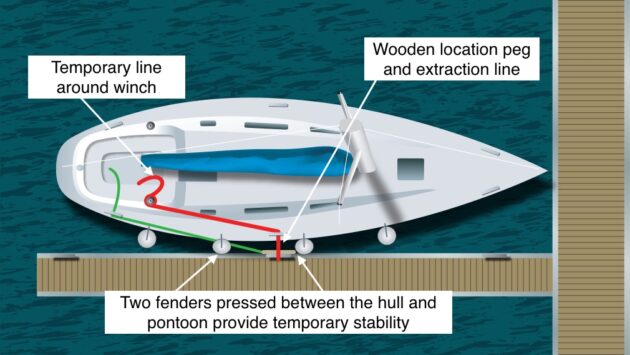
I now sail solo and have devised ways of getting round the need to do several things at once when pontoon mooring, such as casting off the bow and stern lines at the same time when moving away from a pontoon.
My solution was to delete the bow and stern lines in favour of one midships mooring line that could be remotely released from a pontoon-mounted cleat. Or more accurately, after starting the engine, I rig the single line before casting off the springs, bow and stern lines. This is because while the boat may be held against the pontoon, it is not the best way to moor any boat by a single line for a period of time.
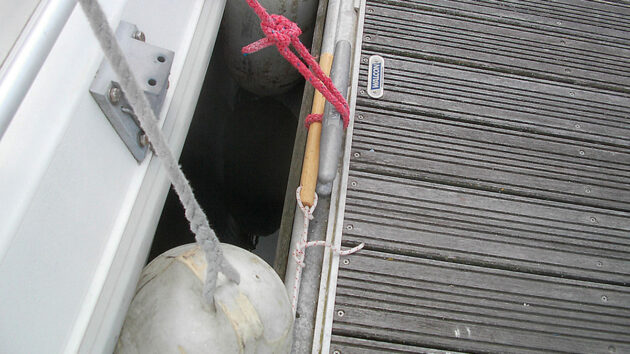
Temporary mooring line rigged. Because it is tailed round a sheet winch, it can be tightened suffi ciently to compress the two fenders slightly, adding to the boat’s stability against being moved by the wind and tide. As soon as the tension is released, the white cord can pull the wooden peg out of the bowline’s eye, releasing the temporary mooring line. Credit: Colin Haines
The obvious problem of how to detach the temporary mooring line is solved with a bowline loop on its outer end. The loop does not go around the pontoon’s mooring cleat, but instead passes over the top and under it, between the cleat’s two support legs.
A wooden location peg, attached to a cord led back to the cockpit, is passed through the bowline’s eye to stop it from retreating backwards the way it came.
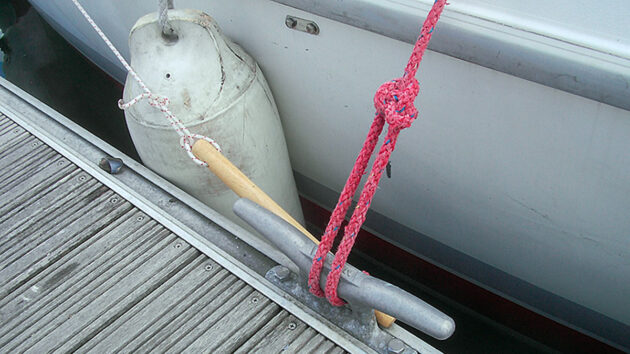
Another view of the temporary mooring line, showing it being slipped as soon as the 1½indiameter pale wooden peg is fully pulled out of the bowline’s eye. If the bowline is passed under the cleat (instead of over it) before the wooden locator is inserted into the eye, the angle of the cord leading to the boat’s stern may make it harder to release the bowline. Besides which, the mooring line may work at an unfortunate angle, nearer to vertical. Credit: Colin Haines
Applying tension with a sheet winch to the temporary mooring line jams the wooden peg in place and, at the same time, pulls the hull tight against the two fenders, preventing the hull from moving. Obviously, if wind and tide conspire to make the use of two fenders inadequate to control the boat’s movement, more can be used. The trick is to maintain the tension on the temporary mooring line and thus keep the peg in place.
As soon as all is clear to move away from the pontoon, slackening the temporary mooring line allows the floating wooden peg to be pulled out and quickly recovered on board. The bowline eye falls free and dangles down beside the hull, where only being a short rope it probably doesn’t even reach the water and definitely can’t reach the propeller. Recovery can be done at leisure.
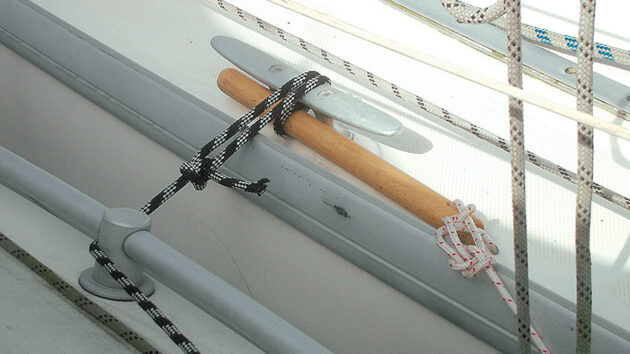
The same technique can be used when leaving a raft of boats, provided that the adjacent boat has something like a midships cleat to carry the bowline and peg. Things made from rope and wood will not damage the neighbour’s boat. If the boats are reversed in this situation, the
bowline could pass under the tubular toerail and then be locked in place by turning the loop into a sort of cow-hitch. Credit: Colin Haines
An observant reader will note that the same technique can be used to release a mooring line at the bows from the cockpit and that, depending on boat and mooring cleat, the rope can equally pass under the pontoon cleat. This choice is based on keeping the rope as near horizontal as possible.
If a bollard is involved, turning the open end of the bowline eye into a cow-hitch round the mooring line and positioning the peg in the eye can achieve the same results.

Sailing alone: a checklist for solo sailors
It’s easy to forget vital bits of information when setting off on a single-handed passage. Making checklists helps, but everyone’s…
Solo sailing tips – anchoring and berthing
Andrew Blyth, who regularly sails his 9m Maurice Griffiths cutter single-handed, describes a selection of methods for dealing with tricky…
Yann Quenet: Why this solo French sailor refitted his micro-yacht to sail the globe again
Yann Quenet stands out as much for the philosophies behind his self-designed and built 13ft Baluchon as for his sailing…
A solo sailor shares his top safety tips
John Cotton describes the modifications he has made to his Albin Ballad to make her a safe and dependable yacht…
Sailing solo: how to go from crewed to single-handed
Round the world sailor Ian Herbert-Jones shares valuable advice on how to transition from crewed to single-handed sailing
Want to read more seamanship articles like Solo pontoon mooring: How to slip a line from the cockpit?
A subscription to Practical Boat Owner magazine costs around 40% less than the cover price.
Print and digital editions are available through Magazines Direct – where you can also find the latest deals.
PBO is packed with information to help you get the most from boat ownership – whether sail or power.
-
-
-
- Take your DIY skills to the next level with trusted advice on boat maintenance and repairs
- Impartial, in-depth gear reviews
- Practical cruising tips for making the most of your time afloat
-
-
Follow us on Facebook, Instagram, TikTok and Twitter
PBO web categories