



From the archive, David Harding test sails the w1DA - a boat unlike any other that he has sailed and that marked a new approach to the production yacht
w1Da: the yacht that broke the mould

One of the hazards of testing boats for a living is that you tend to find yourself on the receiving end of enquiries from people looking to buy one. All too often they go something like this: ‘I want a boat that will be safe to sail with my wife and two children, small enough to be easily managed on my own and yet able to accommodate a few friends for the occasional weekend. Although I’ll be mostly day-sailing, I’m hoping to do some cross-Channel trips and would like to be able to sail to northern Spain or perhaps across the Atlantic in a few years’ time.
‘Shallow draught would be ideal, it must have standing headroom and I don’t want anything that’s difficult or expensive to maintain. I will need to trail it home for the winter and keep it in my garage. It must be stable, roomy and comfortable because my wife is still a bit nervous, but some friends are keen to do some racing as well. I have a budget of £12,000. What do you suggest?’
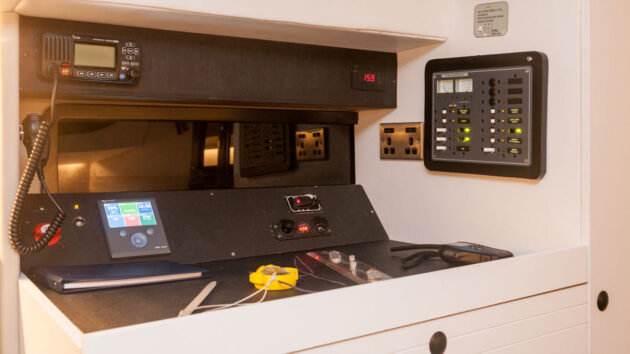
Nerve centre for the electrical system is at the chart table. Heat generated by the energy controller, which runs at 7kw and is about 97% efficient, heats the hanging locker. Credit: David Harding
Believe it or not, some have been not unlike this: all they want is the impossible. Regardless of budget, it has always been a challenge to combine easy handling with round-the-cans performance, good sea-keeping qualities, family friendliness, spacious accommodation, ditch-crawling potential and trailability to boot.
So what’s the answer? Short of re-inventing the laws of physics, there isn’t one – or at least there wasn’t until the Wild Atlantic One Design, or w1Da (pronounced wonder) came along, even if she would call for a sizeable garage.
W1Da: the boat for everyone
For the team behind the w1Da, creating a boat that did pretty well everything – and did it better than almost anything else – was principally about eliminating the features that people find troublesome or just don’t want.
Why, they reasoned, have a heavy, noisy, smelly and complicated diesel engine? So they developed an electric propulsion system instead, using a retractable rim drive on the transom that weighs all of 18lb (8kg). Its design is by w1Da themselves, other components coming from Germany. The motor is controlled by a management system similar to that used in the latest generation of electric cars, and among the methods of charging the fifth-generation lithium batteries is a solar panel.
Being stuck with a boat in one place can also be rather limiting, so the w1Da team made theirs so it could be trailed and launched by its owners. But that didn’t mean building a 25-footer: they built a 31 (closer to 33ft with the bowsprit) that weighs the same as a typical 25.
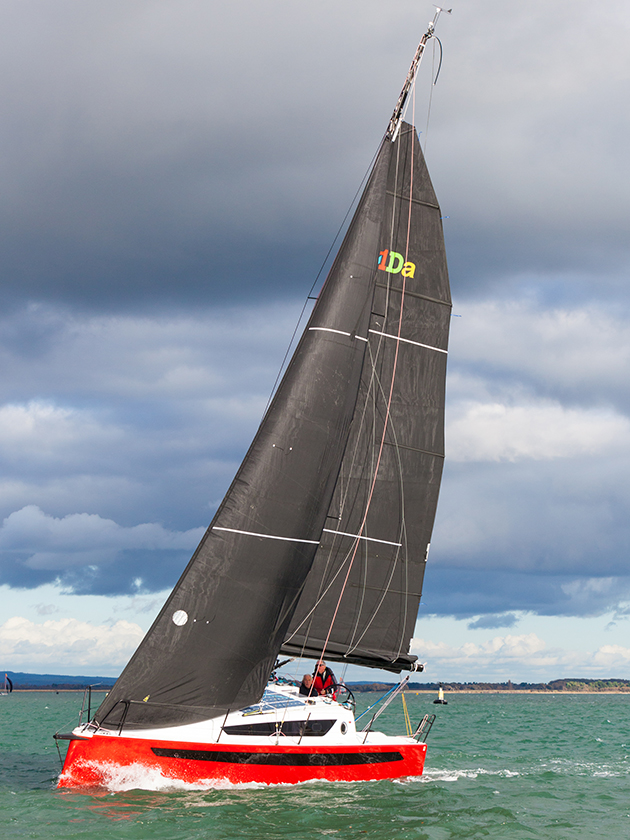
Length of the w1Da including the bowsprit is 32ft 5in (9.88m). Credit: David Harding
The boat tips the scales at around 6,600lb (3,000kg) and the three-axle trailer at less than 1,100lb (500kg). That gives a total weight behind a car of 7,700lb or 3,500kg; within the legal limit and towable by many 4x4s. With the maximum width for towing without restrictions now being 9ft 6in (2.89m), there was scope to create a light, slim-hulled 30+-footer (with a fully-retractable keel, of course) that can be hitched up and taken wherever you fancy going.
The big question, of course, is this: how on earth did w1Da (it’s the company’s name as well) build a boat of this size that weighs just three tonnes? Again, the answer was by embracing new technology. Instead of traditional glassfibre laminates, they used structures found in top-end race boats, aircraft and performance cars: vacuum-infused, foam-cored epoxy composites.
The result is greater strength-to-weight ratio, minimal chance of osmosis, a 20-year hull warranty, no on-going styrene emissions and vastly superior eco-credentials during build. Environmental legislation is making life increasingly hard for builders of glassfibre boats so, as in other respects, w1Da wanted to be ahead of the game. A bonus of this construction is its inherent buoyancy: the word ‘unsinkable’ is avoided, but the boat should remain afloat if holed or flooded.
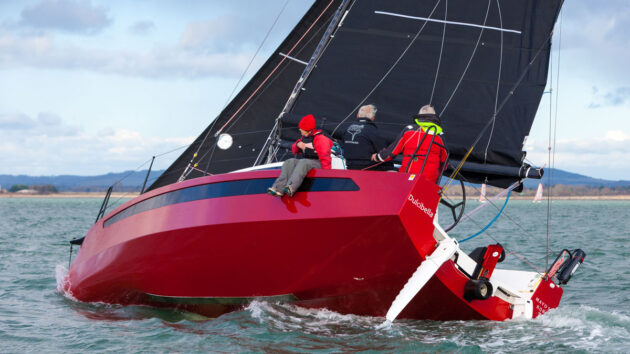
Made from vacuum-infused, foam-cored epoxy composites, the w1Da is light and strong. Credit: David Harding
Of more relevance from day to day, the hull’s thickness should keep the cabin quiet and well insulated. Swinging down from inside its integral case is the keel with its stainless steel frame, encased in a profiled epoxy laminate and containing lead at the bottom to keep the centre of gravity as low as possible. It’s raised and lowered by an electrically-powered hydraulic ram with manual back-up and a built-in shock-absorber that allows it to lift if it hits something.
Even the twin retractable carbon rudders aren’t conventional. They have serrations along the leading edges (the proper word is ‘turbocles’), claimed to reduce cavitation, increase lift and generally make the blades more efficient.
Of course, a multi-role boat like this wouldn’t be taking full advantage of its minimum draught of just 14in (36cm) if it couldn’t take the ground. To that end the w1Da has mini bilge-runners moulded into the hull and capped with stainless steel. Apart from providing protection, they should improve directional stability.
Weight and sea
Whether or not you subscribe to the ‘lighter is better’ (as long as it’s strong enough) philosophy, it’s hard to take issue with the logic of saving weight aloft. Since that means less heel, pitch and roll for starters, it’s no surprise that the w1Da has carbon spars.
Made by Seldén, the tapered mast weighs less than 100lb (45kg) complete with spreaders and rigging, so raising it with an A-frame should be straightforward. In similar vein, the standing rigging is Dyneema rather than stainless steel – both lighter and relatively simple to splice. The boom and canting wheel are carbon too, or you can have a tiller if you prefer.
Sails on the test boat were made from Dacron impregnated with carbon. On future boats they’ll be made from a fabric being developed by w1Da in conjunction with a sailmaker. It’s said to be both lighter and more durable than existing laminates, a life of over 10 years being talked about. As we have already discussed, you can trail the w1Da if you want to.
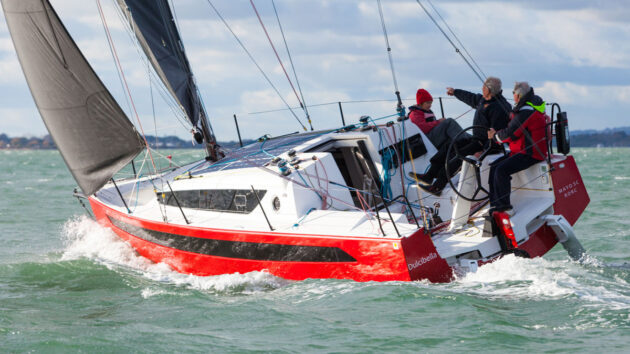
The w1Da has a long keel and a slim and shallow hull. Credit: David Harding
Making the trailer heavier than absolutely necessary would have meant reducing the size and weight of the boat, so it was built in aluminium rather than steel. Still relatively rare in the UK, aluminium trailers are widely found in Australia and the USA. At this point it might be tempting to ‘do a Monty Python’ and ask, ‘apart from the light, strong, long-lasting and eco-friendly hull construction with its positive buoyancy and insulation, the fully-retractable, low-cg swing keel and shock-absorbing ram, the high-lift, low-drag rudders, the efficient, non-polluting, silent electric motor, the latest lithium batteries with a life of 10-15 years, the carbon rig, the light, durable sails and trailability behind a 4×4, what does the w1Da offer that other boats don’t?’
Well, there is more. The hulls start in white but are covered with an aircraft-grade vinyl wrap in whatever colour you choose. It’s impregnated with an antifouling agent that’s claimed to be effective for seven years. Anything else? Well, on deck the layout is geared around cross-winching for the headsail sheets, so you have the luxury of trimming from the high side.
The winches are Seldén’s reversible type: to ease the sheet you just turn the handle the other way. You can walk on the solar panel because it’s designed to be walked on and has a non-slip finish. Down below you find no seacocks: the engine doesn’t need any, the heads is flushed with fresh water directly into a holding tank, and grey water goes into the holding tank too. The electric-flush heads comes from Raritan in America and is claimed to be odour-free. And so it goes on. Almost every aspect of boat’s design, construction and fit-out has been examined in detail, and if there appears to be a better way to do something, that way has been chosen.
Adopt and adapt
While much of the technology found in the w1Da is realtively new to boats – or to cruising boats at least – it has been tried and tested in other industries. For example, Rolls Royce has been making rim-drive electric motors for silent-running submarines for decades, and it just so happens that one of the w1Da development team worked as a senior manager at Rolls Royce. With other Wonderers, as we might call them, having backgrounds in electrical engineering and the aerospace industry, technical expertise has not been lacking. Between them they can also boast many decades of cruising and racing experience up to Admiral’s Cup level, while the hull lines were drawn by Joe Richards and Guy Whitehouse in Cowes. When it comes to credentials, this boat has the lot.
Racing and cruising the w1Da
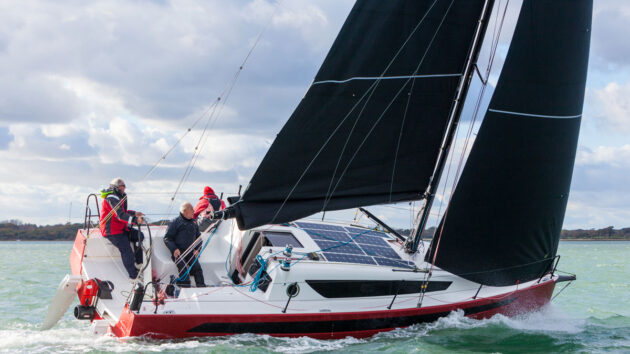
Given her pedigree, there was no way the w1Da was ever going to look old hat, her sharp lines being accentuated on the prototype by the bright red hull. Although perhaps looking a little sporty for a cruising boat, she has been conceived as a cruiser as well as a racer (both one-design and IRC).
The fact that she’s light and (theoretically at least) pretty quick should not be held against her by prospective cruising owners. Being slim and easily driven she needs a relatively small rig, leading to lighter hardware, smaller, more easily-handled sails and less effort on the part of the crew. Her provisional IRC rating is 1.023, making her faster on paper than all but the most racy boats of her size.
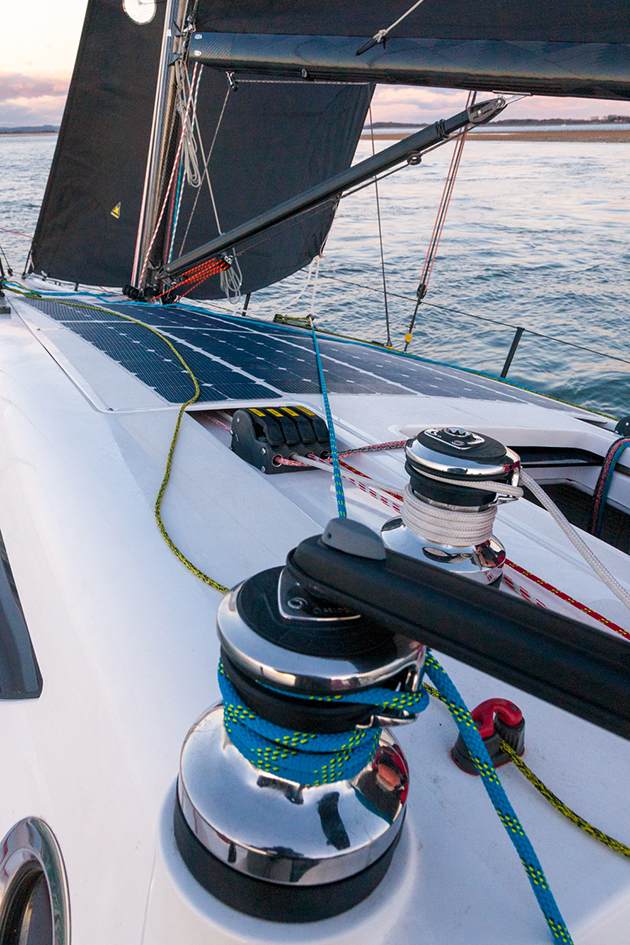
Cross-winching means you can sheet in and trim the headsail from the windward side using the Seldén reversible winches. The solar panel can be walked on. Credit: David Harding
Nonetheless, as I found on a breezy autumn day, she’s a pussy cat rather than a tiger when it comes to manners. We set off with a slab in the main as the north-westerly wind was blowing at a good 15-20 knots. The tide was beginning to ebb, so I took the photos inside the harbour before hopping aboard on the way down the channel under asymmetric spinnaker.
Handling was as simple as could be. The boat proved to be light, precise and responsive to sail and the cross-winching worked a treat. Our test boat had the Jefa steering linked to a canting wheel. There was a little slack in the system and the steering arms are to be lengthened, but even so it was clear the boat is fundamentally well balanced.
Gauging speed and tacking angles was difficult given the strength of the tide, the shiftiness of the offshore wind and the absence of a log. Besides, the combination of the chop and a saggy forestay due to the bedding-in stretch in the rigging didn’t allow her to demonstrate her full potential upwind.
A further refinement is going to be the addition of a slot-gasket to reduce drag from the keel case. After every wave we felt a slight thud from the water hitting the back of the case, which the gasket should eliminate.
Handling under power was straightforward and, except for the absence of prop-wash, just the same as with a conventional yacht. Acceleration is instant, smooth and silent and the batteries should give a good 8-10 hours’ running (or up to 20 hours if you invest in extra capacity). They can be charged via a solar panel, wind turbines, a shore supply or from the motor itself if you leave it down and put up with the drag under sail
Accommodation on the w1Da
The w1Da provides a high level of creature comforts below decks even if the slim, shallow hull and long keel case means she’s less voluminous than some. The trim will be refined on production boats, but the test model still had the electric loo with its fresh-water flush and the ‘drying room’ abaft the chart table, heated by the energy controller.
The abundant electricity runs an induction hob and a fridge, not forgetting instant hot water: no more fiddling with gas and waiting for the kettle to boil.
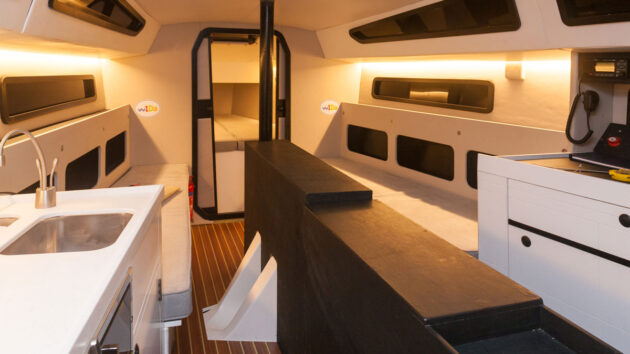
The keel case inevitably dominates the saloon, but provides a useful bracing point for working at the chart table or galley. Credit: David Harding
A significant feature of the boat is the lack of elements that smell. There’s no diesel, no stinky heads, no gas and, of course, no styrene from the hull laminate. You don’t have a diesel tank or an engine taking up chunks of the interior, though much of the under-bunk space is occupied by batteries and the hydraulic keel mechanism. Windows in the hull give a good view out and let in lots of light.
Verdict on the w1DA
It’s safe to say the w1Da is unlike anything we’ve seen before. She combines a vast amount of technological development from a range of fields in a boat that might well resolve many of the issues that put people off sailing and boat ownership.
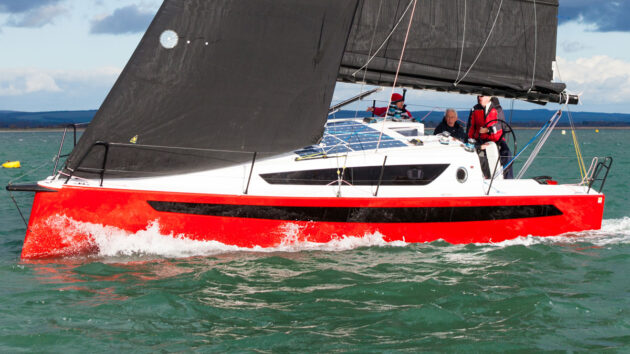
The RCD category of the w1Da is A/B. Credit: David Harding
It takes a while to get your head around the full implications of what the w1Da might mean for the future of yachting. Perhaps the biggest question is whether the market is ready for something like this. There’s no reason why it shouldn’t be, because so much of it makes perfect sense and, while the w1Da is not cheap, she comes ready to sail and with a whole host of features that are expensive extras on many boats.
Just as significantly, her running costs are potentially a good deal lower. However she’s received, you have to take your hat off to the team who conceived and designed such a boat. This is a space we will be watching with particular interest.
Details
Length inc. bowsprit:32ft 5in (9.88m)
Hull Length:31ft 2in (9.50m)
LWL:31ft 1in (9.48m)
Beam:9ft 6in (2.89m)
Draught – keel up:1ft 4in (0.40m)
Draught - keel down:6ft 6in (1.93m)
Displacement:6,614lb (3,000kg)
Ballast (inc. batteries):2,646lb (1,500kg)
Sail area (mainsail + 100% foretriangle):562sq ft (52.2sq m)
Sail area/displacement ratio:25.50
Displacement/length ratio:98.33
Motor:7kW electric, rim-drive
RCD Category:A
Designer:w1Da/Joe Richards/Guy Whitehouse
Builder:w1Da Experience Ltd
Price when new:from £180,000