



David Harding tests this simple and efficient trailer-sailer gaffer which doesn't hang around
Kite: the lightweight trailer-sailer with heart

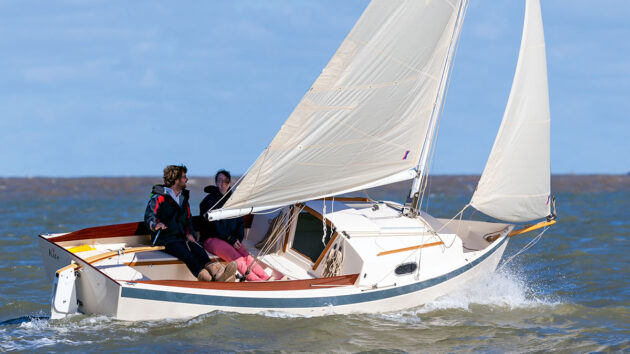
Some people still don’t believe that a gaffer can cut it when it comes to practicality or performance – let alone both. Gaffers don’t go to windward, they say (as some in darkened corners still do about multihulls). And what’s the point of having a stick poking out from the front of the boat and a mainsail hung from a yard at the top when you can have an efficient modern rig?
At this point, gaff enthusiasts might gently point out that they’ve been ahead of the game for decades: it’s only in the past decade or so that racing yachts have discovered bowsprits and square-top mainsails. Wherever the discussion might go from here, the fact is that modern gaffers – and other designs that draw inspiration from traditional craft – are winning converts because they can be both practical and fast.
For example, who would have believed that a 6.4m/21ft gaffer designed as a simple, easily-managed trailable weekender could beat Squibs around the race course – and competitive, well-sailed Squibs at that?
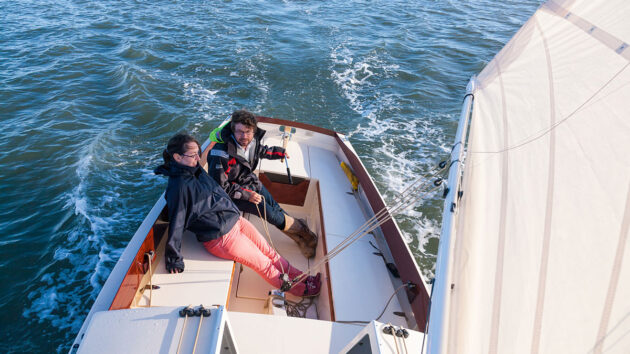
The long cockpit provides generous seating and plenty of locker space. It’s too deep to be self-draining, so there’s a sump beneath the sole. Editor’s note: it is advisable to wear a lifejacket. Credit: David Harding
This is exactly what the first production model of the Kite has been doing, among other things.
I sailed the two epoxy-plywood versions at the English Raid in Falmouth. Kite No1 was jointly owned by her designer, Andrew Wolstenholme, and her builder, Colin Henwood, while Dick Phillips built No2 with a slightly longer coachroof for an owner on the Dart.
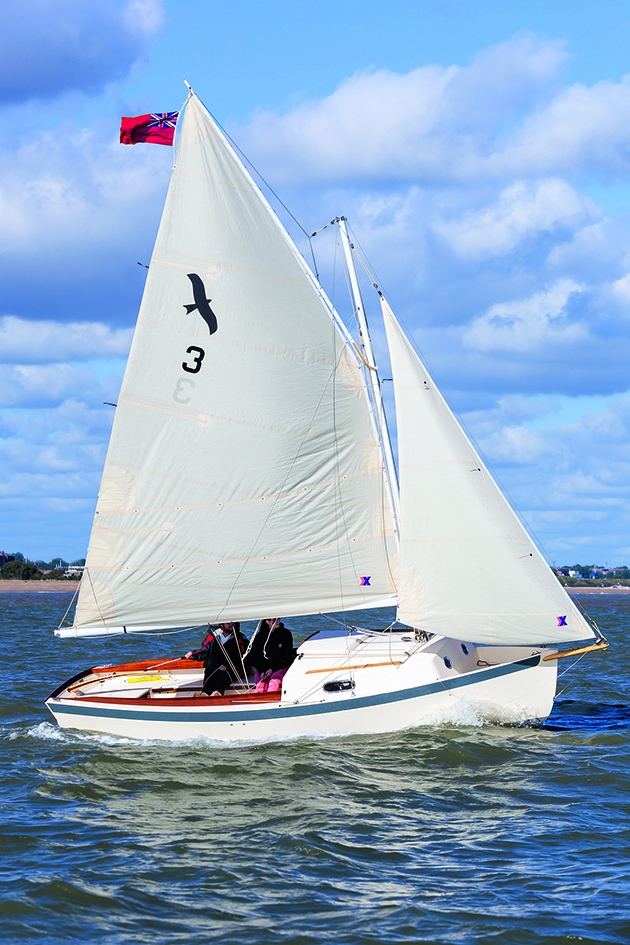
The Kite has a sail area of 19.7sq m (212sq ft). Credit: David Harding
I was impressed by the design and delighted to hear that a production version in GRP was being developed on the East Coast. After all, the Kite is fast, fun and responsive. She has an enormous cockpit, a two-berth cabin with ample space for weekending, an all-up weight that makes her easy to trail, a profiled, fully-retractable
centreplate, spars short enough to stow within the length of the boat (a big tick for the gaff rig) and a carbon mast that weighs just 7kg (15lb). No one is going to struggle to raise that.
It’s a pretty good list of ingredients for civilised trailer-sailing in a boat that also looks the business.
Kite interesting
The Kite is far from being the only modern trailable sailer to incorporate elements of traditional appeal. Others include the Cornish Shrimpers – the 19 and now the 21 – and, of course, Swallow Yachts’ BayRaiders and BayCruisers, which represent more of the modern-meets-classic hybrid approach. Although she will often be compared with both the Shrimpers and the ‘BaySailers’, the Kite differs from both: she’s lighter and more sprightly than the former and more traditional in style than the latter.
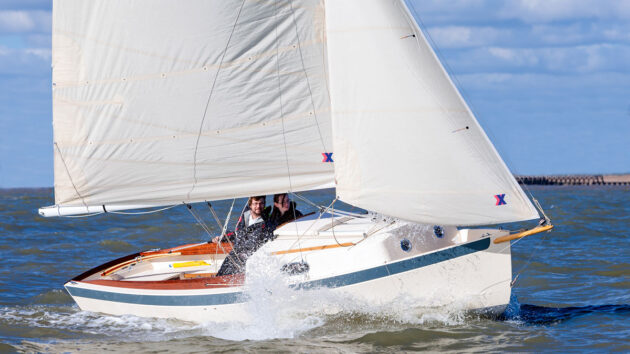
Upwind performance is good for a gaffer. She’s pretty dry, too. Credit: David Harding
Don’t, however, be deceived by the gaff rig, single-chine hull, spruce bowsprit and mahogany and teak trim, because there’s a lot of tech behind the trad. For a start, building a 21-footer weighing just 750kg (1,650lb) in epoxy ply is one thing, but building the same boat to the same weight in GRP is quite another, especially given the flat panels inevitable with a single chine.
This is where Demon Yachts come in. Resin-infused laminates incorporating vinylester resin, multi-axial glassfibre and a foam core might be ambitious for
some but are hardly pushing the boundaries for a yard like this.
Strings for a Kite
All too often when stepping aboard a production cruising boat – recently-launched or otherwise – you find aspects of the hardware and cordage that just aren’t right and that compromise efficiency to the detriment of sailing pleasure. Not so with the Kite.
She’s rigged and fitted out in a way that’s simple and efficient, reflecting Demon’s understanding of what makes a boat tick and the directors’ experience with performance yachts and racing dinghies.
Barton hardware is used extensively, though the mainsheet blocks are from Allen. Most of the cordage is in a golden colour that goes nicely with the off-white
hull (Flaxen is the official name for the colour of the gelcoat) and the well-cut cream-coloured sails from Mike Mac. It’s all pretty minimalist – keeping things light and simple was the aim – but tastefully done.
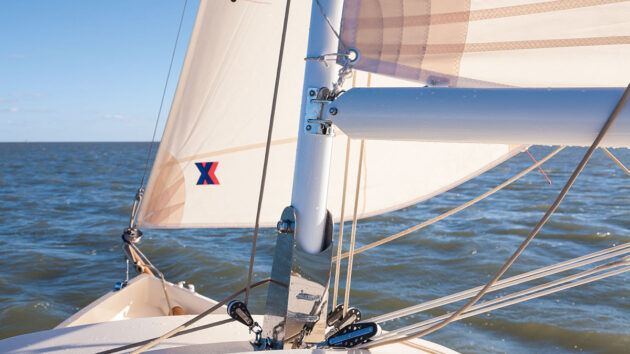
Colourcoordination: creamy deck and sails, white spars and gold coloured ropes. Credit: David Harding
In Falmouth I sailed the Kites on flat water, so this time it was good to have 12 to 15 knots of easterly kicking up a respectable chop off Harwich and Felixstowe. For a
light 21-footer our test boat, Kite No3, was smooth and surprisingly dry upwind. In fact, the only time we took much more than a splash aboard was inside the harbour,
when the wash of a passing workboat hit us on the beam.
In open water the GPS was showing unrealistic upwind speeds of 5.5-6 knots. That might have been due to the ebb tide, but it was the same on starboard tack when we should have been across the stream. Maybe the tides do strange things in these parts. What’s clear is that the Kite doesn’t hang around. Off the wind she quickly slid past the 10m (33ft) yacht under sail from which I was taking the photos. She also had the legs upwind most of the time.
Despite the chop, our tacking angle was a consistent 90°. That’s not bad for a small, light gaffer in a seaway. With the sheets eased and the wind abaft the beam she was eager to surf, though our peak on the GPS of a modest 7.5 knots confirmed that the tide was against us. In any event we would have needed a lot more breeze to break the designer’s current record of 11 knots.
East handling
Importantly for a boat designed to appeal to a wide audience, the Kite is easy and forgiving to sail as well as fast. The helm felt nicely light, and lighter than I remembered from Falmouth. That might have been because this time I jumped straight aboard from eight tons of steel cruiser with a barn-door rudder.
In the circuits and bumps routine she scored highly. We maintained headway when pinching mercilessly, and she stalled only briefly if brought to a standstill before being asked to carry on with the sheets still pinned in. She hove to surprisingly happily for a boat with a large mainsail and small jib, and could be gybed around without the sheets being touched.
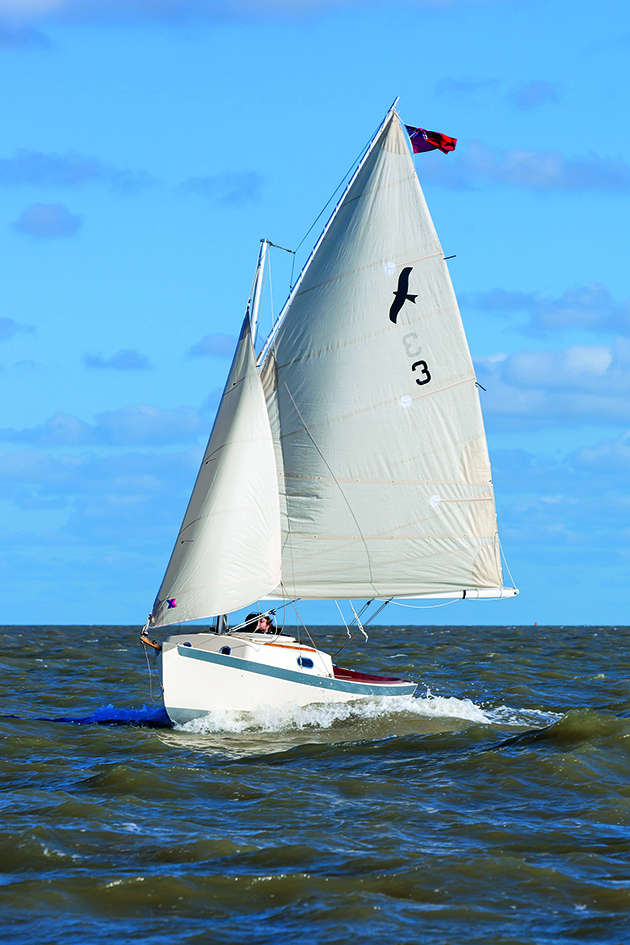
Kite surfing: downwind with a few waves, the Kite is eager to get up and go. Credit: David Harding
The rudder gripped well, too. If we provoked her by over-sheeting and sailing too deep, it hung on until the gunwale was awash – and she took some pushing to go over that far. It goes without saying that it would be sacrilege to sail a boat like this with a prop dragging through the water.
The outboard can’t be tilted up, so you lift it into its dedicated locker and insert the fairing plug in the well. If you’re into power-sailing you can use up to 6hp or consider an electric outboard.
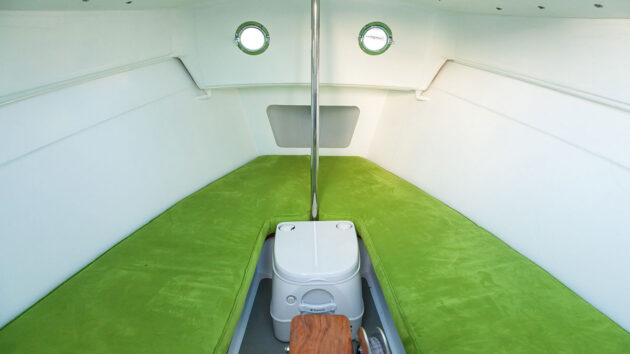
Whatever your choice of upholstery colour, there’s room to
stretch out or sit up down below, plus galley space under the bridgedeck. Credit: David Harding
It also goes without saying that accommodation is not a priority on the Kite: two berths, comfortable sitting headroom, space for a chemical loo and some stowage beneath the bridgedeck is all you need for weekending, together with a tent over the cockpit. It’s all pretty civilised nonetheless.
If the idea of a trailer-sailer gaffer appeals, you might find it hard not to like the Kite.
Details
LOA (plus bowsprit):6.40m (21ft 0in)
Beam: 2.13m (7ft 0in)
Draught (centreplate up): 0.25m (0ft 10in)
Draught (centreplate down):1.16m (3ft 10in)
Weight (dry):750kg (1,654lb)
Ballast (centreplate):80kg (176lb)
Internal lead:115kg (253lb)
Sail Area: 19.7sq m (212sq ft)
Builder:Demon Yachts
Price when launched: £31,950