


Phil Clandillon looks at the best second-hand yachts for Scandinavian cruising and exploring the Stockholm Archipelago. Including: Hallberg Rassy 36 | Albin Ballad | Hanse 400 | Najad 331 | BayCruiser 26 | Maxi 1000.
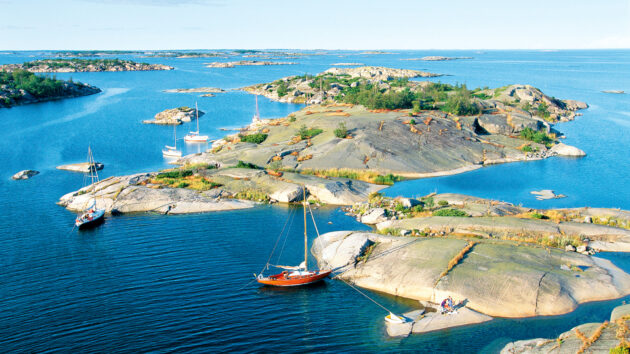
There’s a lot to love about Scandinavian cruising. It’s said that Stockholm sailors rarely venture outside home waters themselves– and with 30,000 islands on their doorstep, who can blame them?
While the number of islands, islets and skerries in the Stockholm Archipelago is only an estimate, the fact that the number isn’t fully agreed upon just goes to show how rich this cruising area is.
The inner and central archipelagos extend outward from the city and are surrounded by the Furusund Fairway and the outer and southern Archipelagos.
These 650 square miles offer something for everyone, from buzzing nightspots and bourgeois villages to beautiful inlets and natural harbours.
Sandhamn is home to the Royal Swedish Yacht Club and the finishing point for the Gotland Runt race.
There are cultured hotspots like Furusund in the north and Utö in the south, and a magnificent art nouveau villa on the island of Mörtö-Bunsö.
The remote island of Hallskär has a large area of flat rocks where Swedes dance on Midsummer’s Eve, and the outer archipelago has an almost infinite number of beautiful fine-weather spots.
And when the wind gets up, many yachts flee to the shelter of superb natural harbours like Rödlöga Island or Grönskärsfladen.
What kind of boats are best suited to Scandinavian cruising?
Unsurprisingly, local designs tend to suit the area well. Going aground is common, so many of the boats I’ve chosen have simple construction that makes for easier repairs.
When Scandinavian cruising, it’s common to be away from marinas for days at a time, so it’s useful to have room to carry a small inflatable.
When mooring in a natural harbour, it is usual to anchor by the stern and bring the bow close to the shore with lines secured to rocks. Locals usually have a ladder on the bow to climb ashore.
Most boats can be modified to accept one, but it’s simpler if the design already has an open or semi-open pulpit.
The Hallberg-Rassy 36: Comfort and classic quality
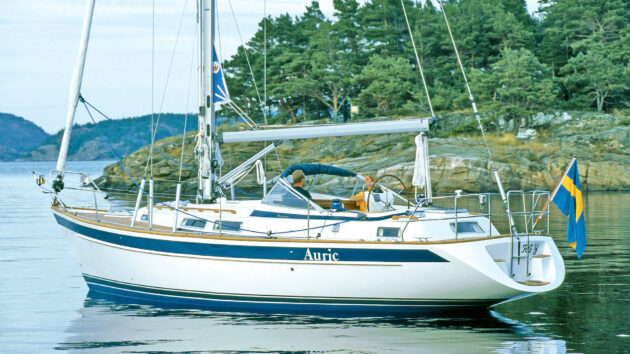
The beloved Hallberg Rassy MK2 is a reliable choice for Scandinavian cruising. Credit: Hallberg Rassy.
Specifications:
- LOA: (Mk1) 10.87m/35ft 8in, (Mk2) 11.31m/37ft 1in
- LWL: 9.35m/30ft 9in
- Beam: 3.55m/11ft 8in
- Draught: 1.70m/5ft 7in
- Displacement: 7,500kg/16,500lb
- Working sail area: 65m2/700ft2
- Built from: (Mk1) 1989-1994, (Mk2) 1994-2003
- Typical asking prices: £67,000 – £130,000
A Hallberg-Rassy can take you anywhere in the world, but it seems particularly at home among the islets of the archipelago, and is a great pick if you’re thinking about doing some Scandinavian cruising.
The Frers-designed 36 is small enough to tuck into a secluded hole in the rocks, but spacious enough for a couple or small family to be comfortable for longer cruises.
The Swedish yard built just over 600 of this centre cockpit cruiser between 1989 and 2003, updating it to the Mk2 version in 1994.
Her designer worked hard on her hull form, and she’s quicker than her looks might suggest, with an example having won her class in the ARC.
The Mk2 version (above) was released in 1994, gaining a wider beam aft and a sugar scoop transom with a small bathing platform, as opposed to the reverse transom of the Mk1. It is 30cm wider at the stern, meaning slightly more room in the aft cabin.
The mast, keel, rudder, underwater hull and engine configuration remained identical across the two variants.
Her keel is a long fin, bolted on, with a very chunky bulb, allowing a modest 1.7m draught. The rudder is hung on a half-height skeg with a large cutout protecting the shaft-driven prop.
On deck, her centre cockpit is well protected, with high coamings and the typical Swedish glass windscreen.
Halyards are usually handled at the mast, but some boats have been modified to lead the main halyard aft.
The mainsheet traveller is on the aft cabin roof, within easy reach of the helm, and the primary winches are located just forward of the wheel.
Her bow pulpit is semi-open, and a ladder can be hooked on for scrambling ashore.
The Hallberg Rassy 36’s interiors
Below deck, her saloon has a good-sized seating area with an L-shaped settee to port and a linear one to starboard. Immediately aft, her J-shaped galley looks ideal for cooking at sea.
Opposite, to port, a passage behind the forward-facing navigation station leads to a spacious aft cabin and contains some useful stowage.
There is another double cabin forward, with the single heads and shower compartment immediately behind.
All 36s were fitted with Webasto heating as standard, ideal for the cooler evenings of the early and late Swedish season.
Buying a Hallberg Rassy 36
Prices range from £67,000 to £130,000 depending on age, condition and equipment.
Although Hallberg-Rassy’s build quality is legendary, these are older boats now and suffer from many of the same issues as other brands.
Used values are very healthy, however, so it’s common to find well-maintained examples, particularly if buying in Sweden.
The teak deck is the main watch out, and it should be surveyed carefully. Otherwise, the 36 would be a great choice for anyone looking to explore the archipelago and do some Scandinavian cruising in style and comfort.
The Albin Ballad: Small, slim, and speedy
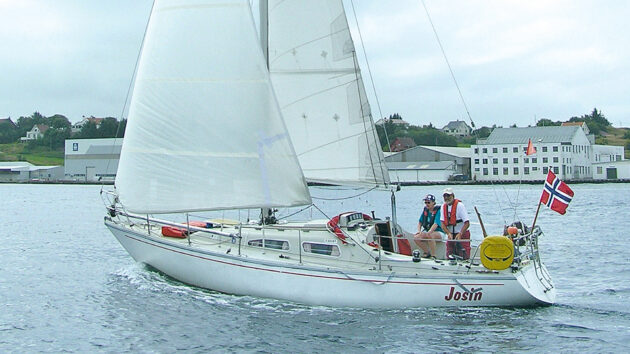
The Albin Ballad’s healthy sail area, high ballast ratio and slender hull make for sporty Scandinavian cruising. Credit: John Cotton.
Albin Ballad specifications
- LOA: 9.14m/30ft 0 in
- LWL: 6.90m/22ft 8in
- Beam: 2.96m/9ft 6in
- Draught: 1.50m/4ft 11in
- Displacement approx: 3,300kg/7,275 lb
- Total sail area approx: 48.1m2/518ft2
- Built from: 1970-1982
- Typical asking prices: £6,500-£25,000
In 1968, budding local designer and sailmaker Rolf Magnusson launched his prototype Joker and entered the Half Ton Cup at Sandhamn. He finished third in a 42-boat fleet, beating most of the world’s elite racers.
In 1971, Albin Marine developed the design into the Ballad, selling a massive 1,500 boats before filing for bankruptcy in 1982.
Over 40 years later, the Ballad is a modern classic.
Her healthy sail area, high ballast ratio and slender hull make for sweet sailing characteristics, and her fin keel and elliptical rudder were advanced for the time.
Her masthead rig was typical of the period, with a skinny mainsail and a large overlapping genoa.
Like most early International Offshore Rule (IOR) boats, she can be a handful when pushed hard downwind, but that is not likely to be a problem when pootling around the archipelago.
The Ballad isn’t a practical vessel by modern standards, but if you fall in love with her looks and sea keeping, a lot can be forgiven.
Inside the Albin Ballad
Below, she has a GRP inner moulding, meaning no droopy headlining, the scourge of many older boats.
Her slim hull doesn’t have the space of modern designs, but a couple who don’t mind the simple life could easily live aboard in the archipelago for a couple of weeks.
All Ballads have a double berth in the forecabin, with a wardrobe behind to port and the heads to starboard.
The saloon has a twin settee layout with a drop-leaf table.
Moving aft, there is a chart table on the port side with a quarter berth behind, and a small galley opposite to starboard.
Early boats had pilot berths above the normal saloon berths, while later models used that space for built-in stowage.
Buying an Albin Ballad
Albin built these boats strongly, and any survivor is very likely to have had serious defects corrected by now.
Most boats will have been re-engined by now, and some will be on their second rig. The best examples will be refitted with modern equipment.
Her lead ballast is encapsulated in the GRP keel, meaning encounters with rocks are more easily remedied.
Expect to pay as little as £6,000 for a fixer-upper, while refitted boats can be priced up to £25,000. It should be possible to pick up a very tidy example for around £15,000, particularly if you’re buying locally in Sweden.
The Hanse 400: Modern comfort for Scandinavian cruising
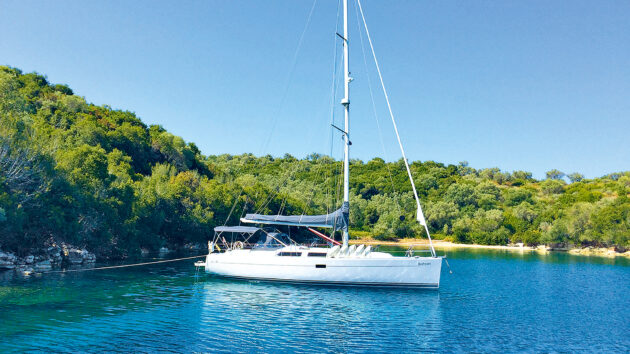
The Hanse 400 won European Yacht of the Year after her launch in 2006. Credit: Ben Sutcliffe-Davies.
Hanse 400 specifications
- LOA: 12.10m/39ft 7in
- LWL: 10.80m/35ft 5in
- Beam: 4.04m/13ft 3in
- Draught: (standard) 2.05m/6ft 8in, (shallow) 1.65m/5ft 5in
- Displacement: (standard) approx 8,190 kg/18,519lb, (‘e’ version) 7,900kg/17,417lb
- Total sail area approx: 105.6 m2/1,137ft2
- Built from: 2006-2014
- Typical asking prices: £80,000-£135,000
Launched in 2006, the 400 won her category in the European Yacht of the Year award, impressing with her ability to combine comfortable cruising with performance.
This Judel/Vrolijk design is a spacious and efficient passage maker, with a tall fractional rig and long waterline.
Jefa’s rod-link wheel steering system gives her responsive handling, and a self-tacking jib makes her easy to sail upwind.
Boats built between 2006 and 2007 had a single wheel, aluminium-framed coachroof windows and a composite iron and lead L-shaped keel.
A revamp in 2008 brought optional twin wheels, bonded acrylic windows, and a cast-iron T-keel.
Standard draught was 2.05m, but a 1.65m shallow L-keel was also available.
Construction was strong, with a rigid floor, a grid of laminated foam stringers, foam core below the waterline and balsa core above.
Like most modern production boats, however, the floor matrix is not straightforward to access for repair if she were to have a severe grounding.
The 400e version was built with epoxy resin, saving around 500kg and making for a stiffer hull. Teak decks were available, which look great, but will be expensive when they need to be replaced.
Her cockpit is spacious enough for a spot of club racing, but enclosed enough for cruising, and she has a neat deck layout with sculpted plates covering lines led aft.
Standard boats had the mainsheet track on the coachroof, but a traveller on the cockpit floor could also be specified.
The foredeck is large enough for a dinghy to be stored inflated, and there is good access for boarding from the bathing platform and transom gate. Her open pulpit is easily fitted with a ladder.
Inside the Hanse 400
Hanse claimed there were 18 possible variations on the 400s interior, but I’m only going to cover the major ones. There was a choice of twin or single aft cabins, with single aft cabin boats having a substantial cockpit locker and a longer galley.
In the saloon, all layouts have a dinette on the starboard side. Most have two armchairs and a central navigation table to port, but some have a single settee, which is better for lounging or for use as a sea berth.
All had the same size aft heads to port, with a stand-up shower.
The forecabin had options for an en-suite heads, dressing table or additional wardrobe, and Pullman or vee-berth. The vee-berth and dressing table use the space best.
Buying a Hanse 400
The aluminium rudder stock should be checked for electrolytic corrosion, and the lower bearing may also need cleaning or replacing periodically.
Some owners of 2010 boats report that the black powder coating on deck hatches and portlights failed, resulting in bubbling and peeling of the finish.
Yanmar recommends that the cone clutch on the SD50 saildrive be inspected every 500 hours and may need servicing or replacing.
Asking prices start from around £80,000 for a boat which needs some updating, and top out at around £135,000 for a well-looked-after 400e version.
The Najad 331: Rugged and reliable
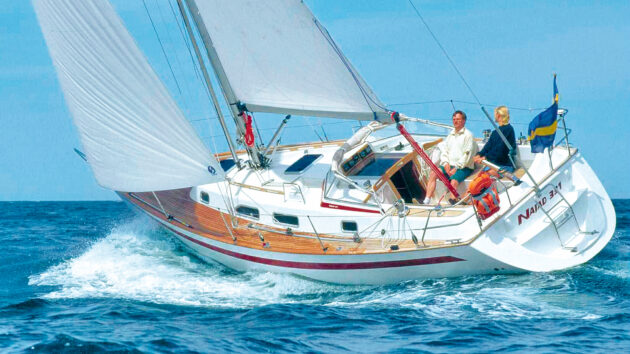
The Najad 331 has the maker’s trademark sensible styling, hard dodger and handcrafted mahogany interior, but with a modern hull, keel, and rudder. Credit: Najad.
Najad 331 specifications
- LOA: 9.98m/32ft 8in
- LWL: 8.14m/26ft 8in
- Beam: 3.26m/10ft 8in
- Draught: (standard) 1.7m/5ft 7in, (shallow) 1.5m/4ft 11in
- Displacement approx: 5,300kg/11,700 lb
- Total sail area approx: 50m2/538ft2
- Built from: 1997-2004
- Typical asking prices: £60,000-£77,000
The 331 is a tough, compact cruiser whose rugged looks conceal a sailor’s boat.
It was launched in 1997 to replace the ageing 330, introducing a modern hull, keel and rudder, while maintaining Najad’s trademark sensible styling, hard dodger, and handcrafted mahogany interior.
A fractional rig provides sufficient power, and the lead keel carries its weight low. Tiller steering was standard, but a wheel was available.
Her mainsail is slab reefed with a stack pack, and the headsail is on a roller furler.
The deck layout is clean and simple, but it is worth noting that halyards are winched at the mast.
Her cockpit has high coamings, providing good back support and a feeling of safety. The transom integrates a swim platform and fold-down boarding ladder.
Her bow pulpit is semi-open, and it is easy to fit a ladder for archipelago-style mooring.
The design was developed into the 332 from 2005, but changes were minor; wheel steering became standard, and the interior featured more white surfaces for a brighter feel.
Najad’s build quality was excellent in this period. Divinycell was used as the core material for hull and deck, bulkheads were tabbed in, and the hull was strengthened with glassed-in stringers and bearers.
Accounting for the increased likelihood of contact with rocks while cruising Scandinavian arcipelagos, the lead keel is bolted to an angled keel stub to more efficiently transfer grounding loads to the hull.
Standard draught is 1.7m, but a shoal keel drawing 1.5m was also available.
The Najad 331’s interiors
Inside, the 331’s warm interior is well thought out and beautifully detailed. Stowage is everywhere, meaning it is easily possible to stow belongings and provisions for a couple of weeks.
Headroom in the saloon is 6ft 1in, with good airflow courtesy of twin Dorade vents on the coachroof.
Her aft cabin has a wide, 2m-long berth, and the forecabin’s vee-berth is 2.05m long, although not as broad.
A good-sized heads is located aft on the starboard side, with a shower attachment on the sink.
In the saloon, there is a practical L-shaped galley with twin sinks to port, and a forward-facing navigation station to starboard. The twin settees also provide two berths, and the drop-leaf table can seat six in comfort.
What to check before buying a Najad 331 (if you can find one)
Problems specific to the 331 are rare, but as with the Hanse 400, the aluminium rudder stock should be inspected for electrolytic corrosion.
The bottom rudder bearing should be checked, and, if necessary, serviced or replaced.
Many 331s had teak decks. If they haven’t already been restored or replaced, that is likely to be a significant future cost.
Najads have always been built in small numbers, so you’ll only see a few 331s for sale at any one time.
Prices start at around £60,000 for a boat that may need some updating, and rise to around £77,000 for a well-kept example with updated equipment.
The BayCruiser 26: A top-end trailer-sailer for Scandinavian cruising
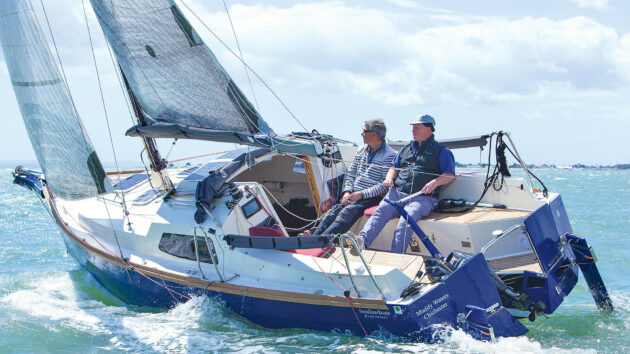
The BayCruiser 26 trailer-sailer offers the maximum amount of comfort you can legally tow around Europe, and making it convenient for Scandinavian cruising. Credit: David Harding.
BayCruiser 26 specifications
- LOA: 8.64m/28ft 4in
- LWL: 7.62m/25ft 0in
- Beam: 2.54m/8ft 4in
- Draught: (board up) 0.30m/1ft 0in (board down) 1.58m/5ft 2in
- Weight: 3,968lb (1,800kg) (without water ballast) 5,620lb (2,549kg) (with water ballast)
- Total sail area: 28.52m2/307ft2
- Built from: 2014-today
- Typical used asking price: £70,000
Sailing from the UK to Sweden is a nice cruise in itself, but it’s a long trip. If you have limited time available, towing a trailable yacht cuts the delivery down to a few days, maximising sailing time among the islands.
This is where Swallow Yachts’ BayCruiser 26 comes in. She blends classic styling with modern design and offers the maximum amount of comfort you can legally tow around Europe.
Her plum bow, attractive sheer and teak trim disguise a modern hull shape, with a fine entry, long waterline and a hard turn of the bilge for good initial stability.
Her twin lifting rudders, and electrically lifting, lead-tipped daggerboard, allow her to float in just 30cm, ideal for launching and recovery, and also give a shallow draught and the ability to dry out flat.
The 750kg of electrically-pumped water ballast adds righting moment, but she can also ghost along in lighter weather with the tanks empty.
A fractional rig in carbon reduces weight, and swept back spreaders with no backstay means she can carry a fat-head main, which twists off as the wind increases.
Her small headsail is easily managed, and an asymmetric kite can be flown from the bowsprit, which also handles the anchor. The mast has a tabernacle and includes a carbon jib-stick for single-handed raising and lowering.
Her wide cockpit has deep lockers on each side, providing room to stow a small inflatable. An outboard is mounted in a notch in the transom, with a clever mechanism that steers the engine with the tiller.
The jib is sheeted via tracks on the coachroof, and the mainsheet comes to a point on the cockpit floor.
Clambering off the front when moored bow-to will be harder with her plumb stem, but her freeboard is relatively low, and shallow draught means you can pull her right in.
Below deck on the BayCruiser 26
There is 1.83m/6ft of standing headroom in the saloon, and the wide forward-facing window gives the space a bright feel.
To starboard, the galley slides out from under the cockpit, offering a fridge, twin sinks and a two-burner stove.
The port settee continues under the cockpit a little, providing an occasional berth, and a folding table stows vertically on the port side bulkhead.
Her enclosed heads uses the daggerboard casing for one side, and the forecabin offers a generous vee-berth with an infill and shelving.
Buying a BayCruiser 26
These boats are still quite new, so I wouldn’t expect any major problems yet, but watch out for any signs of damage to the bottom from launching and recovery, and to the expensive carbon spars.
Some early boats were built from plywood, but most are GRP, which would be my preferred option.
The 26 is built in relatively low numbers, so you may have to wait a while for one to come up.
Expect to pay around £70,000 for a tidy used example, and north of £100,000 for a new boat, depending on
its specification.
The Maxi 1000: a springy cruiser/racer for Scandinavian cruising
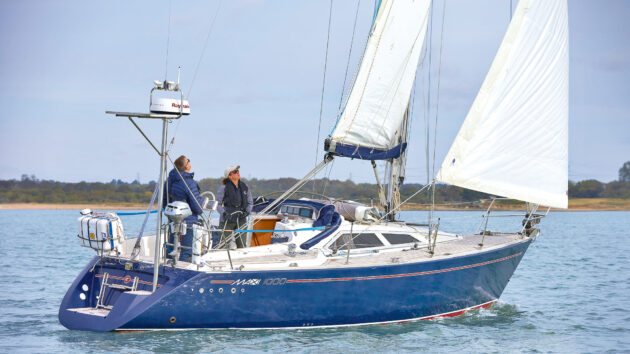
Credit: Graham Snook.
Maxi 1000 specifications
- LOA: 10.20m/33ft 6in
- LWL: 8.20m/26ft 11in
- Beam: 3.25m/10ft 8in
- Displacement approx: 4,500kg/9,921lb
- Total sail area approx: 45.9m2/494ft2
- Built from: 1985-1992
- Typical used asking prices: £36,000-£64,000
The Maxi range was designed by Swedish Olympic medallist Pelle Petterson, and occupied a sweet spot between sailing performance and cruising comfort.
The 1000 was one of the most successful models in Maxi’s middle period and, fittingly, the brand sold around 1,000 examples of this sprightly 33-footer in seven years of production.
The 1000 is a true cruiser racer, with a 7/8th fractional rig, quality deck gear, and a wood-trimmed interior with nice joinery.
Owners report a comfortable motion upwind in waves thanks to a deep forefoot and little weather helm once trimmed correctly. Most examples are tiller steered, but a wheel was optional.
Ample sail area means progress in the archipelago’s lighter airs will be respectable, particularly under genoa.
Two sets of tracks allow sheeting a jib inside the shrouds, or a genoa outside. The main traveller spans the middle of the cockpit, within easy reach of the helm.
The cockpit has a deep locker to starboard, and lazarettes to port and at the stern. Her transom has steps down to a swim platform and ladder.
Her side decks are wide, and the foredeck has enough space to inflate a small dinghy. Her bow pulpit is semi-open, making it easy to fit a ladder.
Inside the Maxi 1000
Wide companionway steps lead to a well-laid-out interior, finished with a mix of solid teak and veneers.
There’s an L-shaped galley with twin sinks immediately to port, and a forward-facing navigation station to starboard. Headroom is 1.9m/6ft 3in initially, but decreases moving forward.
Her saloon has a shallow U-shaped settee to port, which converts to a double berth and a single settee to starboard, with a central drop-leaf table.
Stowage is everywhere, making it easier to plan for an extended cruise.
Her aft cabin has 1.83m/6ft of headroom in the entrance, and good space above the double berth.
The heads is located aft to starboard, with a shower fitting on the tap, and a wet locker draining to the bilge.
Her forecabin is a little tight, with no space to dress with the infill in place. Although long, the vee-berth is only 1.44m/5ft 9in wide at shoulder height.
The hull is solid GRP, with Divinycell core in the deck. The bolt-on, cast-iron keel is supported by transverse GRP beams, and her mast is deck stepped, supported by a compression post inside.
Buying a Maxi 1000
Asking prices start at around £36,000 for boats that need some upgrading, and rise as high as £64,000 for a well-maintained example with modern equipment.
Owners don’t report any serious issues, but the usual older boat caveats apply. Some boats have teak decks, which should be surveyed carefully.
Cabin windows can leak and may need resealing. The anode on the Volvo saildrive should be replaced regularly to prevent corrosion of the leg.
Practicalities and pilotage for Scandinavian cruising
It’s essential to supplement your usual charts with Swedish Båtsportkort booklets. There are three volumes for the Stockholm Archipelago, covering the North, South and Central areas.
Boats should be equipped with a stern anchor for bow-to mooring; locals tend to use all rode for quick deployment.
Carry a bag of bergskils (iron pegs) for hammering into crevices to create mooring points, and long lines to run ashore to them.
In a guest harbour, there can be a stern buoy used for mooring bow-in. You’ll see boats with a webbing reel and snap hook mounted on the stern for this purpose.
Carry a long power cable, as shore connections can be quite far from where you tie up.
Stockholm Archipelago: The 50 Best Harbours by Anders Hellberg, Kerstin Benckert and Gustaf Hannar, published by Brixham Books (£32.50), is invaluable, and also has pilotage information in English for each stopping point.
Phil Clandillon has sailed everything from offshore racers to a Thames barge. In 2023, he turned his obsession with finding the best used yachts ads into a successful Instagram account, @immaculateyachts.

Bay Cruiser 26: space, pace and practicality
How do you combine trailability, performance and live- aboard comfort in a 26-footer? David Harding explains the secrets of the…

Sailing Norway: paradise found
Marina Guedes sails into the Arctic Circle and discovers the timeless beauty of Norway's west coast and Lofoten Islands
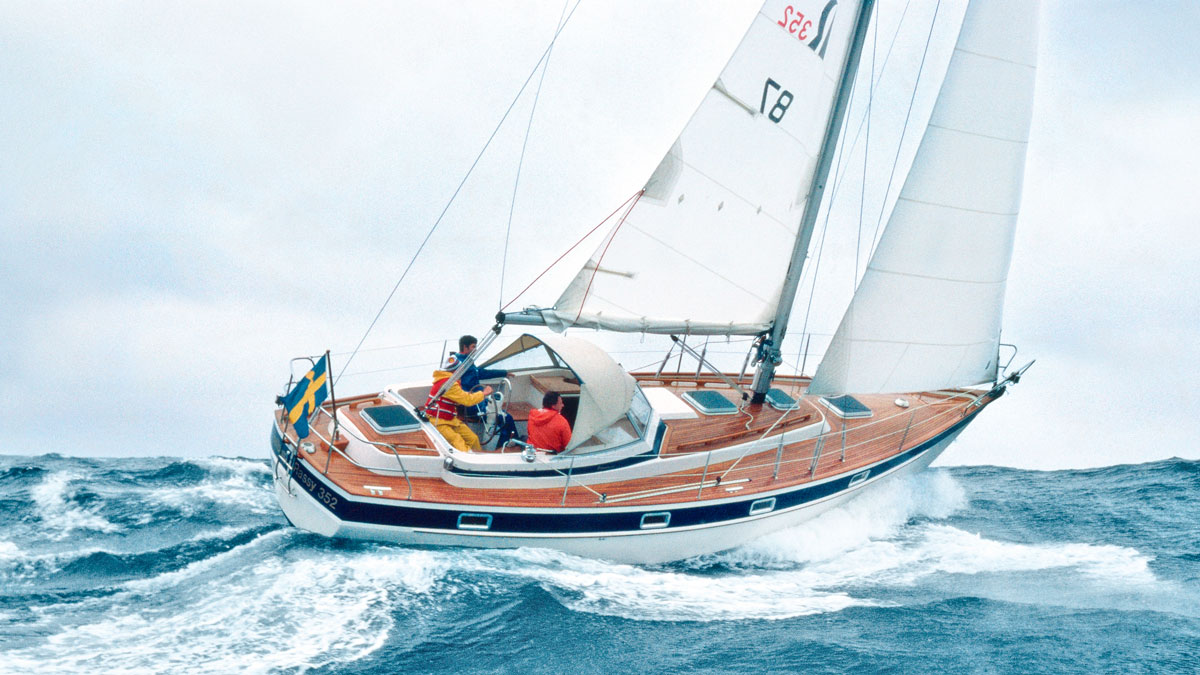
Second hand focus: Hallberg Rassy 352 + 8 alternative yachts to consider
Rupert Holmes celebrates the attributes of this iconic, but expensive, Scandinavian design and highlights other options

Coming alongside – essential skills for shorthanded crews
Coming alongside can be tricky for singlehanded and short-handed sailors. Øyvind Bordal has some sailing skills that will come in…
Want to read more articles like The best boats for Scandinavian cruising?
A subscription to Practical Boat Owner magazine costs around 40% less than the cover price.
Print and digital editions are available through Magazines Direct – where you can also find the latest deals.
PBO is packed with information to help you get the most from boat ownership – whether sail or power.
-
-
-
- Take your DIY skills to the next level with trusted advice on boat maintenance and repairs
- Impartial, in-depth gear reviews
- Practical cruising tips for making the most of your time afloat
-
-
Follow us on Facebook, Instagram, TikTok and Twitter