



Clive Marsh sings the praises of the Flying Fifteen – an attractive, self-righting and popular fixed-keel dinghy that sails brilliantly

From the day we met outside the headmaster’s office, holding similarly unimpressive exercise books, John and I became the best of friends. John crossed the bar some years ago, but we had some very good times sailing.
I was always keen on boats, but John showed no interest until he met his lovely wife, Moira, who had sailed GP14s. She introduced him to our sport, and together they bought a Mirror dinghy. I sailed with John on the Medway estuary and off the beach at Shoreham. He liked racing and had a room full of cups.
Progressing to a Maxi 84 yacht, which they kept at Brighton, they finally purchased a Flying Fifteen. This two-person racing keelboat has the characteristics of a dinghy and looks admirable in or out of the water – it’s a sculptural work of art and symmetry like an E-type Jaguar, kind on the eyes and something your neighbours should be pleased to see sitting on your front drive.
One cold March morning, we entered a Flying Fifteen race on Bewl Water near Wadhurst, East Sussex. John was a competitive sailor, but for some reason when the start gun sounded, we were nowhere near the line.
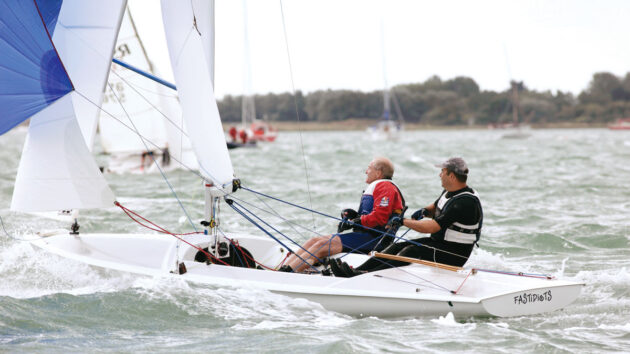
The Flying Fifteen is self-righting. Credit: Michael Austen/Alamy Stock Photo
Bewl is a good-sized lake but, compared to the sea, was tight for these 20ft boats, and as soon as the spinnaker was up, it was time to get it down again. This was okay for the youngsters, but we were getting on a bit. We eventually came in second place which pleased me considering our poor start, but it didn’t impress Moira, who had a greater competitive streak than I.
Stylish Performance
What impressed me was the boat’s looks and performance. Sleek, steady and fast. She planed easily while at the same time her ballasted fin keel gave her the righting capability of a yacht.
She was decked with a small cockpit which could easily be bailed. These features made her a safe boat. She was a large self-righting dinghy.
Her only disadvantage was launching and recovery with that deepish fixed keel. John’s boat had a special trolley with tall berthing arms to guide and keep the boat upright. This is a good arrangement, but you need a good slipway – you can’t launch this boat from a beach. We used a long rope from the car’s tow bar.
At my sailing club, the dinghy people sail vessels that readily capsize. But their boats are easy to right, and they seem to enjoy the whole getting wet experience. I like to keep out of the water and sail seaworthy traditional dinghies that are unlikely to see me swimming. However, if they do capsize – and they never have for me – they will be almost impossible to right again. They do have buoyancy, though, so I would be left clinging to an upturned hull.
So, you could say that fully open sail boats with no ballast may be risky. But I still prefer them to ‘sailing surfboards’ because they’re more comfortable and less likely to dunk me.
A friend, in his eighties, fell out of his Mirror dinghy off the Pembrokeshire coast. He found that he could not get back in it again and sailed her back to shore, hanging off the transom. Luckily, his wife, a retired nurse, was waiting on the beach and had alerted the emergency services. An ambulance was waiting for him, and they warmed him up when he reached shore.
What is the solution? Do we have to accept a compromise and make a choice between safety features? Well, my old Winchelsea Lugger with her water ballast system may have been easy to right, but I never tried.
But the Flying Fifteen should self-right like a ballasted yacht. However, having low freeboard and wide decks, it is necessary to hike out, and I like to lean with my back supported while helming my boats.
Resisting Temptation
All things considered, much as I want a Flying Fifteen, I think I’ll stick with my traditional fully open boats: I’m less likely to fall out, and I get back support. Many Flying Fifteen owners are oldish, and I wonder how they get on with back pain?
Still, for those who want to own a thing of great beauty that sails brilliantly, is self-righting and has an international racing schedule you must surely try one. World and European championships are on alternate years, with the world championships alternating between the northern and southern hemispheres.
Competition is encouraged in older boats, and there is an active classic division for sail numbers 2700 and below and a silver fleet division for sail numbers between 2701 and 3400. Older boats often in very good condition can be purchased at very fair prices.
This is not a boat that can be launched anywhere. As I’ve said, you’ll need access to a suitable slipway and a well-serviced trailer if you want to attend club meetings.

More than 4,000 Flying Fifteens have been built. Credit: Gerry Walden/Alamy Stock Photo
Evolving Design
The UK Flying Fifteen Sailing Association describes how the ‘original construction was for a 1/8in thick diagonal inner skin and 3/16in fore and aft, Honduran mahogany outer skin over 3/8in x 1/4in ribs at 2in centres. The deck was 3/16in marine plywood.
The original design weight was 285lb for the hull with a 400lb keel. Driving this was a sail plan and mast height exactly as for the International 14 of that period.
Construction methods in the early years were wide ranging – traditional carvel, moulded ply, aluminium, Tufnol, and glassfibre being used, before the latest hulls settled on an epoxy foam sandwich with carbon used in high stress areas, which gives a significantly stiffer structure and long competitive life.
Uffa Fox agreed to modernisation changes towards the end of his life to improve the design specification and sail plan. Many well-known UK builders constructed 15s in their preferred method, and for many years the class had traditional wide building tolerances, and this led to much experimentation to obtain the best shape for a given sailing location.
The Ovington Flying 15 is now built of epoxy resin and carbon fibre, and buyers have a choice of non-slip on the foredeck and adjustable mainsheet bridle via longitudinal tubes fitted during construction.
Smaller Sister
More than 4,000 Flying Fifteens have been built and raced. It’s arguably one of the best-looking boats of all time.
The Fifteen does have a smaller sister called the Flying Twelve. This boat is 16ft LOA and has a draught of only 2ft. Uffa claimed that this boat was uncapsizable with her fixed keel of 225lb. The keel was detachable for ease of transport.
This could be an ideal boat. The problem is they are as rare as hen’s teeth and mostly reside in museums, including The Classic Boat Museum on Cowes, Isle of Wight. Cowes is where Uffa Fox and Prince Philip sailed together on the prototype My Dainty Duck in 1948, and later Uffa organised the people of Cowes to present Coweslip FF 192 to the Queen and Prince Philip as a wedding gift in 1949.
The National Maritime Museum of Cornwall also possesses more boats designed by Uffa Fox than by any other designer. A few years back, my wife and I shared a week on a motor cruiser with John’s wife and daughter. We made good use of its 12ft sailboat – the spirit of sailing carries on.
Flying Fifteen Specifications
Designer: Uffa Fox
LOA: 6.10m (20ft 0in)
LWL: 4.57m (15ft 0in)
Beam: 2.13m (7ft 0in)
Keel: swept fin keel
Ballast: 169 kg (372lb) minimum
Construction: Glassfibre or wood
Sailplan: fractional rigged sloop
Mainsail area: 9.332m2 (100.45ft2)
Jib/genoa area: 3.83m2 (41.25ft2)
Spinnaker area: 14.00m2 (2150ft2)
Total sail area: 13.16m2 (141.70ft2)
Class association website: flying15.org.uk
Boatbuilder: ovingtonboats.com/flying-fifteen

Learning to sail in a Mirror dinghy built from a kit – the hard way
Having built a Mirror dinghy and taken it to the Isles of Scilly on a ferry, Peter Baylis and friends…

Dinghy Cruising Association at 70
The Dinghy Cruising Association may be 70 years old – but it’s never been so on trend, reports Laura Hodgetts

Dinghy cruising: 30 ways to experience the ultimate small-boat adventure
Ben Lowings shares his tips for dinghy cruising around the UK and further afield
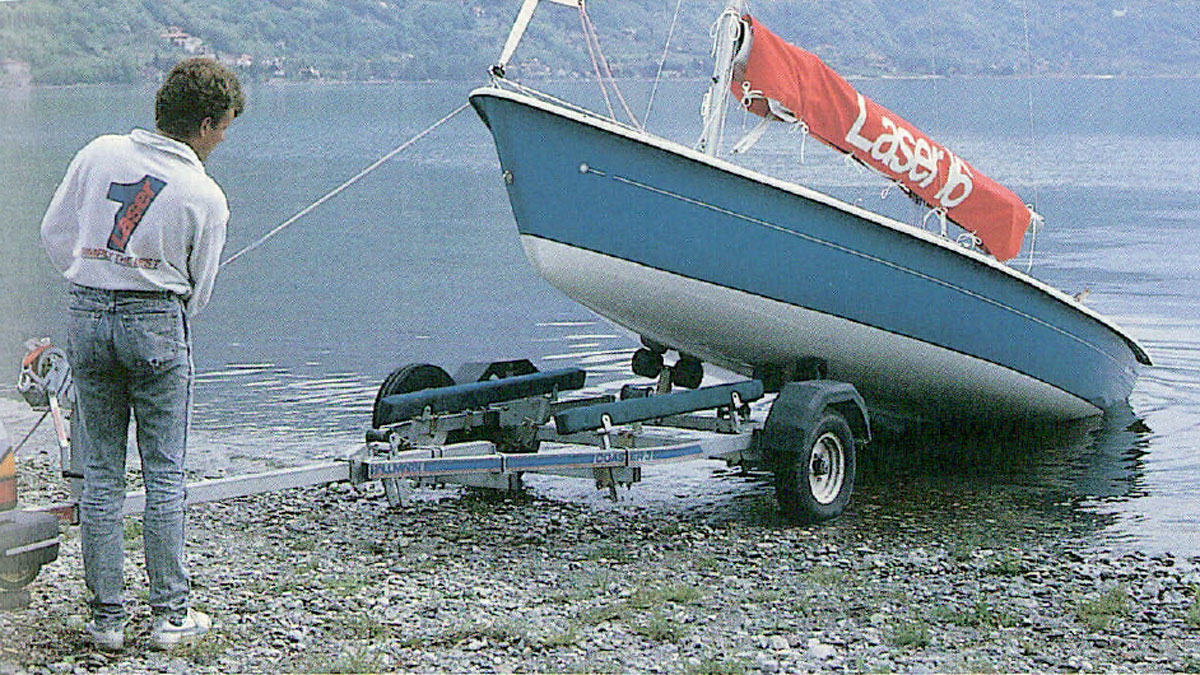
Why the Laser 16 is a “proper trailer sailer”
At last, a proper trailer sailer, says Wendy Fitzpatrick of the Laser 16 cruising dinghy, in a review for the…
Want to read more articles like The Flying Fifteen: the spirit of sailing?
A subscription to Practical Boat Owner magazine costs around 40% less than the cover price.
Print and digital editions are available through Magazines Direct – where you can also find the latest deals.
PBO is packed with information to help you get the most from boat ownership – whether sail or power.
-
-
-
- Take your DIY skills to the next level with trusted advice on boat maintenance and repairs
- Impartial, in-depth gear reviews
- Practical cruising tips for making the most of your time afloat
-
-
Follow us on Facebook, Instagram, TikTok and Twitter